Personality Isn't Permanent
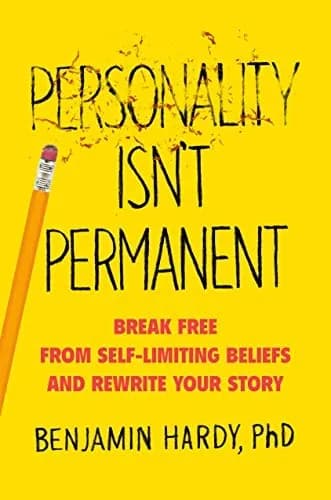
Benjamin Hardy holds a PhD in industrial and organisational psychology from Clemson University, completed in 2019 under Robert Sinclair, and this 2020 book is the second prescriptive self-help title in the library after *Finding Focus*. It carries about 162 endnotes, which is more apparatus than most of this shelf holds, and none of it is visible to a reader. The finding that makes the book worth a page is not the hidden apparatus, which the library already had. It is that the quality of the sourcing runs inversely to the risk of the material.
What it covers
An Introduction, six chapters and a Conclusion, main text running to p. 230. The argument opens by dismantling personality typing, moves through a definition of personality as effect rather than cause, and then prescribes: transform your trauma, shift your story, enhance your subconscious, redesign your environment.
The premise is mainstream. That personality is not fixed is the settled position of the field, and Hardy is right about it. The inference is where it goes wrong. From evidence that personality changes he derives that personality is chosen, and those are not the same claim.
The closing chapter makes the title claim in its strongest form, that the past itself can be changed, and tracks a verb across four pages without ever marking the shift: she began to see her past differently on p. 227, the past is happening for you on p. 228, "Their future continues to change their past" on p. 229, and "You are equipped to embrace your future and change your past" on p. 230. The move from an interpretation changing to a past changing happens inside two pages with no marker, and nobody is credited for it.
Main topics
- Personality change, and the three separate literatures the book treats as one.
- The MBTI and the five-factor model, where he names the NEO-PI-R and reaches a defensible conclusion.
- Trauma, redefined non-clinically, and reframing as the route out of it.
- Narrative identity, credited correctly to Dan McAdams, which is the cleanest attribution in the middle of the book.
- Memory and re-remembering, including Donna Bridge's reconsolidation work, described in method and result.
- The subconscious, fasting and physiology, the most concrete prescription in the book.
- Environment design, and ego depletion assumed uncited underneath it.
- The past-change thesis, stated in a scientific register and sourced nowhere.
Concepts drawn from it
- ego depletion, assumed with no citation in a book published in 2020, by the author of Willpower Doesn't Work
- reconstructive memory and memory consolidation, the Donna Bridge passage
- self-continuity and the sunk cost fallacy, both borrowed
- neuroplasticity, used as a warrant that the prescription will work
- the self-report problem, which he names once himself on gratitude research
- the replication crisis, in a new variety, since most of the load-bearing claims were never in the literature to fail replication
- YMYL, which this book is more exposed to than any prescriptive title the library holds
Reliability
The apparatus is real, and the reader never sees it. About 162 notes, keyed by page number plus a short italicised catchphrase from the body text, with no superscript markers anywhere in 230 pages. A reader on p. 32 has no signal that a note for p. 32 exists. Behind a body text naming almost no researchers sit Science three times, Nature Reviews Neuroscience, the Journal of Personality and Social Psychology, Psychological Bulletin and the Journal of Neuroscience twice. This is not an unsourced book. It is a sourced book whose sources the reader is never shown.
The comparison with [Finding Focus](/books/finding-focus) is the useful one, and the defect is identical while the contents are not. Finding Focus* carries an apparatus that is roughly 71 per cent peer-reviewed, most entries carrying volume, issue, year, page range and DOI. Hardy's is about 23 per cent peer-reviewed, and its largest single class is trade and self-help books at about 34 per cent. Same structural defect, different contents, and the mixture is undeclared. Blind notes tell a reader nothing about what stands behind them.
The sourcing runs inversely to the risk, and that is this book's finding. Chapter 5, "Enhance Your Subconscious", is the best-sourced chapter at about 37 per cent peer-reviewed, and it earns ten of its twenty-seven notes, including all ten of its journal articles, from a single body page carrying an intermittent-fasting prescription with doses on it. Strip that page and the best-sourced chapter has no peer-reviewed citations at all. Chapter 3, "Transform Your Trauma", which covers childhood sexual abuse, PTSD, addiction, domestic violence and suicidal ideation, is the worst-sourced chapter at about 5 per cent, one journal article across nineteen notes. The chapter that most needed evidence has the least of it, and the chapter handing out physiological doses has the most.
The apparatus stops before the book does. Chapter 6's last note is keyed to p. 220. The Conclusion carries exactly one note, at p. 221, to a trade self-help title. The main text runs to p. 230, so the final nine pages carry nothing, and those nine pages hold the book's strongest claims and its most serious YMYL passage. After *Dopamine Nation*, this is a pattern across three books rather than an accident of one, and in each case the uncited pages are the takeaway.
The load-bearing mechanism is cited to a YouTube interview. Joe Dispenza's claim that a sustained emotional refractory period becomes first a temperament and then a personality trait is block-quoted on p. 123 as the book's explanation of how personality forms. Its note cites an Impact Theory interview on YouTube, and eleven lines away in the same column sits a Nature Reviews Neuroscience review, set in identical type. Recorded neutrally, and with the components separated: Paul Ekman's refractory period is a genuine construct, and the emotion, mood, temperament, trait hierarchy ordered by timescale is a standard descriptive framework in affective science. What has no peer-reviewed support is the fusion, the claim that the duration of a refractory period is the causal mechanism that converts an emotion into a trait. Dispenza holds a Doctor of Chiropractic degree from Life University and works as an author, lecturer and workshop leader; he does not present himself as a medical doctor and the library should not imply that he does. The principle is what matters, and it generalises: a reader who checks a citation and finds it real has no way to learn what class of thing they have found. A self-help book may quote whoever it likes, and books in this genre routinely cite nobody at all. The failure here is not the presence of these sources. It is the undifferentiated typesetting that makes a practitioner's own website indistinguishable from Science.
The hinge is one clause on p. 32. He cites Hudson and Fraley (2015), "Volitional Personality Trait Change", JPSP 109, no. 3: 490 to 507, and the citation is correct on every element including author order. It is exactly the paper the argument needs, and most books making this argument do not have it. He then prints his own concession that the research "is conservative in expected change, at least in the short term", and overrides it: modest average change reflects the fact that people do not make purposeful changes, for emotional and situational reasons, "both of which are controllable". Nothing is cited for that clause. The next page makes all five factors learnable skills. Effects in that literature run about 0.16 SD over sixteen weeks at best. The clause is unfalsifiable as stated, since any observed limit on change is reassigned to a failure of will rather than counted as evidence about how much change is available, and it inverts what the study measured, because Hudson and Fraley's participants were self-selected for having change goals.
Three literatures are conflated, and holding them apart is the reusable part. Mean-level change across the lifespan, Roberts, Walton and Viechtbauer (2006), says populations drift with age, largely without anyone deciding anything. Rank-order stability, Roberts and DelVecchio (2000), says a person's position relative to others is stable and grows more so, reaching about .74 by age 50. Intervention-driven change, Roberts and colleagues (2017) across 207 studies, gives about d = .37 over an average of 24 weeks, coming overwhelmingly from therapy for distress rather than from goal-setting. None of the three answers whether a person can decide to have a different personality and thereby have one. The premise is mainstream and the inference fails.
On health and safety, the fasting page is the sharpest finding, and it is a safety finding rather than an irony. The prose tells readers that during a fast, cravings for nicotine, alcohol, caffeine and other drugs rapidly dissipate. The literature points the other way: food restriction increases drug self-administration and enhances reinforcing efficacy in animals, acute deprivation reinstates drug seeking, and on the human side caloric restriction is associated with raised relapse risk among abstinent smokers. One of the peer-reviewed citations holding that page up carries Male Wistar Rats in its own title, under a prescription of human doses, eighteen hours named as the threshold and sixteen to twenty-four recommended, with "if physically able" as the entire caveat. The brain-cell claim is rodent-only, and whether meaningful adult hippocampal neurogenesis occurs in humans at all is itself unsettled. The lifespan claim has no human evidence and structurally cannot yet have any. Both sides, because the rule requires it: the weight and cardiometabolic benefits of time-restricted eating are well supported, with consistent reductions in weight, waist circumference, fat mass and BMI, and adherence often better than continuous caloric restriction. That claim was available, it is unglamorous, and he reached past it. Never reproduce the craving claim in any form, and nothing on this page is medical or dietary advice.
Three further YMYL passages, stated precisely. On p. 113 trauma is redefined as any negative experience that shapes who you are, with PTSD named only to be set aside as "the extreme manifestation", so a reader with diagnosable PTSD and a reader once embarrassed in an art class are addressed by the same chapter with the same tools. Across pp. 177 to 189 a documented severe hamstring avulsion and a clinical diagnosis of tendonitis and arthritis are reframed as suppressed emotion by a non-clinician over the telephone, and the advice relayed is to stop all physical treatments and exercise through the pain; the disclaimer arrives on p. 183, after the advice. And the final chapter narrates Melissa Hull's suicide plan with the intended method specified, with no clinician, helpline or resource named on those pages, anywhere in the chapter, or in the back matter. Method specificity without signposting is a breach of standard suicide-reporting guidance and is recorded here as such. The mitigation that exists is real and amounts to four sentences across 230 pages, the best of them the p. 184 caveat that the science describes population trends and is not medical advice, which he wrote himself and unprompted. Take no clinical framing from this book in either direction.
On chronic pain the therapeutic direction is defensible and the aetiology is not. Psychological and central contributions to chronic pain are established, imaging findings such as disc degeneration are common in wholly asymptomatic people, and the treatment evidence is strong: Ashar and colleagues, JAMA Psychiatry 79, no. 1 (2022): 13 to 23, found 66 per cent of the pain reprocessing therapy group pain-free or nearly pain-free against 20 per cent for placebo injection and 10 per cent for usual care, with reattribution of pain to brain processes on the causal path. That vindicates half of Sarno's clinical intuition and should be said plainly. What it does not vindicate is the psychodynamic aetiology, that unconscious rage causes the pain through induced ischaemia, which has not been tested and supported, and which is not what pain reprocessing therapy proposes. Where this book is right about Sarno, cite Ashar and colleagues, not Sarno, and never carry the instruction to discontinue physical treatment.
Two claims do not hold, and we do not repeat them. "Individuals suffering from PTSD often score zero on imagination" (p. 115) traces to no instrument, no study and no secondary trace; no PTSD assessment instrument contains an imagination subscale, and the nearby real literature reports impoverished future thinking and reduced imagery specificity, which is a finding about richness rather than about zero. And the claim that 75 per cent of people who leave prison come right back (p. 71) has no note at all; the Bureau of Justice Statistics (2021), on the 34-state 2012 release cohort, gives about 71 per cent rearrested within five years and about 46 per cent returned to prison.
Misattribution, milder than the library's earlier instances. The end-of-history illusion paper is Quoidbach, Gilbert and Wilson (2013) in Science, and the book credits Daniel Gilbert on p. 35 as its author. Jordi Quoidbach is first author and is credited first here. The same paper is used earlier with no name claimed, so the book's most-used empirical result appears under its second author's name, and the effect is itself contested. No famous name in this book is credited for work they had no part in; the pattern is second-author and secondary-source credit. The sharper attribution problem is psychological flexibility, used repeatedly in the register of clinical psychology while Steven Hayes and acceptance and commitment therapy are named nowhere. Its one note, Kashdan and Rottenberg (2010), is the correct canonical review and sits about seventy pages upstream of the discussion that needs it.
What he gets right, given real space. The MBTI section is the strongest passage in the book. He names the Revised NEO Personality Inventory, calls the five-factor model the most scientifically backed theory of personality, insists explicitly that none of the five factors are types, and gives the psychometric case, four standards a theory must meet, with the verdict no on all four. The substance holds: roughly half of respondents receive a different four-letter type on retest four to six weeks later, and Stein and Swan (2019) find the four dimensions continuous rather than bimodal. He also gives Katharine Briggs and Isabel Myers the fair mitigating context on women's access to university training at the time. His sources for that passage are a trade history, a quotation and a podcaster's joke. The formulation to use is that the conclusion is defensible and the pages do not carry it. Beyond it: he cites Hudson and Fraley correctly, twice. Dan McAdams on narrative identity and Donna Bridge on memory reconsolidation are clean attributions. He flags his own apocrypha at the Whistler story. He notes that most gratitude research is self-reported, on the same page as his strongest gratitude claim. And on p. 233 he prints that his own PhD supervisor "likely disagree[s] with much that is written in this book", which is unusual and honest, and which should be counted in his favour.