Stolen Focus
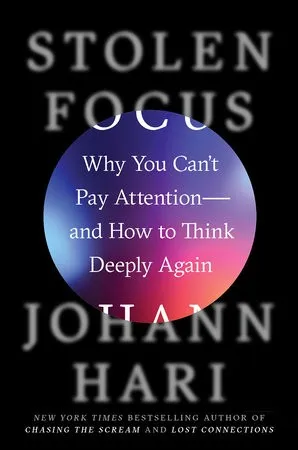
Johann Hari's 2022 book argues that the collapse of sustained attention is environmental rather than personal, produced by twelve forces acting at once, so individual self-help is not merely insufficient but a kind of cruelty when sold as the answer. Nothing else we have read tries to hold sleep, food, pollution, stress, play, working hours, reading and surveillance capitalism in a single frame. Its value is that structure. Its problem is that the prose does not separate published research from interview talk.
What it covers
The book is built as twelve numbered causes across fourteen chapters, framed by a three-month phone-free stay in Provincetown. Hari reports 30,000 miles travelled, more than 250 experts interviewed and more than 250 studies drawn on.
The organising analogy is obesity. Focus is still achievable, but it now requires swimming upstream, in what one of his interviewees calls an attentional pathogenic culture. From that follows the book's central term, cruel optimism, which Hari takes from Ronald Purser, who takes it from Lauren Berlant: offering an individual solution, in upbeat language, to a structurally caused problem, so that when it fails people blame themselves.
He borrows a useful taxonomy from James Williams, three grades of attention, the spotlight for immediate action, the starlight for longer goals, and the daylight for knowing what your goals are at all. Hari adds a fourth of his own for collective attention. He argues that mind-wandering is a second form of attention rather than its absence, and that constant stimulation suppresses it. He argues that children have been moved indoors and put under continuous supervision within two generations, removing the free play in which attention is built.
The later causes are the ones nobody else covers. Chapters on lead, on air pollution, on food additives, on sleep debt, and on the physical environment of childhood sit alongside the expected chapters on technology. The remedies he proposes are political rather than personal: ban surveillance capitalism, adopt a four-day week, rebuild childhood around free play.
To his credit, he states plainly that the decisive data does not exist. Nobody has run the study that would settle whether attention has declined, which is why his case is assembled from separate factors rather than measured directly.
Main topics
- Attention as a systems problem, twelve causes acting together rather than one.
- Cruel optimism, the argument against individual fixes.
- Mind-wandering, treated as a capacity rather than a failure.
- Reading on screens, where the book's best-supported claim sits.
- Sleep, food additives, lead and air pollution, the material no other book here covers.
- Free play and confinement, childhood as the place attention is built.
- ADHD, its heritability and its environmental candidates.
- Surveillance capitalism, the four-day week and the right to disconnect, the political remedies.
Concepts drawn from it
- screen inferiority, reached independently here and in *The Shallows*
- mind-wandering and flow state
- switch cost and attention residue, the mechanics of interruption
- negativity bias, via the material on feeds and engagement
- precommitment, the one individual move the book has time for
- techno-panic, which the book is partly an instance of and partly a study of
- ego depletion, which the book uses without caveat and we do not
Reliability
This book has a sourcing problem and a transparency habit, and both are unusual enough to state up front.
The distinction that governs everything is that Hari is a journalist who travels and interviews scientists, so his claims arrive in three grades the prose does not separate. Published research. An interviewee talking, which is a named scientist's opinion in conversation rather than their published finding, and routinely looser than anything they would write. And Hari's own synthesis or personal experience. The book's most quotable material is overwhelmingly the second and third kinds. The phrase about a perfect storm of cognitive degradation, the estimate of 200,000 lifetimes lost a day, the claims about treatment outcomes, the claim that the sleep decline alone proves the crisis, and every one of the concrete redesign proposals: all conversation, none published.
What the endnotes show is a mixed picture, and both halves are worth holding.
Against him: he states plainly that the printed endnotes are partial, with more material on his website, and roughly twenty pages of the body carry no endnotes at all. A large share of one key interviewee's quotations come from an unpublished transcript handed to Hari by another journalist rather than from his own interview. Several load-bearing numbers rest on a product company's marketing blog, a 2006 blog post, an unpublished privately commissioned study, and an unpublished study reported by a broadcaster.
For him: he published one interviewee's objection to being quoted out of context alongside his answer, and posted the full audio of that interview. He asked a source for a citation supporting a heritability figure of 75 to 80 per cent, received one estimating 74 per cent, and printed the discrepancy rather than smoothing it. He flags his own counter-argument on falling violence, which cuts against his thesis. He labels one anecdote as probably apocryphal, prints a researcher's admission that the evidence cuts both ways, and admits he did not write down one story at the time.
The pattern worth naming is that counter-evidence is repeatedly parked in the endnotes rather than the body. The qualification of the diet-failure figure, the adjudication of the radicalisation dispute, and a counter-finding in one animal study are all there. A reader of the body alone sees none of it. The endnotes are more honest than the book.
Specific items not to repeat. The ten-IQ-point drop from technological distraction rests on a study Hari's own endnote says was never published and was commissioned by a private company, and he relays the researcher's objection to the comparison being drawn. The claim that students receiving texts score 20 per cent worse is likewise unpublished, with no researcher and no sample size. A national diagnosis rate given as 0.1 per cent is unsourced and sits one to two orders of magnitude below commonly cited prevalence, and is placed so as to imply a cause. A 22 per cent rise in severe attention diagnoses carries an unsourced causal implication and no definition of the term. A workplace anecdote attributed to 1920s Britain is almost certainly wrong on its face, since the experiment in question was American and began in 1930. Two attributions are simply misassigned: the well-known 23-minute interruption-recovery figure is credited to the wrong researcher, and the study of accelerating collective attention is credited to its second author rather than its first, as is the study behind the line about the wandering mind.
There are also company claims presented beside academic findings without distinction, including a four-day-week trial with no control group inside a firm whose owner had staked his reputation publicly, and a one-month corporate productivity figure from a press release. Hari flags the vested interest in the first case and prints the numbers anyway.
He also uses ego depletion without caveat, and calls its principal researcher the world's leading willpower specialist. That construct failed a 23-lab preregistered replication, and we treat it accordingly.
What is solid is worth being specific about, because it is real. Screen inferiority, which agrees with the meta-analysis we already held, though Hari does not print its boundary conditions: expository text under time pressure, absent for narrative. The lead chapter, which carries a Cochrane systematic review, a meta-analysis of 18 studies of which 16 found a role for lead, and the documented decline in American blood-lead levels, is the strongest evidence in the book. The air-pollution chapter is well cited by this book's standards. The Southampton food-additive trial and the elimination-diet trial are real randomised controlled trials with stated sample sizes, though the second is small at 27 children and the field is unsettled. The Minnesota cohort is real and is the best evidence in its chapter, within the limit that all its subjects were born into poverty in one American city. The French right-to-disconnect law is a matter of record.
Use it as a map rather than as a source. Take the twelve-cause structure and re-source every claim inside it. It is also our best two-sides case: Hari devotes a chapter to arguing against the individual-fixes approach of *Indistractable*, its author answers inside the book, and both positions are in print with the right of reply published and the audio posted. That is as good as this kind of disagreement gets.