The Attention Merchants
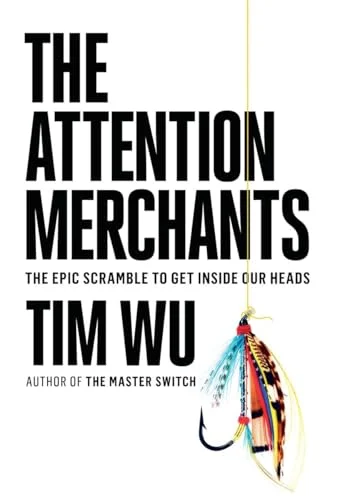
Tim Wu's history of an industry that has existed since 1833 and has never had a settled name. Benjamin Day sold the New York Sun below cost and resold his readers' attention to advertisers, and every business model since that harvests attention and resells it is a variation on that trade. The book's value here is that it makes the current moment look like an episode rather than an invention.
What it covers
Wu is a legal historian, and the book is structured chronologically rather than psychologically. It runs from the penny press through patent medicine advertising, the First World War propaganda apparatus and its peacetime commercial afterlife, radio, television and prime time, the rise and discrediting of motivational research, cable, the web, and finally the smartphone and the social feed.
The recurring shape is a four-beat cycle, and it is the most useful thing in the book. A new medium arrives and harvests attention cheaply. The harvesting intensifies until it becomes intolerable. A revolt follows, sometimes cultural, sometimes regulatory. The industry retreats, then finds a new surface and begins again. Wu calls the revolts the attentional revolt, and he is careful to note they usually succeed at ending one arrangement and fail at preventing the next.
He also names the underlying trade honestly. Free content in exchange for attention is a bargain, not a theft, and most people have accepted it knowingly. The question is whether the terms have drifted since it was struck.
Main topics
- The attention economy, from Benjamin Day and the Sun onward.
- Propaganda and its commercial descendants, and how wartime persuasion machinery was repurposed for peacetime selling.
- Broadcast and prime time, the invention of scheduled mass attention.
- Motivational research, Ernest Dichter's Freudian focus groups, the 1950s ancestor of neuromarketing, and a cautionary tale about unfalsifiable claims sold to executives who want certainty.
- Geodemographic clustering and nanotargeting, the long road from postcode to individual.
- The attentional revolt, the recurring backlash, and why it keeps winning battles and losing wars.
- The grand bargain, attention traded for content, and whether the terms still hold.
Concepts drawn from it
- persuasive design, placed in a much longer lineage than the tech critique usually allows
- variable rewards, traced from Skinner through the 1970s email check-in to pull-to-refresh as one continuous line
- status signaling, via geodemographic clustering and microfame
- the disenchantment effect, Wu's account of why every attention-harvesting medium eventually exhausts its audience
Reliability
The most reliable book in this collection, and the reason is structural rather than a comment on the author. It is history, sourced to documents, dates and business records rather than to laboratory effects, so it has not been exposed to the replication problems that hit the psychology titles. Where Wu makes a psychological claim he generally attributes it to someone else.
The place to read him critically is interpretive rather than factual. The four-beat cycle is a strong frame, and strong frames make evidence fit. Whether the current phase really is another turn of the same wheel, or something different in kind because the harvesting is now continuous and personalised, is the argument the book invites rather than settles.