The Distracted Mind
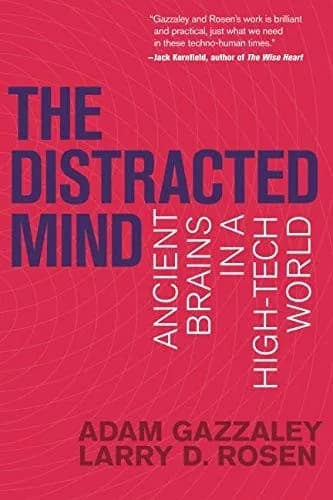
Adam Gazzaley and Larry D. Rosen's 2016 book treats distraction as a collision between limits that are ancient and triggers that are new. It is the best-sourced book on attention we have read, with notes keyed to the text, most of them peer-reviewed, and the critical literature cited beside the supportive. Its one serious gap is a disclosure: the game at the centre of its intervention chapter is licensed to a company its senior author co-founded, and the book does not say so.
What it covers
Gazzaley and Rosen, a neuroscientist and a psychologist writing together, argue that distraction is not a character failure but a mismatch. Human beings set goals far better than they hold on to them, and the gap between those two abilities is where the trouble lives. Their central claim is that we do not really multitask at all. We switch between tasks, quickly and at a cost we rarely feel, and modern technology has simply given us more to switch to than any earlier environment offered. They give that collision a name, interference, and treat it as the unit of analysis rather than treating screens as the villain.
The book runs in eleven chapters across three parts. Part I sets out the neuroscience: cognitive control, the limits of attention and working memory, and the finding that ignoring is an active operation rather than the absence of attending. The ageing chapters report that older adults enhance relevant information as well as the young do and fail specifically at suppressing the irrelevant. Gazzaley's lab describes the brain as alternating between networks rather than running tasks in parallel, which is the mechanical version of the switch-cost argument.
Part II turns to behaviour, and is substantially Rosen's. It covers the psychology of technology, the effects of constant switching, how different populations are affected, and why we interrupt ourselves. Its answer to the last question borrows the marginal value theorem from animal foraging: people leave an information patch when its returns fall below what they expect elsewhere, and accessibility changes that calculation. The book reports that roughly two thirds of workplace interruptions are generated by the worker rather than the device.
Part III is about remedies. Chapter 10 reviews ways of boosting control, from education and nature to meditation, cognitive training, video games, drugs, neurofeedback, brain stimulation and exercise, and grades each on a three-rung scale of the authors' own. Chapter 11 turns to behaviour: tech breaks, managing expectations about response times, sleep, and arranging life so the triggers fire less often.
The framing carries a practical consequence, and it is the reason the book sits in the management shelf rather than the abstinence one. If the limits are ancient and the triggers are new, the answer is not to give up modern tools but to arrange life so the triggers fire less often. So the book ends where it does, on ways of living in a high-technology world without renouncing it.
Main topics
- Goal interference, the authors' framework for distraction and interruption.
- The limits of cognitive control, attention, working memory and their hard ceilings.
- Network switching, the neural case that we alternate rather than multitask.
- The suppression deficit, the ageing finding that ignoring fails before focusing does.
- Self-interruption and foraging, why we leave a task before it is done.
- Cognitive training and transfer, including the authors' own game, NeuroRacer.
- The evidence ladder, the book's scale for grading interventions.
- Modifying behaviour, tech breaks, sleep and the case against digital detox.
Concepts drawn from it
- switch cost, given its neural mechanism here
- the suppression deficit, the ageing finding that older adults fail at ignoring rather than at focusing
- working memory, one of the two hard limits the book is built on
- multichannel multitasking and mind-wandering
- boredom, from chapter 9's account of self-interruption
- cognitive training and transfer, where near transfer holds and far transfer does not
- the evidence ladder, the authors' own three-rung grading scale
- attention restoration theory, behind the break protocols
- conflict of interest disclosure, the book's one gap
- source-class inflation, concentrated in chapters 6 and 9
Reliability
This is the best-sourced book on attention we have read, and it is not close. The notes are keyed to superscripts in the text, run to the end of the last chapter, and are about 65 per cent peer-reviewed. There are no bare "studies show" notes and no unattributed figures. Chapter 10, which argues for cognitive training, cites the large trial that found brain training produced no transfer and the methodological case on placebo effects in psychology, side by side, at the point where the case for training is made.
The authors police themselves unusually well. They say their imaging cannot support causal conclusions; they refuse to turn a lab finding into advice; they report other labs contradicting them; they report their own hypothesis failing on page 172; they say their foraging account is untested; they keep findings that cut against their thesis; and on page 199 they write that "cognition does not equal behavior". On their own evidence ladder they grade exercise, the one intervention in which they have no stake, as the only prescriptive one, and their own category one rung lower. They deny that technology created the problem, which is a more careful position than most attention books take, and on that point we think they have the better of the argument.
The gap is a disclosure. Gazzaley co-founded Akili Interactive Labs in 2011, and the company holds the licence to the NeuroRacer method, which later became the FDA-cleared EndeavorRx. NeuroRacer is the centrepiece of chapter 10, and it appears earlier in the book as a measuring instrument, several times, before it is proposed as a treatment. The interest was disclosed in the 2013 Nature paper on the game, where the journal required it. It appears nowhere in the book: not in the front matter, the acknowledgements, the text, the notes or the author biographies. No rule was broken, since trade publishing has no such requirement, and the interest was public throughout. It is a disclosure gap, not misconduct, and one sentence in the front matter would have settled it. One figure supporting the game's sensitivity, figure 5.3, is labelled as unpublished data from the authors' lab, honestly, and is still a claim no reader can check.
The underlying trial, Anguera and colleagues in Nature in 2013, randomised 46 older adults across three arms and found gains in multitasking that transferred to sustained attention and working memory. It has not been independently replicated. The wider literature on brain training finds near transfer real and far transfer unsupported, and the book's warmth towards game-based training reads as too warm from here.
The book is evidentially two books. Chapters 7, 8 and 10 run on journals; chapters 6 and 9 run substantially on marketing sources, and the typesetting gives no signal of the difference. Three numbers should not be repeated: a consultancy's estimate of the annual cost of interruption, a figure for people checking phones before brushing their teeth that traces to a marketing blog, and a count of 150 device checks a day from an industry slide deck. The figure that students cannot study for more than three to five minutes should be given as Rosen's published finding, under six minutes on task, from direct observation of 263 students over fifteen minutes. The Ophir, Nass and Wagner study of media multitaskers, which the book cites correctly, has not held up in replication. Herbert Simon's idea of a poverty of attention is cited to a magazine feature rather than his 1971 paper. The evolutionary frame of the subtitle is narrative, which the authors largely acknowledge.
Cite it in preference to other books on the subject, check the note before using chapters 6 or 9, and say who built NeuroRacer whenever chapter 10 is used.