Thinking, Fast and Slow
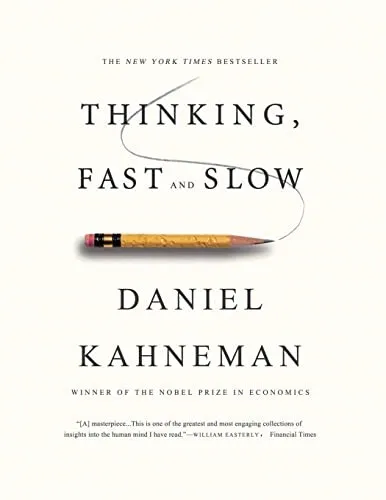
Daniel Kahneman's 2011 account of forty years of work on judgment and choice, and the strangest book in this collection to assess. Its statistical spine holds. Several of its most repeated experiments do not. Kahneman spent the years after publication publicly retracting parts of it, including the priming chapter, his own income figure and the claim that the hot hand does not exist. It is partly a monument and partly a ruin, and the person who surveyed most of the ruin is the author.
What it covers
The book runs in five parts. Part 1 builds the two-character device the book is known for, System 1, fast, automatic and associative, and System 2, slow, effortful and lazy. Part 2 is the heuristics-and-biases programme: representativeness, availability, anchoring and adjustment. Part 3 is overconfidence, expert judgment and the illusion of understanding. Part 4 is prospect theory and choice. Part 5 is the split between the experiencing self and the remembering self.
Two things about the device are routinely lost in secondary coverage, and Kahneman states both plainly. The System 1 and System 2 labels are Stanovich and West's rather than his. And the systems are, in his own description, fictitious characters with no home in any part of the brain, adopted because minds handle stories about agents better than lists of properties.
The mechanism underneath most of the book is substitution. Faced with a hard question, System 1 answers an easier one and the answer is translated back onto the original scale without the person noticing. Alongside it sits WYSIATI, the observation that confidence tracks the coherence of the story you can build rather than the quantity or quality of evidence, which is why less information can produce more of it.
The conclusion is more practical than the reputation suggests. Kahneman's position is that individual debiasing barely works and organisational debiasing does: checklists, reference-class forecasting, the premortem, decorrelated judgments, and a shared vocabulary for naming errors. Observers catch what actors cannot.
Two of the actual research papers are reprinted as appendices, the 1974 Science paper on heuristics and biases and the 1984 paper on choices, values and frames. They matter more than they look, for reasons the Reliability section gives.
Main topics
- The two systems, presented by their author as a narrative fiction rather than as neural machinery.
- Substitution and WYSIATI, the engine underneath most of the biases in the book.
- The heuristics-and-biases programme, anchoring, availability, representativeness and the errors each one predicts.
- Overconfidence and expert judgment, including the literature on formulas outperforming clinicians, which is the strongest material here.
- Prospect theory, reference dependence, diminishing sensitivity, probability weighting and a steeper loss limb.
- The two selves, and why the remembering self makes choices the experiencing self would not.
- Organisational debiasing, the book's actual recommendation.
- Self-correction, scattered across four hundred pages and collected in our reading notes.
Concepts drawn from it
- prospect theory, the framework Kahneman himself calls descriptive rather than true
- loss aversion, the construct that survives even where its coefficient does not
- framing, among the best-supported effects in the book
- the endowment effect, which Kahneman flags as fragile in the text itself
- sunk cost fallacy and escalation of commitment
- processing fluency and ego depletion, both of which the site carries with failed replications attached
Reliability
This is the weakest-evidenced book in our library. Seventy per cent of its scored concepts here are contested or mixed, the worst ratio of the fourteen books we have audited. The surprise is where the damage sits. It is not concentrated in the social-priming chapter everyone expects, though that chapter has gone: it runs through the core heuristics-and-biases constructs the book is famous for.
Start with the general problem, because it governs everything else. The body text names a researcher for well under half its empirical claims and prints a sample size for perhaps a dozen. Our distillation counted fifteen unattributed findings in a single thirty-page stretch. The endnotes are excellent and are where the real sources live, which means any claim taken from this book has to be traced through the endnote to the primary paper and then checked for replication. The book's own text is not a citable source for almost anything.
What has failed outright: social priming, chapter 4, conceded by Kahneman in a 2017 open letter in which he wrote that he had placed too much faith in underpowered studies. Ego depletion, indistinguishable from zero in a 23-lab preregistered replication, though Baumeister continues to defend it, so we record it as a live dispute rather than a closed one. Glucose as willpower fuel, which is also mechanistically implausible, since a sugar mouth rinse produces the effect. Facial feedback, which matters structurally, because the frowning study is the book's evidence that base-rate neglect is System 2 laziness rather than ignorance. Disfluency improving reasoning. The watching-eyes honesty box, which fails meta-analytically.
Reversed rather than failed: the hot hand. The 1985 paper contained a selection bias that, corrected, turns the original data toward evidence for streak shooting. Kahneman acknowledged this. The book states the opposite of the current position.
Superseded by the author: the $75,000 income satiation figure, replaced by a 2023 adversarial collaboration between Killingsworth, Kahneman and Mellers finding that experienced well-being keeps rising with income for most people, flattening only for an unhappy minority.
Contested rather than dead: loss aversion at a ratio near 2, where the construct survives but the universal coefficient does not; scope insensitivity; the Linda problem, where the effect is robust and the interpretation has been argued over for forty years. Base-rate neglect comes with the author's own correction attached on page 152, and citing the finding without the correction leaves out what the book says. Tetlock's dart-throwing experts must never be quoted without Tetlock's own later work showing some forecasters durably beat chance and that the skill is trainable.
What is solid is a short list, and it is worth having: anchoring, framing, prospect theory, hindsight bias, regression to the mean, and the law of small numbers. Add the Meehl literature on formulas beating clinicians, which is the strongest material in the book and has never been overturned. That is roughly the half of the book about statistics and judgment rather than about priming and depletion.
Two practical notes. Cite the appendices rather than the chapters wherever you can: they are the actual papers, with the sample sizes and exact percentages the body text omits. And read the book as the best available record of a field correcting itself. Kahneman revises the base-rate claim, the reception of Linda, prospect theory's blind spots, his own definition of well-being, and his prediction about one of his studies, in the text. On the limits of the whole enterprise he is blunter than his readers: the research, he says, only showed "that Humans are not well described by the rational-agent model", and he reports that studying these errors for a career did not debias him. Anyone writing that reading Kahneman will make you think better is contradicted by Kahneman.