Active Frontage
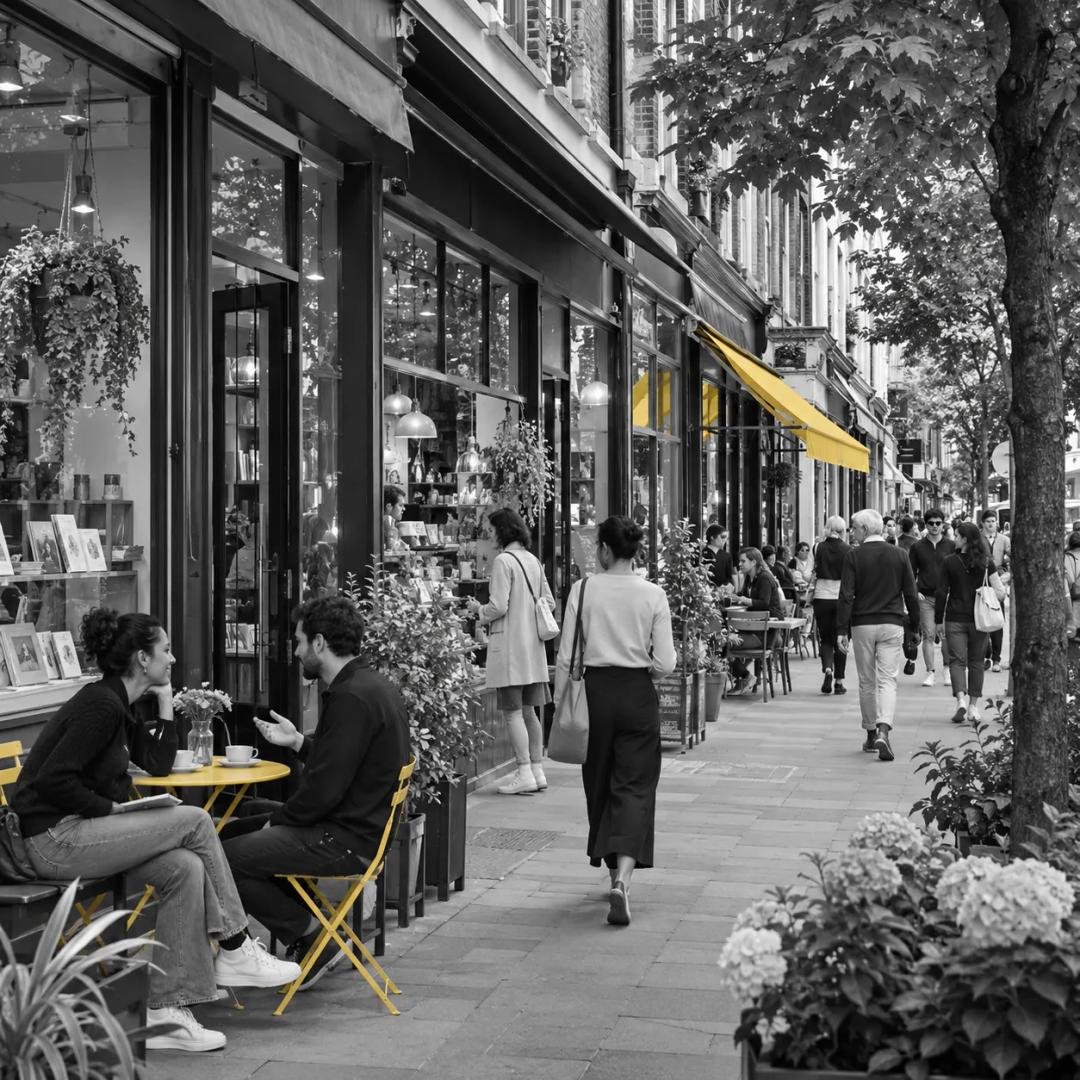
Active frontage is a ground floor with frequent doors, windows, displays and uses facing the pavement, as opposed to blank walls or long uniform fronts. In reported observations, people walked more slowly and stopped more often in front of it.
What it is
The term describes the edge where a building meets the street. A frontage is active when it gives the walker something to look at and somewhere to go: many entrances, openings, displays and varied fronts. It is passive when the edge is closed, uniform or blank. Jan Gehl, Kaefer and Reigstad argued in 2006 that buildings have grown large while the people passing them keep a small stature and slow pace, so the ground floor is where the two scales meet and needs welcoming design.
The published summary of their observations reports that in front of active facades pedestrians walk more slowly and more of them stop, with stops and other activities about seven times as frequent as in front of passive facades.
In effect
Charles Montgomery uses the idea in Happy City, arguing that streets with many doors, windows, varied facades and mixed uses slow walkers and invite pausing, while blank or uniform frontage speeds people up and lowers mood. Related studies point the same way. Marek Fránek found that students walked faster through areas with more traffic, noise and crowding and no greenery. Pall Lindal and Terry Hartig found that varied facades and lower buildings raised how restorative a street was judged to be. Vikas Mehta found that seating, personalised storefronts and wider pavements went with more stationary and social activity.
What it does not say
The seven-times figure comes from the summary of one set of observations, and the studies that surround it use different streets, measures and methods. Variety in facades raised judged restoration in the Lindal and Hartig study but was not associated with preference, so a lively edge is not the same as a liked one. Walking speed is a rough gauge of comfort, not proof that any one feature causes lingering.
Sources
- Gehl, J., Kaefer, L. J., & Reigstad, S. (2006). Close encounters with buildings. Urban Design International, 11(1), 29-47. https://doi.org/10.1057/palgrave.udi.9000162
- Fránek, M. (2013). Environmental factors influencing pedestrian walking speed. Perceptual and Motor Skills, 116(3), 992-1019. https://doi.org/10.2466/06.50.PMS.116.3.992-1019
- Lindal, P. J., & Hartig, T. (2013). Architectural variation, building height, and the restorative quality of urban residential streetscapes. Journal of Environmental Psychology, 33, 26-36. https://doi.org/10.1016/j.jenvp.2012.09.003
- Mehta, V. (2007). Lively streets: Determining environmental characteristics to support social behavior. Journal of Planning Education and Research, 27(2), 165-187. https://doi.org/10.1177/0739456X07307947
- Montgomery, C. Happy City: Transforming Our Lives Through Urban Design. Penguin, 2013.