Affiliative Imitation
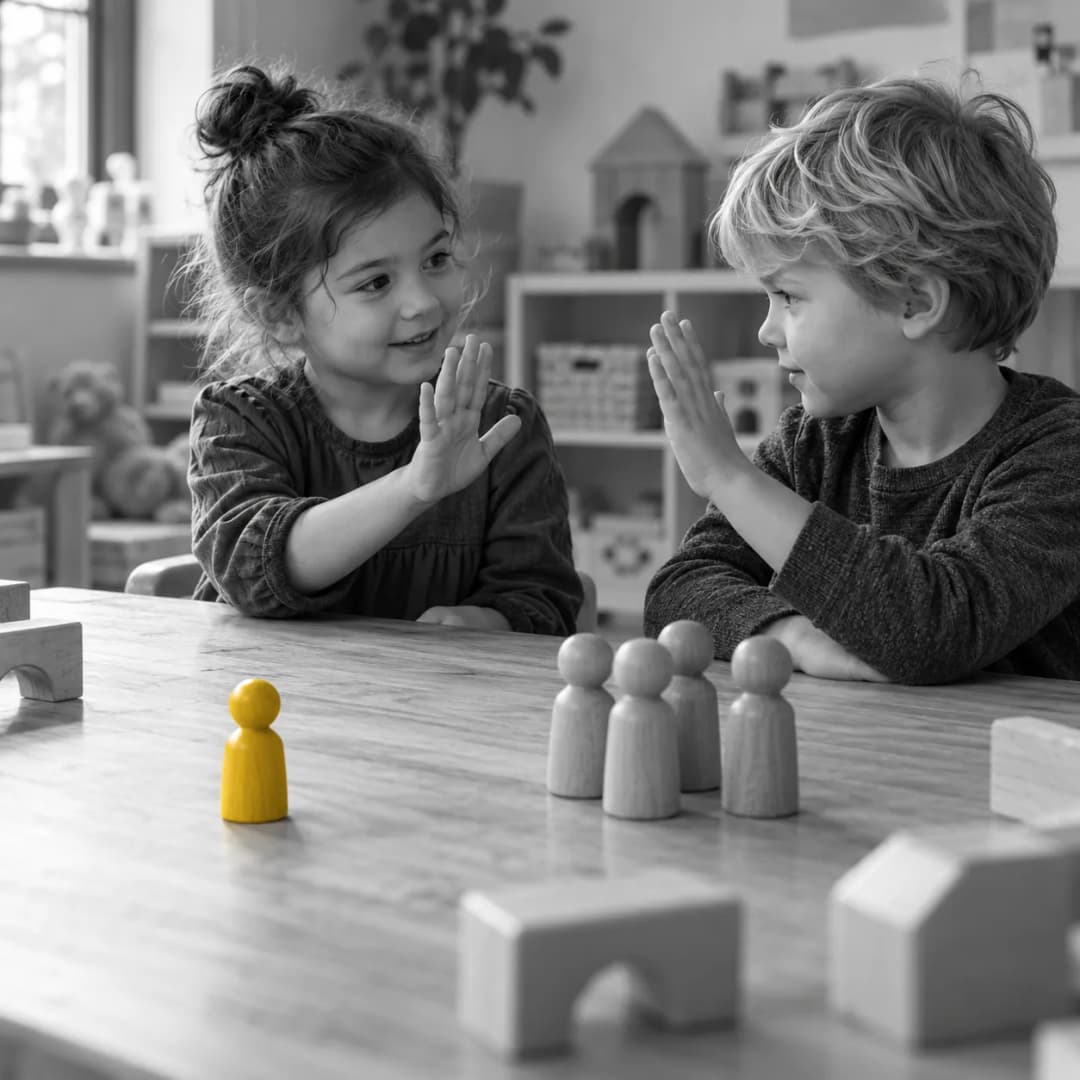
Affiliative imitation is imitation that serves to bond with another person. Harriet Over and Malinda Carpenter reported in 2009 that 5-year-olds who watched a video of a shape being left out by a group of other shapes imitated a model's actions more closely than children who watched a control video.
What it is
The term describes copying that is done for social reasons, as a way of moving closer to another person, and not only to learn how to do something. Researchers working with adults had reported that people increase their mimicry of others after being socially excluded. Over and Carpenter asked whether children do the same.
Their study, Priming third-party ostracism increases affiliative imitation in children, appeared in Developmental Science in 2009. Five-year-old children watched either a video in which one shape was left out by a group of other shapes or a control video. The children who saw the exclusion video went on to imitate a model's actions more closely. The authors reasoned that a strong need to belong might make even indirect exclusion meaningful, so that witnessing it, without being excluded, would be enough, and the result agreed. They concluded that children are highly sensitive to social exclusion and adjust their social behaviour in response.
The imitation task itself was ordinary. An experimenter showed each child how to make a box light up with a tool, using a particular grip and a particular way of moving the tool across the lid, and the measure was how faithfully the child reproduced those details. Faithful copying of the incidental parts of a demonstration is what marks imitation as social rather than purely practical, because the details add nothing to getting the light to come on.
The two authors later set the result inside a wider account. In a 2013 review in Child Development Perspectives, The social side of imitation, they argued that developmental research had mostly treated imitation as a way of learning from others, and that it does more than that. On their account children often imitate because they want to be part of a group and to bond with the people around them, and their copying is shaped by social motives and pressures both between individuals and between groups. The review also offers this as a way to reconcile two lines of findings: children sometimes copy selectively and sometimes copy every step of a demonstration, including steps that serve no purpose. It connects the study of imitation to social psychology research on mimicry, conformity, norms and group identity.
In effect
In the article Why Do We Need to Belong?, the study is one of the experiments that test what a motive should predict. A strong need to belong should show early in life, and it should respond to social signals that do not involve the person directly. The finding fits both expectations.
The design also matters. The children saw shapes, not people, and were not themselves excluded. The study therefore shows how little it takes to influence social behaviour in 5-year-olds, and it uses that fact to make a point about sensitivity to exclusion.
What it does not say
The study does not show what children feel when they watch the shapes, and it does not measure anything outside the imitation task. It concerns one age group and one kind of exclusion video.
It is also a single study. The 2013 review is an argument about how to read a body of imitation research, and this page reports it as the authors' account, not as a further experimental result.
Sources
- Over, H., & Carpenter, M. (2009), Priming third-party ostracism increases affiliative imitation in children, Developmental Science, 12(3), F1-F8. https://doi.org/10.1111/j.1467-7687.2008.00820.x
- Over, H., & Carpenter, M. (2013), The social side of imitation, Child Development Perspectives, 7(1), 6-11. https://doi.org/10.1111/cdep.12006
- Baumeister, R. F., & Leary, M. R. (1995), The need to belong: Desire for interpersonal attachments as a fundamental human motivation, Psychological Bulletin, 117(3), 497-529. https://doi.org/10.1037/0033-2909.117.3.497