Ambient Scent
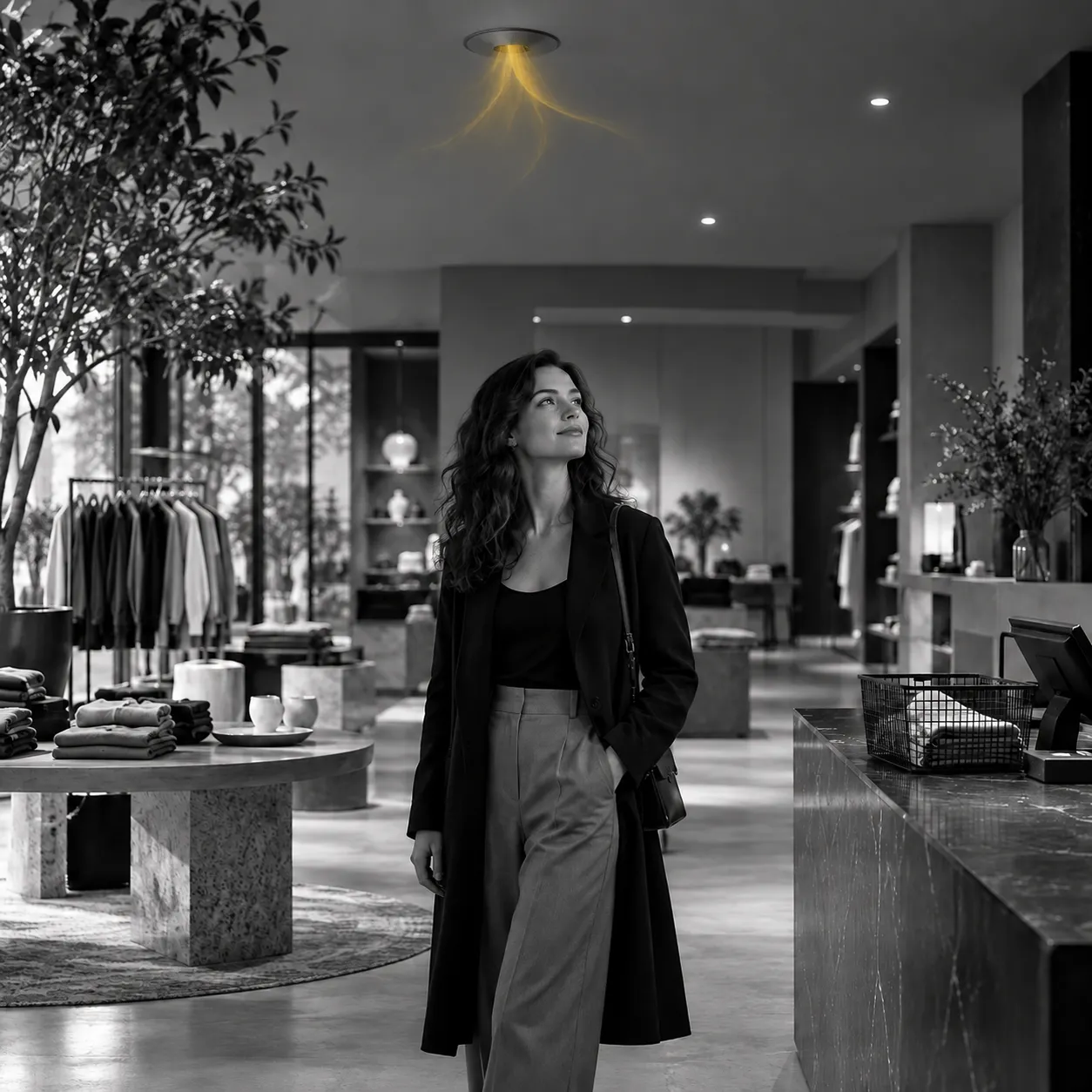
Ambient scent is scent diffused into a space rather than given off by anything in it, which is why a shop can be scented and the goods cannot. In the largest synthesis of the research, 671 effects from 64 articles and 15,447 respondents, ambient scent produced small positive effects on recall, satisfaction, product and environment evaluations, purchase intentions, mood and time in store. Two customer responses it did not move reliably: a shopper's sense of being in control, and the amount of money they spent.
What it is
The distinction that defines the term comes from the founding retail paper, and it is commercially the whole point. A perfume counter smells of perfume because there is perfume on it. A clothes shop that smells faintly of clean laundry smells that way because somebody installed a diffuser, and nothing a customer can see is the source. That makes ambient scent a property of the environment rather than of any product, which in principle lets it change how a whole shop is judged, and how goods that cannot themselves be scented are judged.
It is also the thing a scent marketing contract actually buys, which is why the gap between what the research measures and what the industry claims matters.
On ratings and memory the evidence is consistent in direction and modest in size. Holger Roschk and Masoumeh Hosseinpour's 2020 meta-analysis in the Journal of Marketing pooled 71 samples from 64 articles published between 1989 and May 2018, 15,447 respondents and 671 extracted effect sizes. Their Table 3 gives adjusted correlations by customer response: recall at .177, shopping satisfaction .144, environmental quality .122, product evaluations .121, time elusiveness .111, purchase intentions .105, intention to recommend .098, mood activation .097, mood valence .088 and lingering .078. All positive, all significant, all small.
Expenditure is the exception, and it is the one that pays. Fifty-two effects, 8,150 respondents, an adjusted correlation of .051, carrying no asterisk, which the table note defines as p greater than .05, with an I squared of 76 per cent, meaning three quarters of the variation between studies is unexplained. The authors state the position themselves: they report that scent produced significant positive effects on customer responses, with mood control and expenditures as the exceptions.
The three per cent sales lift that circulates from that paper is not the pooled effect. It is a sensitivity calculation on their third model: three per cent with all situational contingencies at their mean, ten per cent with a congruent, unidimensional and familiar scent, 23 per cent once a service setting, no clashing music and a female-dominant sample are added, and, in the same paragraph, a reduction of 17 per cent in sales when the less favourable conditions were combined, compared with no scent at all. The honest statement of the model is a predicted range from plus 23 per cent to minus 17.
The field studies behave as the pooled numbers suggest. The founding study, Eric Spangenberg, Ayn Crowley and Pamela Henderson's 1996 paper, ran 298 participants through a simulated store sixteen by twenty feet and raised almost every evaluation it measured, while finding no change in actual time in store, no change in product tags examined, and no sales measure at all because there was none to take. Andreas Herrmann and colleagues got clean positive money in 2013 in one Swiss home decoration store, where a simple orange scent produced a mean basket of 56.83 Swiss francs against 43.11 for a complex blend and 45.96 for no scent, F(2,400) = 3.36, p = .04, with the complex scent sitting below the control. Christoph Teller and Charles Dennis's scented shopping mall, the best-designed field experiment in the literature, found no behavioural effect under any design and showed that the standard design had been reporting pre-existing differences between groups as scent effects. Jasper de Groot and colleagues' preregistered study measured a questionnaire and a till in the same shop and got a four-to-one gap between them. And Mary McGrath and colleagues' randomised replication of the most publicised sales result in the field found nothing.
In effect
The simulated store with no cash register
The research case to start from is the founding one, because its shape set the field's habits. Spangenberg, Crowley and Henderson built a one-stop shop for students in a consumer behaviour laboratory, deliberately stocked it with unscented goods, and scented it with lavender, ginger, spearmint or orange, none of which had anything to do with what was on sale. Evaluations rose almost across the board and significantly: the store rated more favourable, good, positive, liked and modern, the merchandise more up to date, better selected and higher quality.
Then the parts that are rarely quoted. Time in the store did not change, 577.71 seconds scented against 585.61 unscented. Product tags examined did not change. Only one of three products gained in purchase intention. Both hypotheses about which scent to choose failed, and the authors' own conclusion was that the presence of a scent mattered more than which scent was used. Nobody spent any money, because there was nothing to spend it on. Their stated limitation: generalisability is limited because the store was simulated.
Walking into a shop and liking it for no reason you can name
The everyday version is the reason this industry exists. A shop smells of clean cotton, or faintly of cedar, and it registers as a nicer shop, better kept, better chosen, without the smell ever becoming the object of attention. The research supports exactly that much: ratings, atmosphere, memory of the brand a day later. One detail from the preregistered Dutch study sharpens it and points the wrong way for the trade. Among the 269 customers who had not noticed any particular smell, the small till effect held, F(2,266) = 4.48, p = 0.012. Among the 39 who did notice, the F statistic was less than 1.
A diffuser on a monthly invoice
In commerce the decision is a procurement decision, and the honest brief is narrow. Ambient scent is cheap, easy to install, and well supported as a way to change how a shop is rated and remembered. What it is not is a sales instrument with a known return: the pooled effect on expenditure does not reach significance, the famous three per cent is a model prediction whose own range crosses zero, and the field has almost no replications. Anybody being sold a percentage uplift should ask which study produced it, what was measured, and whether anything was measured at a till. Two products are being confused in this market, an atmosphere purchase and a sales instrument, and nobody is pricing them differently.
What it does not say
It does not say that ambient scent raises sales. The pooled expenditure effect across 52 effects and 8,150 respondents is .051 and not significant, with three quarters of the between-study variance unexplained, and the best-controlled field experiment found no behavioural effect at all.
It does not license the three per cent figure as a measured result. That number is a prediction from a moderator model, and the same model predicts a seventeen per cent fall under unfavourable conditions.
It does not support the trade's famous numbers. The 84 per cent Nike figure, the eleven per cent sales figure, the eighty per cent purchase-intent figure, the Samsung time-underestimation claim, the Hyatt Place claim and the Novotel claim are not used on this site in any form, because each traces to a vendor page, a press article, or no document at all. Where the chain can be followed it ends badly: the Nike figure's earliest reachable source is a 1991 conference presentation never published in a peer-reviewed journal, and the founding 1996 paper reports in print that the underlying finding was not statistically significant.
It does not tell you how much scent was in the air in any of these studies. Davide Giacalone and colleagues searched for exactly that across twenty field studies and found that no study measured scent concentration, airflow or air quality, and only three named the diffuser model.
And it does not settle the question in the negative either. Two real shops produced real money, the direction of every pooled effect is positive, and the replication that failed was underpowered by its own authors' account. The defensible position is that scent reliably changes judgements and that its effect on spending is small, conditional, occasionally negative, and unsettled.
Who developed it
The retail construct is Eric R. Spangenberg, Ayn E. Crowley and Pamela W. Henderson's, in the Journal of Marketing, 1996, the paper that drew the distinction between ambient scent and product scent and tested it. The field's calibration is Holger Roschk's, in two meta-analyses with different co-authors in 2017 and 2020.
Sources
- Spangenberg, E. R., Crowley, A. E., & Henderson, P. W. (1996). Improving the Store Environment: Do Olfactory Cues Affect Evaluations and Behaviors? Journal of Marketing, 60(2), 67-80. doi:10.2307/1251931. Read in full.
- Roschk, H., & Hosseinpour, M. (2020). "Pleasant Ambient Scents: A Meta-Analysis of Customer Responses and Situational Contingencies." Journal of Marketing, 84(1), 125-145. doi:10.1177/0022242919881137. Read in full.
- Teller, C., & Dennis, C. (2012). "The effect of ambient scent on consumers' perception, emotions and behaviour: A critical review." Journal of Marketing Management, 28(1-2), 14-36. doi:10.1080/0267257X.2011.560719. Read in full.
- de Groot, J. H. B., Walther, C., & Holland, R. W. (2022). "A Fresh Look on Old Clothes: Laundry Smell Boosts Second-Hand Store Sales." Brain Sciences, 12(11), 1526. Read in full.
- Herrmann, A., Zidansek, M., Sprott, D. E., & Spangenberg, E. R. (2013). "The Power of Simplicity: Processing Fluency and the Effects of Olfactory Cues on Retail Sales." Journal of Retailing, 89(1), 30-43. doi:10.1016/j.jretai.2012.08.002. Read in full.
- McGrath, M. C., Aronow, P. M., & Shotwell, V. (2016). "Chocolate scents and product sales: a randomized controlled trial in a Canadian bookstore and cafe." SpringerPlus, 5, article 670. doi:10.1186/s40064-016-2303-5. Read in full.
- Giacalone, D., Pieranski, B., & Borusiak, B. (2021). "Aromachology and Customer Behavior in Retail Stores: A Systematic Review." Applied Sciences, 11(13), 6195. doi:10.3390/app11136195. Read in full.