Amplification and Numbing
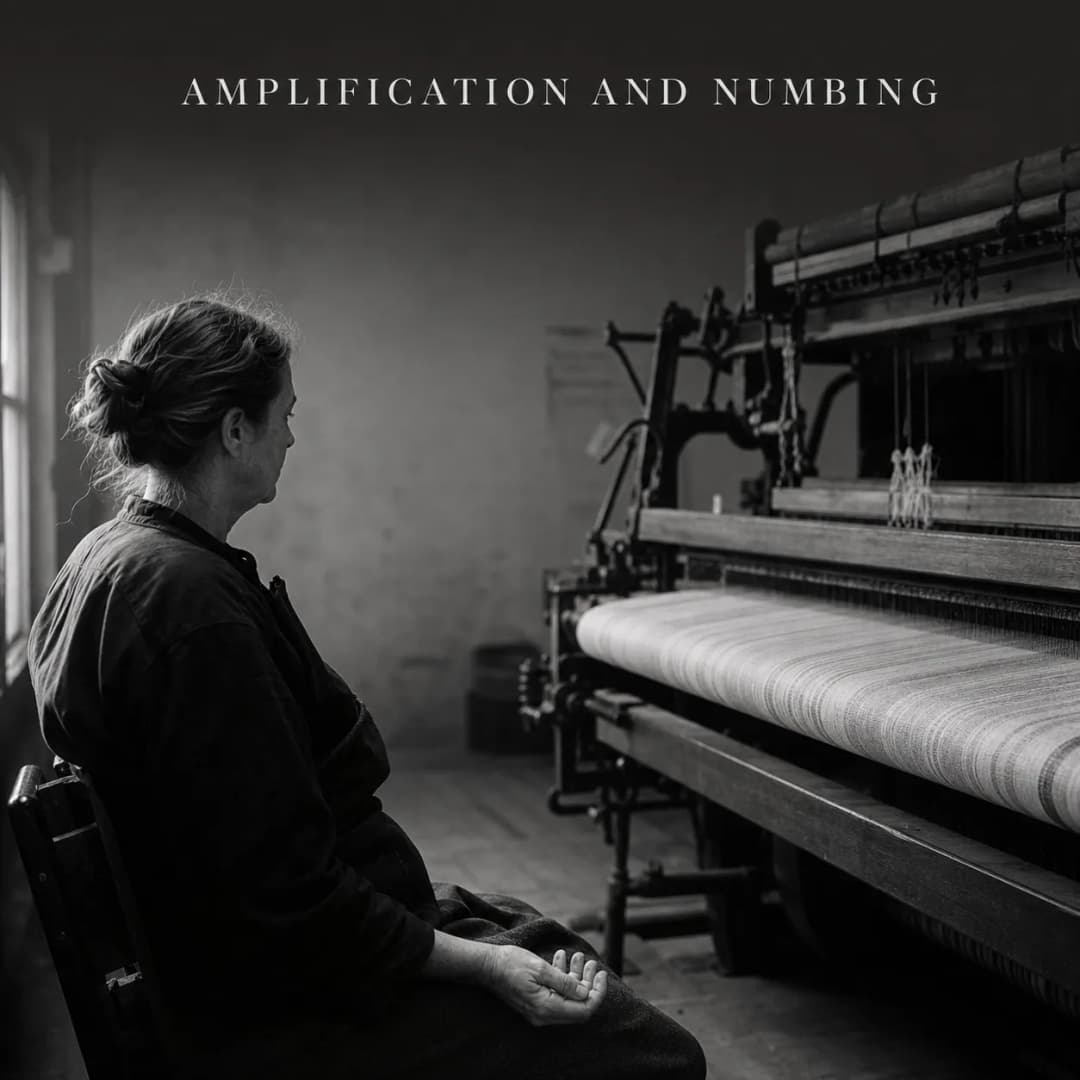
Amplification and numbing is Marshall McLuhan's principle that every technology extending a human faculty also dulls the natural version of it, and that the extension and the atrophy are one event rather than a trade-off to be managed. The loom amplifies output and dulls the hand. The map amplifies navigation and dulls the sense of direction. It is a frame rather than a finding, and unfalsifiable as stated: any change in a skill reads as amplification or numbing depending on which you went looking for.
What it is
The claim fits in a sentence. A tool that extends a faculty dulls the natural version of that faculty, and there is no separate moment at which the cost arrives, because the cost is inside the gain.
McLuhan gave Understanding Media the subtitle The Extensions of Man in 1964, and the extension half is the part everyone remembers. The wheel extends the foot, the book extends the eye, electric media extend the nervous system. Amplification and numbing supplies the invoice. A faculty handed to a machine stops being exercised. A faculty that stops being exercised gets worse. On McLuhan's account this is not an unfortunate side effect of an otherwise good bargain, it is what an extension is.
The physical cases are the ones that make it obvious. The loom amplifies output and dulls the hand. The tractor amplifies the farmer's reach and puts him in an air-conditioned cab. The car amplifies range and removes the walk.
The intellectual cases are the ones Nicholas Carr cares about, and they are what the principle is doing in The Shallows. The mechanical clock amplified coordination between people and dulled the direct bodily sense of time passing. The map amplified navigation and dulled the sense of direction it replaced. Each of these is an intellectual technology in Carr's taxonomy, a tool that extends mental rather than physical power, and the principle is what tells you the extension has a price attached.
The line most people know the idea by is not McLuhan's. "We shape our tools and thereafter our tools shape us" is John Culkin's compression of him, and Culkin's phrasing is the form the principle takes when it arrives in The Shallows. Our source note records the formulation without a citation to Culkin's own text, so it is given here as Carr transmits it rather than as a located quotation. Culkin has no page on this site.
Now the caveat, which sits in the vault note and belongs near the top rather than buried at the end. The principle is a frame, not a finding. It is unfalsifiable as stated, because there is no observation it forbids. A skill that improves after a technology arrives can be read as amplification. A skill that declines can be read as numbing. A skill that does neither can be read as an extension that has not yet been adopted widely enough. That is not a fatal objection to a framework, and frameworks are useful for organising what you already know. It is a fatal objection to treating one as evidence, which is why this page carries not-a-research-claim. Cite it as McLuhan's idea, attributed to him. Do not cite it as a result.
The principle becomes checkable only where somebody attaches a mechanism to it, and the mechanism on offer is neuroplasticity, the adult brain's capacity to reorganise itself in response to use. That is Carr's addition rather than McLuhan's, and it is genuinely well evidenced as a phenomenon. What plasticity establishes is that brains change with use. It does not establish that any given change is a loss, and a task-specific shift after practice is what learning anything at all looks like from inside a scanner. Neuroplasticity has no page on this site yet.
The contemporary research literature that overlaps with the numbing half is cognitive offloading, which studies what happens to memory and effort when a task is delegated to a device rather than performed. That literature has the advantage of measuring something, and the disadvantage of a bad few years: the Google effect, its most quoted result, failed a preregistered multi-laboratory replication in 2018 and failed again in 2020. Amplification and numbing is not damaged by that, because it never staked anything on the study. It also gains nothing from it.
In effect
The London taxi drivers, and the worry Eleanor Maguire added herself
The research case is the best-evidenced thing in The Shallows and it points both ways. Maguire and colleagues, in PNAS in 2000, found posterior hippocampal grey matter larger in London taxi drivers in proportion to the years they had spent driving. The obvious objection, that people with larger hippocampi choose the job, was answered twice: a 2006 study used London bus drivers as a control, who navigate a complex city on fixed routes and showed no such difference, and Woollett and Maguire's 2011 longitudinal work found the change only in trainees who passed the Knowledge. The vault verified this on 1 September 2026 and the instruction is to cite it freely.
That is the amplification half, measured. Maguire has also said publicly that she worries satellite navigation will erode the effect, which is amplification and numbing stated by the researcher who produced the evidence rather than by a theorist. The worry is a worry. No study establishing that satnav shrinks anyone's hippocampus is recorded here, and the taxi-driver work shows a brain adapting to a demand rather than a brain being damaged by a device. Maguire has no page on this site yet.
The number you no longer know
Most people can recall a childhood telephone number and cannot recall the mobile number of someone they contact daily. Nothing about that observation is controlled, and it is the version of the principle that persuades people, which is worth noticing as a fact about the principle rather than about memory. The contacts application amplified reach, in that you can now hold a thousand numbers instead of nine. Whether the recall capacity itself declined, or was simply never exercised on this material in the first place, is exactly the question the framework cannot settle and the offloading literature is trying to.
Christof van Nimwegen's helpful software
The product-design case is the strongest applied finding in the second half of The Shallows. From 2003 onward van Nimwegen ran experiments in which users solved a puzzle either with helpful on-screen guidance or without it. The guided users were faster at first and worse later. Eight months on, the unhelped group solved a variant of the problem nearly twice as fast. The result was replicated in a second task, calendar scheduling, with baseline cognitive ability controlled.
Helpfulness is the thing interface design sells, and it is sold on the amplification side of the ledger alone. Autocomplete, suggested replies, route guidance and inline hints are all extensions of a faculty, offered as pure gain, and none of them is priced with a line for what happens to the user in eight months. Our reading of van Nimwegen comes through Carr rather than from the primary publications, and it should be treated as that. It is also the closest thing this page has to a test, and it went the way McLuhan said it would.
What it does not say
It does not say a technology damages anybody. The principle asserts a structure, that gain and atrophy are one event, and it asserts it about tools in general. It offers no way of telling a numbed faculty from an unpractised one, or from a faculty that was reallocated to something else. Where a specific claim about harm is wanted, the framework has to be set aside and a measurement put in its place.
It does not carry Carr's general conclusion. No meta-analysis establishes that ordinary internet use impairs attention, memory or comprehension. Firth and colleagues, in World Psychiatry in 2019, is the standard review and is explicitly preliminary and largely correlational. The impairment findings that do replicate concern problematic or pathological use, which is a different population from everybody.
It does not license the satnav claim. Maguire's stated worry is quoted here because the vault records it and because it is striking that it comes from her, and a researcher's speculation about her own finding is not that finding extended.
It is not falsifiable, and a page that presented it as a result would be doing the thing this site exists to argue against. The evidence status is not-a-research-claim for that reason, and the tag is a description of the idea's kind rather than a complaint about its quality.
Who developed it
Marshall McLuhan, in Understanding Media: The Extensions of Man, McGraw-Hill, 1964. The extensions argument is his and the cost principle attached to it is his. John Culkin supplied the sentence it is usually quoted in. Nicholas Carr is the writer who carried it into the modern argument about reading and attention, in The Shallows, and who added the biological mechanism McLuhan never had. See Marshall McLuhan.
Sources
- Carr, N. (2010, updated 2020). The Shallows: How the Internet Is Changing the Way We Think, Read and Remember. Atlantic Books. Full text read, pp. 1 to 237 plus endnotes, 1 September 2026. The vault's concept note locates this material at chapters 10 and 11; the read-through records ten chapters plus an epilogue and a 2020 afterword, so the chapter reference is unresolved and is reported here as the note states it.
- McLuhan, M. (1964). Understanding Media: The Extensions of Man. McGraw-Hill, New York. The extensions argument. Not read here. The principle reaches this page through Carr.
- Culkin, J. The formulation that we shape our tools and thereafter they shape us. Recorded in the vault without a citation to Culkin's own text, so untraced here.
- Maguire, E. A., et al. (2000). PNAS, 97(8), 4398-4403. The taxi-driver hippocampus finding. Verified 2026-09-01, with the 2006 bus-driver control and Woollett, K., & Maguire, E. A. (2011), Current Biology, the longitudinal follow-up.
- van Nimwegen, C., software-assistance experiments, 2003 onward. Reported in The Shallows, chapter 10. Secondary source; not traced to the primary publications here.
- Firth, J., et al. (2019). "The 'online brain': how the Internet may be changing our cognition." World Psychiatry, 18(2), 119-129. Explicitly preliminary and largely correlational.
- Where this came from
- One book in this library carries this concept. A concept resting on a single popular retelling is roughly twice as likely to be contested, mixed or unverified as one two or more books carry, so treat it as unchecked until it has been taken to a primary source.