Apparent Usability against Inherent Usability
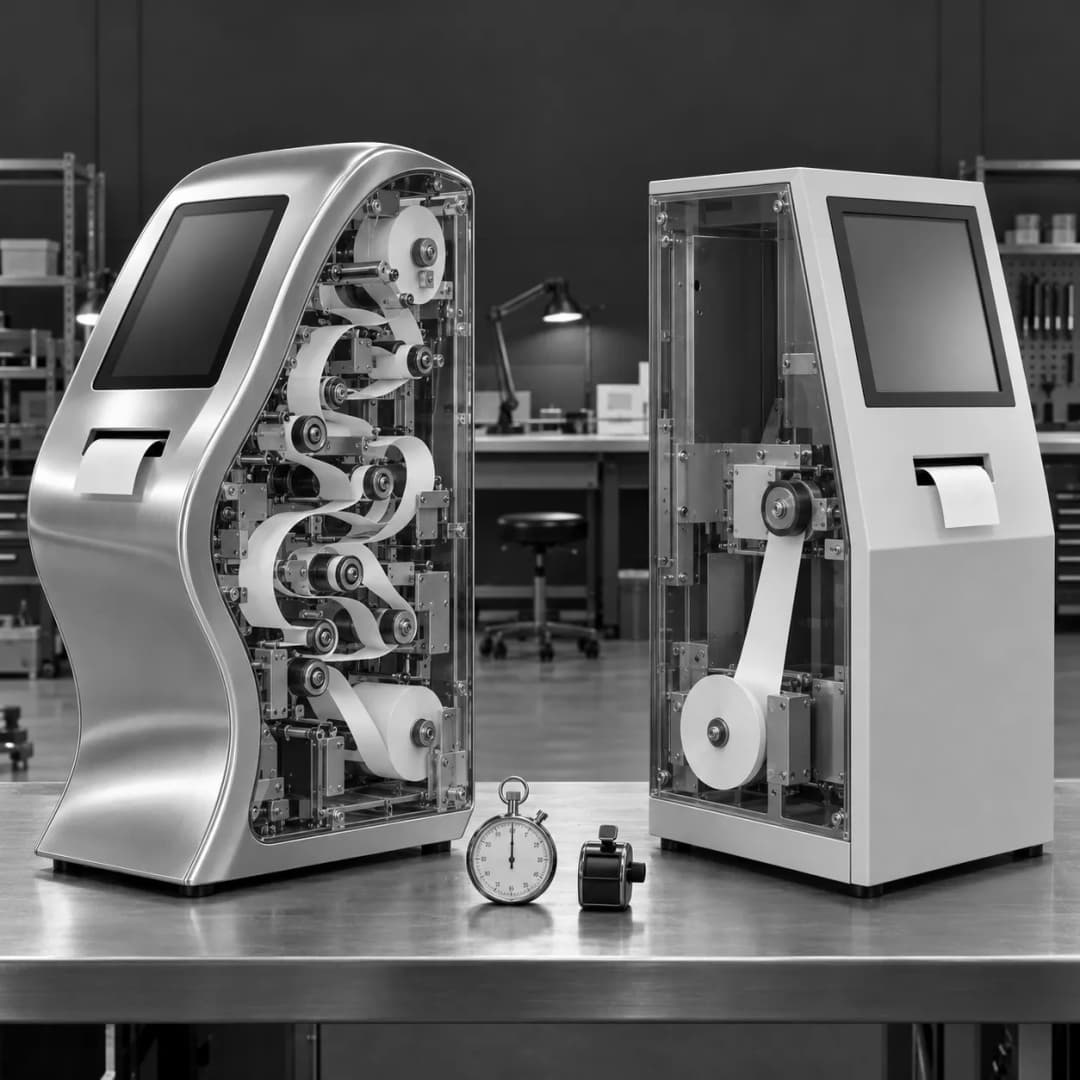
Masaaki Kurosu and Kaori Kashimura's 1995 distinction between how usable a thing looks and how usable it measurably is. Apparent usability is a judgement made on sight. Inherent usability is a property of the layout that can be counted in steps, times and errors. The two are not the same quantity and need not move together, which is the whole reason three decades of argument about attractive interfaces has anything to argue about.
What it is
Kurosu and Kashimura, working at the Hitachi Design Centre, had 252 students rate 26 cash dispenser layouts. Judged ease of use tracked judged beauty closely. It tracked the measurable properties of the layouts much less closely. Their conclusion was not that beauty makes things work, but that the two kinds of usability come apart, and that asking people how usable something is may be measuring something else.
It is worth knowing what the source is. The distinction was set out in a two-page conference companion note at CHI in 1995, not in a full paper, and everything built on it since has been built on that note. Treating the distinction as settled science, or the study as a demonstration of the effect that now carries its name, overstates what two pages can carry.
In effect
The later literature has not agreed on which way the influence runs. Noam Tractinsky and colleagues, working with 132 industrial engineering students on a cash dispenser surrogate, found that a system's aesthetics shifted post-use judgements of both its beauty and its usability, while its actual usability shifted neither. A laboratory study of the same shape by Alexandre Tuch and colleagues, with 80 participants using one of four versions of the same online shop, found the reverse: aesthetics did not affect perceived usability at all, and usability affected post-use perceived aesthetics, with the frustration of a hard interface proposed as the mediator.
Tuch and colleagues state the condition on their own reversal, which is that it appeared with a strong usability manipulation alongside a medium to large aesthetics one. So the honest position is that the distinction is sound and the arrow between its two halves is unsettled.
What it does not say
It does not say that looking usable and being usable are the same thing, which is the point, and it does not say that looks improve what people do. The 1995 study measured ratings, not task performance. The correlation most often quoted from it, between judged beauty and judged ease of use, is a correlation between two judgements given by the same people in the same sitting, and that is exactly the weakness every later study was designed to fix. It is not an effect size for the aesthetic-usability effect and should not be used as one.
It also does not establish that a finding from a 1995 cash dispenser mock-up carries to shipped software. A preregistered meta-analysis published in 2026 raises, without confirming, the possibility that prototypes show larger aesthetic effects than working interfaces. That is a direction for research rather than a result, and a mock-up is what the original apparatus was.
Sources
- Kurosu, M., & Kashimura, K. (1995). "Apparent usability vs. inherent usability: experimental analysis on the determinants of the apparent usability." Conference Companion on Human Factors in Computing Systems (CHI '95), 292-293. doi:10.1145/223355.223680. Hitachi Design Center; 26 cash dispenser layouts rated by 252 students.
- Tractinsky, N., Katz, A. S., & Ikar, D. (2000). "What is beautiful is usable." Interacting with Computers, 13(2), 127-145. doi:10.1016/S0953-5438(00)00031-X. Full text read. 132 third-year industrial engineering students; aesthetics affected post-use perceptions of both aesthetics and usability, actual usability affected neither. The authors note that an all-engineering sample restricts how far the result generalises.
- Tuch, A. N., Roth, S. P., Hornbaek, K., Opwis, K., & Bargas-Avila, J. A. (2012). "Is beautiful really usable? Toward understanding the relation between usability, aesthetics, and affect in HCI." Computers in Human Behavior, 28(5), 1596-1607. doi:10.1016/j.chb.2012.03.024. Abstract read. 80 participants, four versions of one online shop.
- Schlamann, M., Nestler, S., & Thielsch, M. T. (2026). "Attractive Things Do Work Better: A Meta-Analysis on Visual Aesthetics and User Performance." International Journal of Human-Computer Interaction, advance article, 1-43. doi:10.1080/10447318.2026.2664081. Full text read. Preregistered; 31 studies, 18,794 participants. Source of the unconfirmed prototype moderator.