Asymmetric Belief Updating
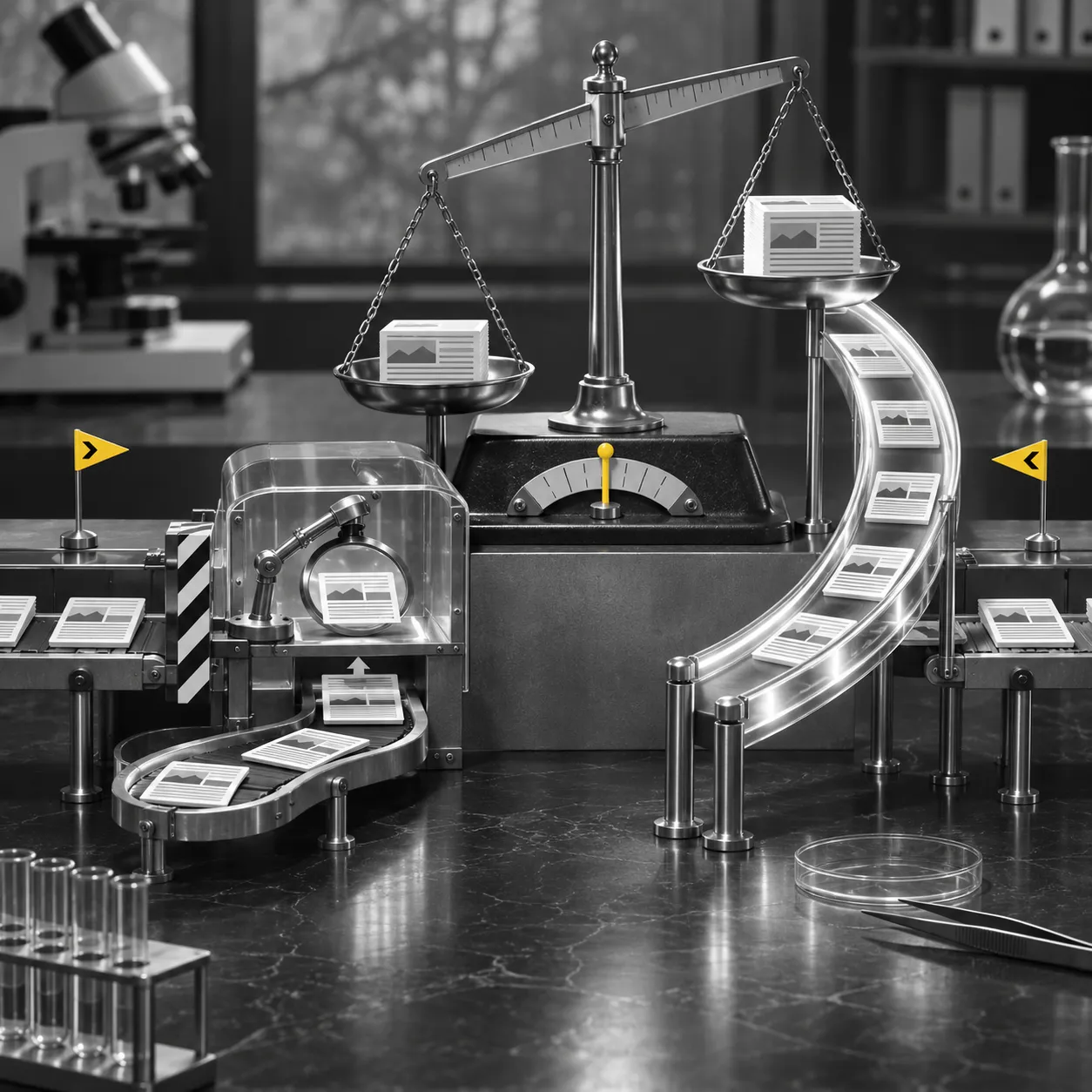
Asymmetric belief updating is the claim that people shift an estimate more after favourable information than after unfavourable information, and that this helps to maintain optimism bias. It is a claim about a process, not about a result at one moment: it says that optimism persists because of how people revise what they believe when news arrives.
What it is
Belief updating is the change in an estimate when new information arrives. A person estimates the chance of an event, is told what the typical chance is, and then estimates again. The size and direction of the change is the data.
The asymmetric claim is that the change depends on whether the news is good or bad for the person. If favourable information moves the estimate further than unfavourable information does, the person's estimates will drift in an optimistic direction over repeated rounds of news. That would give optimism bias a mechanism, and it would explain why the bias survives contact with evidence, which is the question in the 2011 paper's title.
A normative standard states how a belief should change given the evidence, so that behaviour can be compared with it instead of with a guess. A study of updating therefore has two things to get right. The task has to give each participant information that can legitimately move an estimate, and the analysis has to separate a real tilt toward good news from patterns that an unbiased updater would also produce. The 2016 authors' claim is that the standard method does not reliably achieve the second.
The 2016 paper describes the earlier work in these terms: recent studies had attributed unrealistic optimism to biased belief updating, in which favourable information shifts risk estimates more than unfavourable information does. The paper then examined that claim against a normative standard, comparing how participants use new information with the Bayesian standard for revising a belief.
In effect
The 2016 paper made three kinds of argument. It used task analyses to look at how the standard updating task is built. It used simulations to ask what a robust test of optimistic updating would need to look like. And it ran experiments. The authors concluded that the updating pattern is a statistical artefact, that their simulations indicated a robust test of optimistic updating would be very difficult to build, and that across five experiments they found no evidence of optimistic updating.
They drew a wider conclusion as well. The authors concluded that the result casts doubt on optimism as a basic feature of how people think. That conclusion is their reading of their experiments, and it sits beside the 2011 paper in the record rather than replacing it.
The disagreement is also a lesson in how a mechanism claim differs from a pattern claim. Imagine a person whose estimates of misfortune sit below the typical level. Many processes could produce that: where the estimates started, what information the person was given, how the answer scale was built, or a tilt in how news is weighed. A mechanism claim says which of these is at work. The 2016 paper's point is that the usual method cannot yet tell them apart.
The dispute shows why this note is kept apart from the note on comparative optimism. The comparative debate, set out by Harris and Hahn in 2011, concerns whether averages across people can show bias. The updating debate concerns whether people weigh good news more than bad when they revise an estimate. A result on one does not settle the other, so a statement that an updating asymmetry is established leaves out part of the published discussion.
The idea has an appeal that explains why it spread. A pattern of optimistic judgements invites the question of why it persists when the world supplies evidence against it, and an updating asymmetry offers a tidy answer. A tidy answer is not the same as a tested one, which is the reason the 2016 authors built simulations before they ran experiments. The concept is best held as a candidate explanation whose test is still being argued.
For anyone using the concept, the safe course is to name the mechanism as a hypothesis and to cite both papers. The pattern of optimistic judgements is one question. The process that would produce it is another.
What it does not say
It does not say that people never update asymmetrically. The 2016 paper reports no evidence of optimistic updating across five experiments and argues that earlier patterns are artefacts. That is a finding about those studies and designs, not a proof about every task.
It does not say that optimism bias is absent. The comparative literature and the updating literature are separate disputes, and a result on updating leaves the comparative record where it was.
It does not tell us about the brain beyond what the papers measured. The 2011 paper appeared in a neuroscience journal, and this page attributes to it no finding beyond the description given in the 2016 paper.
It does not fix the size of any effect. The abstracts of the two papers give no figure that this page relies on, so none is quoted.
It makes no claim about wellbeing or health.
Sources
- Sharot, T., Korn, C. W., & Dolan, R. J. (2011). How unrealistic optimism is maintained in the face of reality. Nature Neuroscience, 14(11), 1475-1479. doi:10.1038/nn.2949
- Shah, P., Harris, A. J. L., Bird, G., Catmur, C., & Hahn, U. (2016). A pessimistic view of optimistic belief updating. Cognitive Psychology, 90, 71-127. doi:10.1016/j.cogpsych.2016.05.004
- Harris, A. J. L., & Hahn, U. (2011). Unrealistic optimism about future life events: A cautionary note. Psychological Review, 118(1), 135-154. doi:10.1037/a0020997