Ataraxia
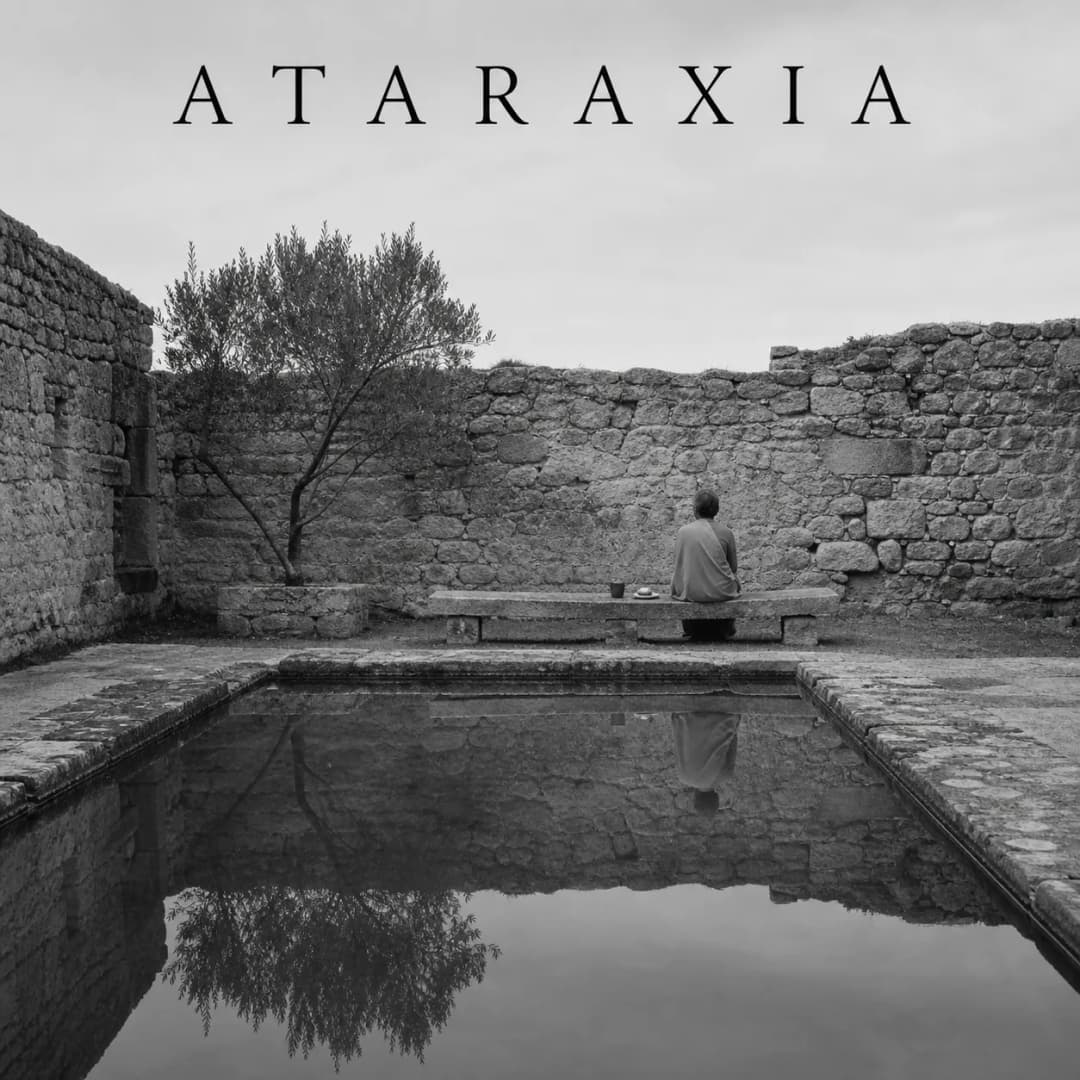
Ataraxia is the Greek word for freedom from disturbance, and Epicurus made it the goal by defining pleasure as the absence of pain. Tranquillity rather than gratification. The move is quiet and consequential: it relocates the problem out of the world and into the person standing in it, which makes wanting itself the thing to be managed. It is the Western route to a claim the Second Noble Truth had already reached by another road, and it is the ancestor of a large modern productivity literature.
What it is
Epicurus, writing in Athens in the decades either side of 300 BCE, is remembered popularly as an advocate of indulgence, which is close to the reverse of what he argued. In the Letter to Menoeceus and the Principal Doctrines he defines pleasure negatively, as the absence of pain in the body and of disturbance in the mind. On that definition the maximum is reached the moment pain is gone. Nothing is added by piling more on top, which is why the school ended up recommending bread, water, friendship and a garden rather than the banquets its name now conjures.
The consequence is structural rather than moral. If pleasure is the absence of pain, then desire is a form of pain, because a desire is by definition a state of lack. Wanting becomes the thing to be reduced, and tranquillity becomes what is left when it has been. Epicurus sorts desires accordingly, into those that are natural and necessary, those that are natural and unnecessary, and those that are neither, with the practical advice following straightforwardly: satisfy the first, be relaxed about the second, and prune the third, which is where most modern unhappiness would file.
This is the same shape as tanha, arrived at some two centuries later and with no plausible line of transmission. The Pali texts name thirst as the origin of dukkha. Epicurus makes the absence of pain the definition of pleasure, which makes the presence of wanting a deficit by construction. Two traditions, two vocabularies, one claim: the disturbance is in the wanting rather than in the world.
The word travels beyond Epicureanism. The Stoics reach a comparable destination by a different route, through judgment rather than through the management of desire, and it is the Stoic version that had the larger afterlife. Epictetus, in the fifth chapter of the Enchiridion, wrote that people are disturbed not by things but by the views they take of them. That line is the seed of the cognitive model, which Albert Ellis quoted directly and built a therapy on. The Epicurean move and the Stoic move are not the same move, and they share the assumption that matters here: what needs adjusting is on the inside.
In effect
Research: the pull with nothing painful in it (Robinson and Berridge)
The strongest available challenge to the Epicurean premise is neuroscientific. Terry Robinson and Kent Berridge's work on incentive salience describes wanting as a pursuit system that can be sensitised until it runs at full strength while the pleasure system stays flat. Rats whose wanting system is ablated go on liking sugar and simply stop going to get it. The description is of a pull, not a discomfort seeking relief. If wanting can operate without anything painful in the mechanism, then defining pleasure as the absence of pain describes a subset of human motivation while claiming the whole of it. Neither Robinson nor Berridge has ever written about Epicurus, and this is an argument by analogy rather than a rebuttal anyone has published. See Wanting vs Liking.
Everyday life: the ordinary shape of wanting something
Test the premise against a case. Wanting to see a friend, wanting to hear how a novel ends, wanting to get to the top of a hill: these are recognisably states of desire, and the phenomenology is not obviously one of pain awaiting relief. The Epicurean reply is available and reasonable, that the pleasure of the arrival is the removal of the lack that preceded it. What is not available is a way to settle the disagreement, because both accounts describe the same experience and neither generates a prediction the other does not. That is a good demonstration of what a philosophical claim can and cannot do, and it is why the neuroscience matters: it puts a mechanism where the argument had only introspection.
Commerce: the productivity market runs on the negative definition
Nir Eyal's Indistractable (2019) takes the Epicurean route explicitly, arguing that all motivation is the desire to free ourselves from the pain of wanting, and that distraction is therefore relief-seeking rather than pleasure-seeking. Time management, on that account, is emotional work misfiled as scheduling, which is the argument this site sets out under time management is pain management. It is a genuinely useful reframe and it is also a load-bearing philosophical premise sold as an observation. A very large market in focus tools, distraction blockers and attention hygiene rests on the assumption that the pull toward a phone is a discomfort you are trying to end. If it is sometimes just a pull, then the product is solving a different problem from the one on the label.
What it does not say
It does not say pleasure is bad or that enjoyment should be avoided. The popular caricature of Epicureanism as luxury is the inverse of the doctrine, and the recommendation of simple pleasures follows from the definition rather than from asceticism for its own sake.
It is philosophy, not evidence. Nothing on this page was measured. Epicurus offers a definition and a set of consequences that follow from it, and a definition cannot be falsified by data, only found less useful than an alternative.
It does not establish that all motivation is relief-seeking. That extension belongs to modern writers, Eyal among them, and it is a much stronger empirical claim than anything in the Letter to Menoeceus. It is also the specific claim the wanting and liking dissociation puts pressure on.
The convergence with the Buddhist account is not evidence for either. Two traditions reaching the same conclusion independently feels like corroboration and is not, because neither had a measure of craving and both were reasoning from the same instrument, an educated person's introspection about their own desires. Independent agreement between two unaided observers using the same faulty instrument is exactly what you would expect if the instrument were faulty. See The Self-Report Problem.
Epicurean and Stoic tranquillity are not interchangeable. This page treats them as neighbours because they share a direction of travel, and the routes differ enough that arguments about one do not automatically transfer to the other.
Sources
- Epicurus, Letter to Menoeceus. Pleasure defined as the absence of pain, and the classification of desires into natural and necessary, natural and unnecessary, and neither.
- Epicurus, Principal Doctrines. The limit of pleasure as the removal of all that is painful.
- Epictetus, Enchiridion 5. "Men are disturbed not by things, but by the views which they take of them."
- Eyal, N. (2019). Indistractable. BenBella. The motivation theory is taken from Epicurus explicitly.
- Robinson, T. E. & Berridge, K. C. Incentive-sensitisation work on the wanting and liking dissociation. Full citation trail on Wanting vs Liking.
- Dhammacakkappavattana Sutta (SN 56.11). The parallel claim, reached independently.
- Where this came from
- One book in this library carries this concept. A concept resting on a single popular retelling is roughly twice as likely to be contested, mixed or unverified as one two or more books carry, so treat it as unchecked until it has been taken to a primary source.