Autokinetic Effect
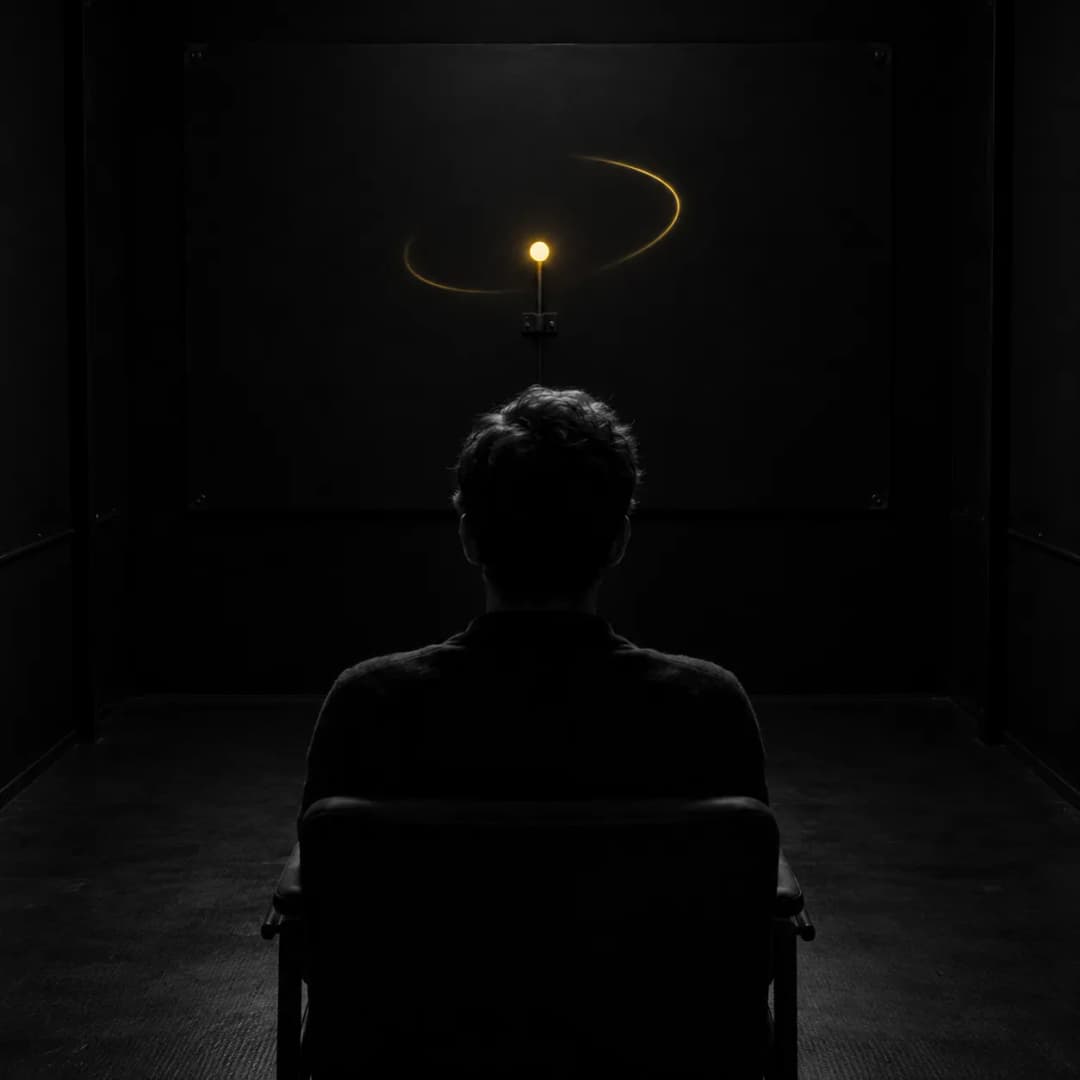
The autokinetic effect is the apparent drift of a single stationary light seen in an otherwise dark room. Muzafer Sherif used it in his 1935 monograph because a person looking at such a light has no outside reference for judging how far it has moved, so whatever estimate they settle on is shaped by something other than the light. His experiments showed that people judging alone each settled on a personal range and typical value, and that people judging together converged on a shared one.
What it is
In a dark room with nothing else to look at, a small fixed light seems to move. The movement is an illusion of perception, and it is the basis of Sherif's design. Because the light does not move, there is no correct answer to be found, and because the room gives no distance cues, each person has to decide for themselves how large the drift is.
Sherif built the arrangement with care. The experiments ran in a sound-proof and light-proof dark room. A dim bulb with an aperture of about one millimetre, diffused through tissue paper, sat five metres from the seated participants, and a screen hid the apparatus so that they had no sense of its distance. Participants pressed a key when they saw the light move, and the light was switched off two seconds later. If no movement was reported within thirty seconds, the trial was recorded as no movement. The group version used three keys and hidden signal lights so that the experimenter could tell who had responded.
The participants were psychologically naive male students aged between 19 and 30 who did not wear glasses. Each gave one hundred judgements per session. The first range experiment used 19 participants, a second intensive range experiment used four, and 40 took part in the group experiments. A separate experiment on direction used 36. The design had four conditions: judging alone, judging in a group, judging in a group after solo sessions, and judging alone after group sessions.
Sherif also listed the factors that affect the illusion. Smaller and fainter lights, and greater uncertainty about the distance of the light, strengthen it, while added lights or sounds disturb it. The point of the arrangement was to keep the situation as unstructured as possible.
In effect
Judging alone, each of the 19 participants settled on a personal range of apparent drift and a typical value inside it. These differed widely between people, with medians running from under half an inch to nearly ten inches. Participants who were later tested alone again kept roughly the same range and typical value, so once a personal reference point was established it persisted.
When people who had first judged alone were then put together, their medians moved closer over the sessions, although they did not come together as tightly as groups that had started as groups. When people began in a group, their medians converged almost at once and the shared level held across later sessions. Groups of two and groups of three showed essentially the same pattern.
The part that gave the experiment its later reputation came afterwards. Members who had begun in a group kept a norm close to the group's when they were tested alone again. The differences between their individual medians and the group medians were small and usually not statistically reliable, whereas pairs who had begun alone still differed more from each other, and those differences were often reliable. The norm had become the participant's own frame for judging the light.
Sherif also observed that only about a quarter of participants believed other people's judgements had influenced them, which suggests the influence operated largely without awareness, and that the effect built up across sessions rather than coming from any single judgement.
The experiment is usually read as a demonstration of informational influence, since the other voices were the only available guide to the light's movement. It also sits at the start of a long line of work on how a group norm forms and how long it lasts.
What it does not say
The illusion is a feature of the task and not of the participants. The task has no correct answer to find, so the experiment shows how people behave when no answer exists in the world and the group is the only guide. It does not show that people give up a correct answer to fit in, which is a different question taken up in other studies.
The sample was male students in a laboratory study in the 1930s, and the reported figures describe those participants and that setting. They describe what the experiment measured, not how often a similar convergence would occur in any given group today.
The finding that group members kept their norm when tested alone describes the sessions of the experiment. The experiment does not measure how long such a norm would last outside the laboratory.
Finally, the report that only about a quarter of participants thought others had influenced them is a statement about what those participants said. It supports the reading that influence operated without much awareness, and it is an interpretation of the pattern and not a measurement of awareness.
Sources
- Sherif, M. (1935), A study of some social factors in perception, Archives of Psychology, no. 187, New York.
- Haun, D. B. M., Rekers, Y., & Tomasello, M. (2014) and Berns et al. (2005) are cited on the Conformity page for later work on the same question.
- Berger, J. (2016), Invisible Influence. (seed book for the article that cites this page).