Automate Last
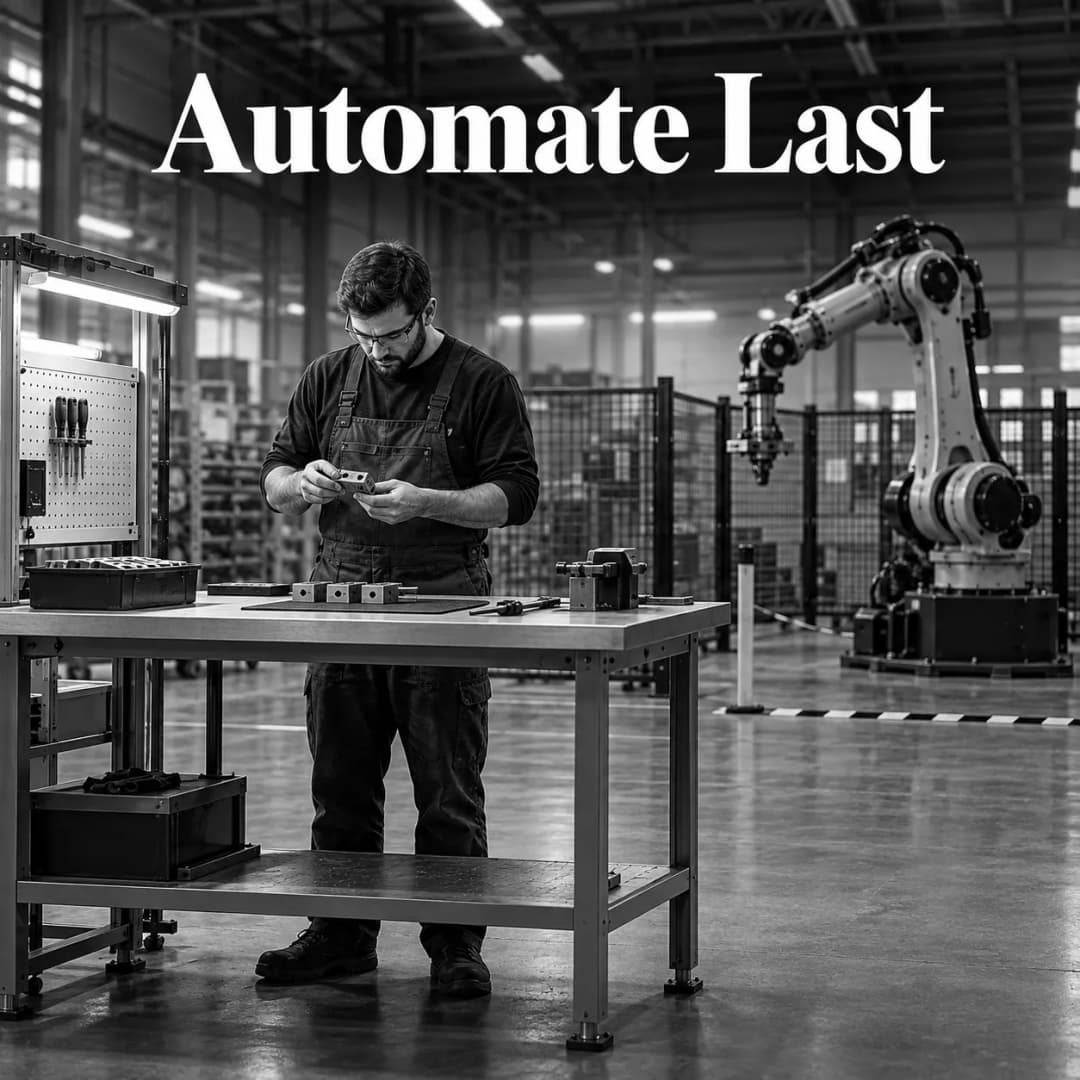
Automate last is the fifth and final step of the Algorithm, the operating sequence set out in Jon McNeill's The Algorithm: automate only once the process has been questioned, cut, simplified and sped up. Automating earlier encodes ignorance in machinery. The book credits Elon Musk with placing the step fifth, and the underlying caution is older than either of them, running back through lean practice. It is a practitioner framework, not a research claim.
What it is
The argument is about order rather than about automation. Nobody in this tradition is against machines. The claim is that a machine built around a process you have not yet interrogated makes the unexamined parts of that process permanent.
The asymmetry is the whole point. A person doing an unnecessary step can be asked to stop. A robot doing an unnecessary step has a budget attached, a vendor contract, a maintenance schedule and a capital cost that somebody signed for, and every one of those makes removal harder. The step stops being a decision and becomes an asset.
Put fifth in the sequence, after question every requirement, delete, simplify and accelerate cycle time, automate last inherits whatever those four have already removed. That is why the ordering is load-bearing and why the book returns to it. Page 76 of The Algorithm deals with the ordering; page 107 records the credit to Musk for placing automation at the end.
The caution is not new. Automation that follows process discipline rather than substituting for it is long-standing lean doctrine, and jidoka, automation with a human touch, is the Toyota Production System's version of the same instinct. Taiichi Ohno is the name behind that line. Anyone presenting automate last as an original insight of the 2010s is missing several decades.
In effect
The book's demonstration is the Fremont tent line in chapter five, told as first-hand recollection rather than as data. Readers should carry the sequence and leave the figures, which this vault has not verified.
The generalisable version is easy to picture. A warehouse buys a conveyor sorter for a returns process which, on inspection, did not need a third of its handling steps. The sorter now fixes those steps in steel. A competitor who removed the steps first and ran the leaner flow by hand for a month buys a smaller machine and changes it less often.
The same pattern shows up wherever software is commissioned to support a workflow nobody has audited. The requirements document records the current process, the build makes the current process expensive to change, and two years later the shape of the work is being defended on the grounds of what the system can do.
The connection to sunk cost is direct and worth naming. Premature automation is hard to reverse partly for real financial reasons and partly because people defend what they have already paid for.
What it does not say
It does not say do not automate. It says automate fifth, and the difference is the entire claim.
It does not rest on evidence. There is no study here. It is a practitioner sequence with a first-hand anecdote behind it, and this page records it as that.
It does not originate with Musk or with McNeill. The book credits Musk with placing the step at the end of the sequence. The underlying caution belongs to lean manufacturing and predates both by decades.
It does not carry the book's figures. The Fremont account is recollection, and the numbers in it have not been checked here.
Sources
- McNeill, J. The Algorithm. Step five, chapter five, pp. 99 to 120. P. 76 on the ordering; p. 107 on the credit to Musk for placing automation last. The Fremont tent line is told as first-hand recollection; its figures are not carried here.
- Lean manufacturing doctrine, via Taiichi Ohno and the Toyota Production System, for the older form of the same caution. Not read here.