Basking in Reflected Glory
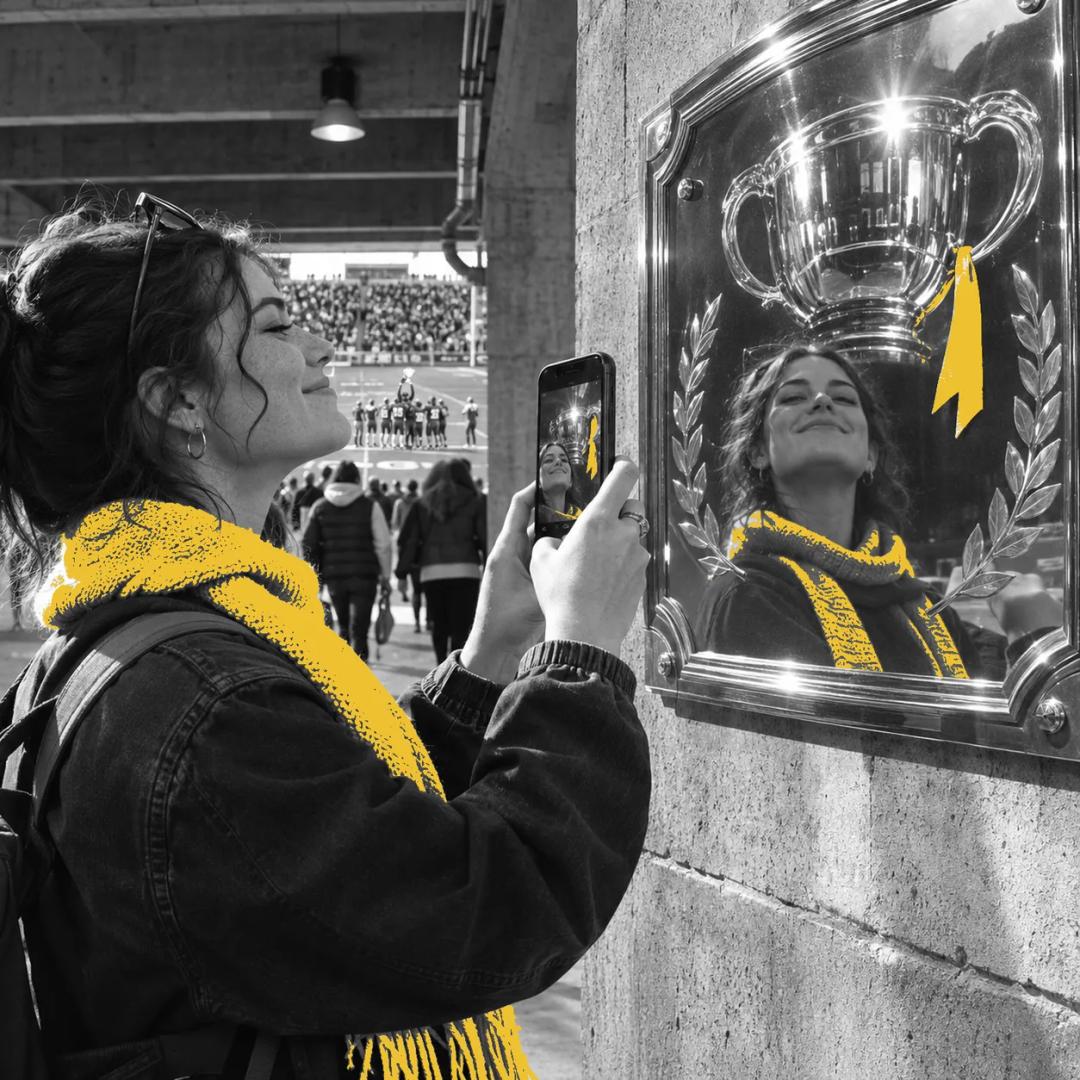
Basking in reflected glory is the habit of publicly announcing a link to a successful person or group, even when you had no part in the success. Robert Cialdini and colleagues reported it in 1976 in three field studies of football supporters at American universities. The pronoun we and the school sweatshirt both rose after a win.
What it is
The idea is simple. When someone we are connected to succeeds, we tell people about the connection. A fan says we won. A graduate mentions the school that has just topped a table. A resident points out that a prize winner grew up on the same street. None of them contributed to the result, and the result still lifts the way they present themselves.
In the 1976 studies, which appeared in the Journal of Personality and Social Psychology, volume 34, issue 3, university students wore clothing that identified their school more after a football win than after a loss, and they used the word we more often when describing a win than a loss. The effect appeared even when the person bore no responsibility for the success. The authors proposed that basking is a way of protecting or improving public image, and two of the studies supported the idea that people were keenest to claim a connection when their image was under threat.
In effect
In the article on sports fans saying we won, the pronoun and the shirt follow the scoreboard. A win invites we; a loss invites a step back. The display is a way of sharing in a success the person did not produce.
What it does not say
It does not say that fans are insincere or that the display is a calculation made in the moment. It describes a pattern in what people wear and say, and the explanation about public image is the authors' proposal, supported by two of the three studies.
It does not say the effect is equal across people. The work on team identification suggests that strong identifiers behave differently from casual ones, and the original studies were of university students.
Where it comes from
Cialdini was a social psychologist at Arizona State University in the 1970s, and the work was done with Borden, Thorne, Walker, Freeman and Sloan. The research design used the natural calendar of a college football season: observe what students wear and say after wins and losses, without changing the games. Cialdini describes in Influence, in the edition of 2021, a telephone version of the pronoun study in which students who were asked about a result used the plural we after wins and a distancing they after losses. The direction of the result is reported in the book and the figures are not.
How it shows up
In sport the sign is a pronoun. A supporter who says we won is sharing in a result the team produced, and the same supporter will often say they lost after a defeat. The second half of that pattern has its own page, cutting off reflected failure. Together the two describe a link that is announced when it helps and loosened when it does not.
The idea extends beyond the stadium. In Influence, Cialdini notes that the pattern has been seen with supporters of football clubs in France and England and with voters after elections in the Netherlands and the United States. Brands use the same mechanism when they invite customers to wear a team colour, share a medal table or follow a winning side, and when a business advertises that it supplies a champion.
What the research found
Two points are firm enough to state. The display followed the scoreboard, and the display held for people who had no part in the outcome.
A related 1986 study by Snyder, Lassegard and Ford in the same journal tested two tendencies in how people relate to groups, sharing in a group's success and distancing from it after failure.
Team identification, the strength of a person's bond with a team, shapes how fans react to defeat. Bernache-Assollant and Laurin studied supporters of elite French rugby union in two studies reported in 2012. Among 153 casual spectators, team identification was a strong driver of loyal reactions after a defeat. Among 64 die-hard fans, team identification was the best predictor of one family of loyal reactions and territorial identification best predicted the first strategies used. These are studies of fans of one sport in one country, and they add detail about who stays loyal after a loss without changing the 1976 finding.
Where opinion differs
One reading, close to the authors', treats basking as impression management: people borrow status from winners because association improves how others see them. Another reading emphasises identity, holding that for a committed fan the team is part of the self, so a win is a personal event and the pronoun we is literal and not strategic. This site presents both and does not choose.
How this site uses it
The Why We Project uses basking in reflected glory in the article Why do sports fans say we won? as the first half of a pattern: the pronoun and the shirt follow the scoreboard. It pairs with cutting off reflected failure and with team identification, and it is used to explain why a small word carries a large amount of social meaning.
Sources
- Cialdini, Borden, Thorne, Walker, Freeman and Sloan (1976). Basking in reflected glory: Three (football) field studies. Journal of Personality and Social Psychology, 34(3), 366-375.
- Snyder, Lassegard and Ford (1986). Distancing after group success and failure: Basking in reflected glory and cutting off reflected failure. Journal of Personality and Social Psychology, 51(2), 382-388.
- Bernache-Assollant and Laurin (2012), two studies of fans of elite French rugby union. International Journal of Psychological Research, 5(1), 122-132.
- Cialdini, R. B. (2021). Influence, new and expanded edition. Harper Business.
In these themes
- Belonging and Community
Why we need groups, and what we give up to stay in them.