Beauty in Averageness
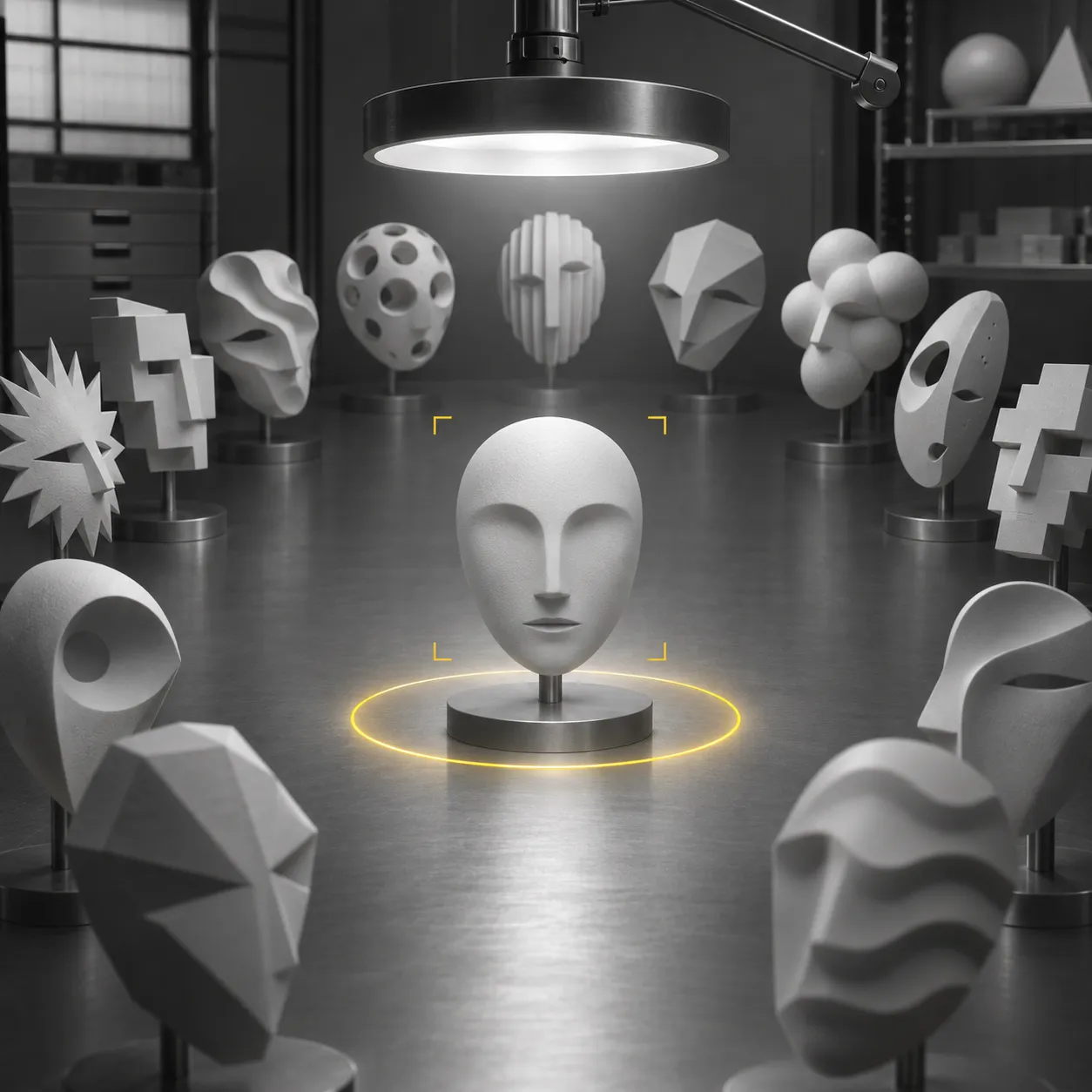
Beauty in averageness is the tendency to find average, prototypical members of a category more attractive than unusual ones. In 2006 Piotr Winkielman and colleagues tested one explanation: prototypes are processed fluently, and fluently processed things are liked. Across three experiments with patterns and facial muscle recordings, prototypicality predicted faster categorisation and higher attractiveness ratings, and speed accounted for much of the link.
What it is
One common explanation holds that prototypicality signals mate value. Winkielman, Halberstadt, Fazendeiro and Catty proposed a more general account. A prototype sits near the centre of a category, so it is easy to place, and ease of processing is itself experienced as pleasant. If that is right, the preference should appear for objects that have nothing to do with mate choice, and should be tied to how quickly the object is recognised as a member of its category.
The team tested this with random-dot patterns and geometric patterns that varied in how prototypical they were. Participants categorised the patterns and rated how attractive they were. In both experiments the more prototypical patterns were categorised faster and rated higher.
In effect
Fluency mediated the relation between prototypicality and attractiveness, meaning that much of the effect passed through categorisation speed, although some prototypicality effect remained once speed was accounted for. The finding held when participants were not explicitly asked to think about category membership. In a third experiment, facial electromyography recorded quick positive affective reactions as participants viewed abstract prototypes.
The same logic appears in a 2011 study of cars, in which the distance of each of 28 car designs from a morphed average design improved sales forecasts, with fluency proposed as the route. Both pieces of work are cited in the article on why so many banks and technology brands choose blue, where applying them to a category colour is presented as an extension.
What it does not say
The patterns in the 2006 experiments were not colours, brands or products, and the work does not say that a category colour is liked because it is typical. It does not give a size for the effect in markets, and it does not say that average always beats distinctive: a separate 2003 study of consumer products found that typicality and novelty each mattered and that the best-liked products combined both.
Sources
- Winkielman, P., Halberstadt, J., Fazendeiro, T., & Catty, S. (2006). Prototypes are attractive because they are easy on the mind. Psychological Science, 17(9), 799-806. https://doi.org/10.1111/j.1467-9280.2006.01785.x
- Landwehr, J. R., Labroo, A. A., & Herrmann, A. (2011). Gut liking for the ordinary: Incorporating design fluency improves automobile sales forecasts. Marketing Science, 30(3), 416-429. https://doi.org/10.1287/mksc.1110.0633
- Hekkert, P., Snelders, D., & van Wieringen, P. C. W. (2003). Most advanced, yet acceptable: Typicality and novelty as joint predictors of aesthetic preference in industrial design. British Journal of Psychology, 94(1), 111-124. https://doi.org/10.1348/000712603762842147