Bigature
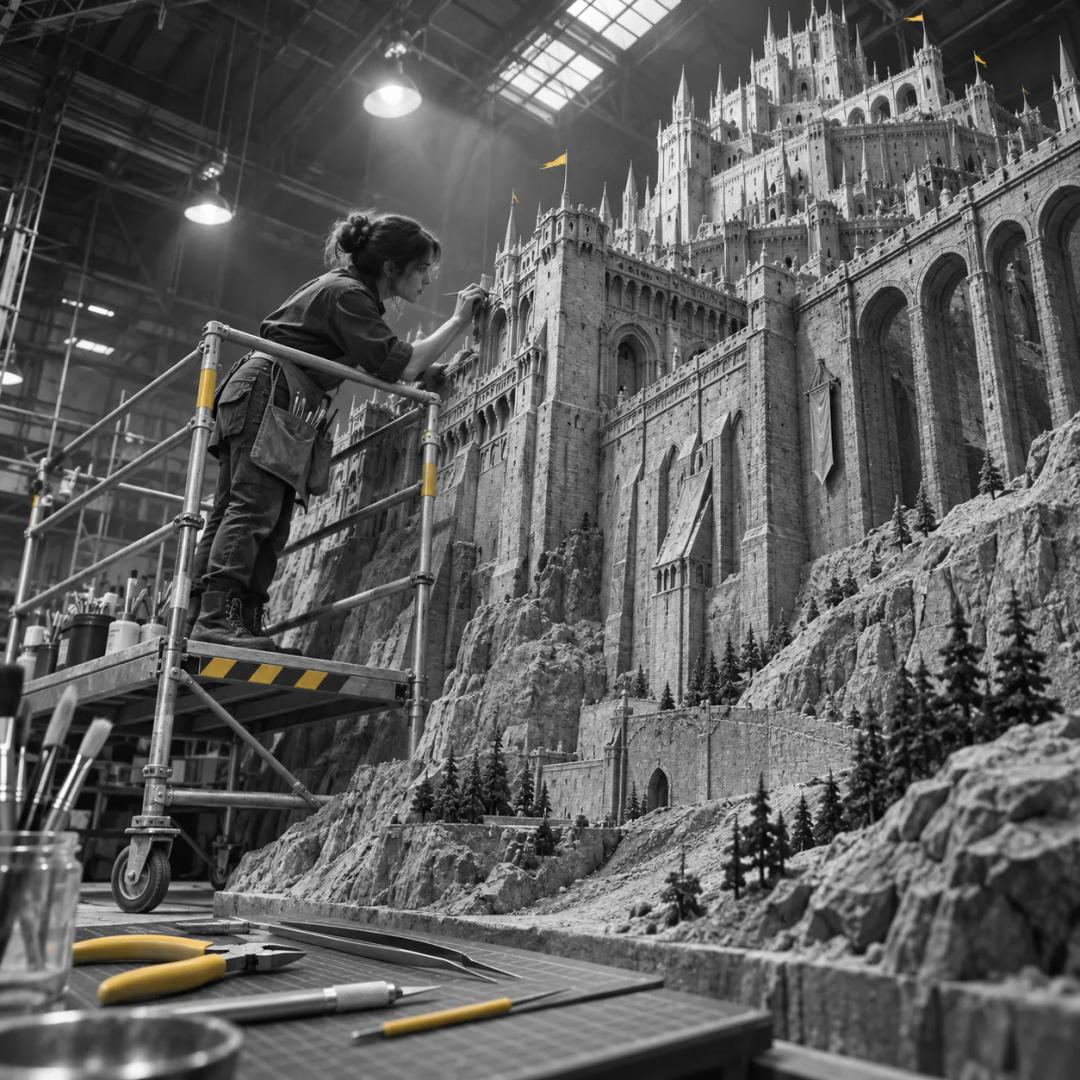
A bigature is an oversized miniature built to stand in for a vast structure or landscape. American Cinematographer reported in December 2001 that the Wētā Workshop team coined the term for the models made for The Lord of the Rings films, because most of them were large.
What it is
Film makers have long used scale models to show buildings and places that would be impractical to build full size. A bigature takes the idea further by making the model large enough to be filmed with the detail and depth of a real location. The magazine's account of the first film's effects reports that Wētā Workshop built more than sixty large miniature environments across the three films.
The same account gives examples of the scale involved. The tower of Barad-dûr was built nearly three stories tall, and rock faces for the miniatures were moulded from the Wellington coastline. For backgrounds, a New Zealand landscape photographer was hired to photograph sunrises, sunsets and vistas across the country.
In effect
In the article on why The Lord of the Rings movies are so good, bigatures are one example of visible physical craft. Research on the effort heuristic, described by Justin Kruger and colleagues in 2004, finds that people tend to rate work as higher in quality when they believe more effort went into it. A viewer who knows the models were handmade and large may judge them more favourably. That link is an interpretation made on this site, and the 2023 replication of the heuristic found mixed support.
What it does not say
It does not say that practical effects are better than digital ones, and it does not compare the films with any other. The word names a kind of model, and the figures come from one magazine account of the first film's effects work.
Sources
- Magid, R. (2001), account of the effects work on The Fellowship of the Ring, American Cinematographer, December.
- Ziano, I. and colleagues (2023), replications of the effort heuristic, Collabra: Psychology.