Black Uniforms and Perceived Aggression
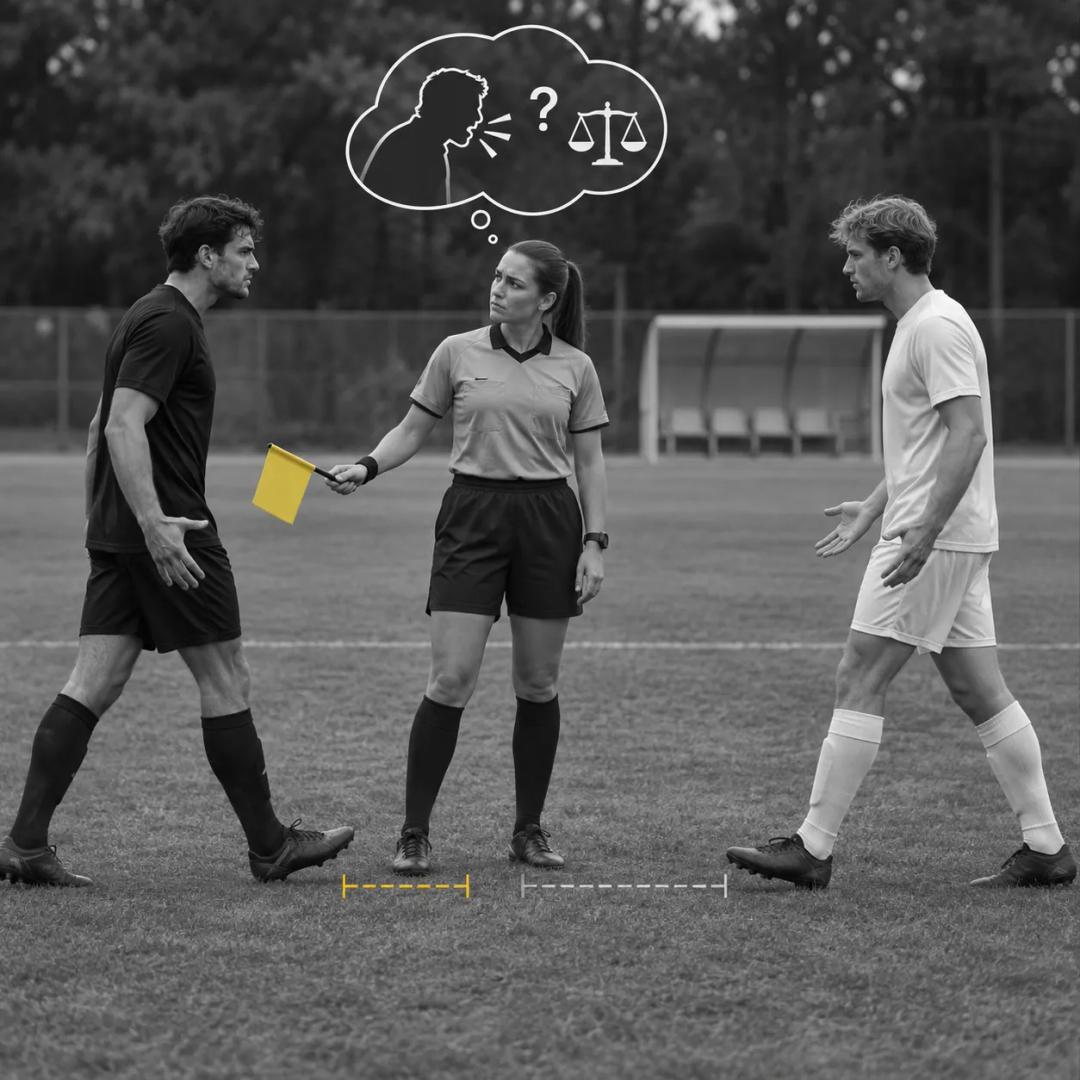
The reported link between black sports uniforms and penalties. Mark Frank and Thomas Gilovich published the 1988 paper in the Journal of Personality and Social Psychology, and Gregory Webster and colleagues returned to it in 2012 with 25 seasons of ice hockey penalty data. In the 1988 paper, penalty records from professional football and ice hockey showed teams in black uniforms near the top of their leagues for penalties, and teams that changed to black uniforms were penalised more immediately.
What it is
The reported link between black sports uniforms and penalties. Mark Frank and Thomas Gilovich published the 1988 paper in the Journal of Personality and Social Psychology, and Gregory Webster and colleagues returned to it in 2012 with 25 seasons of ice hockey penalty data.
It sits close to Brightness-Weight Illusion and The Dominance Game in the wider body of research, and is best taken as one idea among several rather than a stand-alone rule.
In effect
In the 1988 paper, penalty records from professional football and ice hockey showed teams in black uniforms near the top of their leagues for penalties, and teams that changed to black uniforms were penalised more immediately. Two laboratory experiments suggest biased judgments by referees and the players' own increased aggressiveness. The 2012 paper found more penalties in black jerseys than in other colours and discussed possible causes.
What it does not say
The finding comes from the studies named on this page and describes a pattern in those samples. It does not show that the pattern holds for every person, product or market, and it does not tell a brand what to do on its own. It is one input to a decision, to be weighed with other evidence.
Sources
- Frank and Gilovich, Journal of record: Journal of Personality and Social Psychology 54(1), 1988. https://doi.org/10.1037/0022-3514.54.1.74
- Webster, Journal of record: Social Psychological and Personality Science 3(3), 2012 (online 2011). https://doi.org/10.1177/1948550611418535
- Han, Nunes and Drèze, Journal of record: Journal of Marketing 74(4), 2010. https://doi.org/10.1509/jmkg.74.4.015