Brightness-Weight Illusion
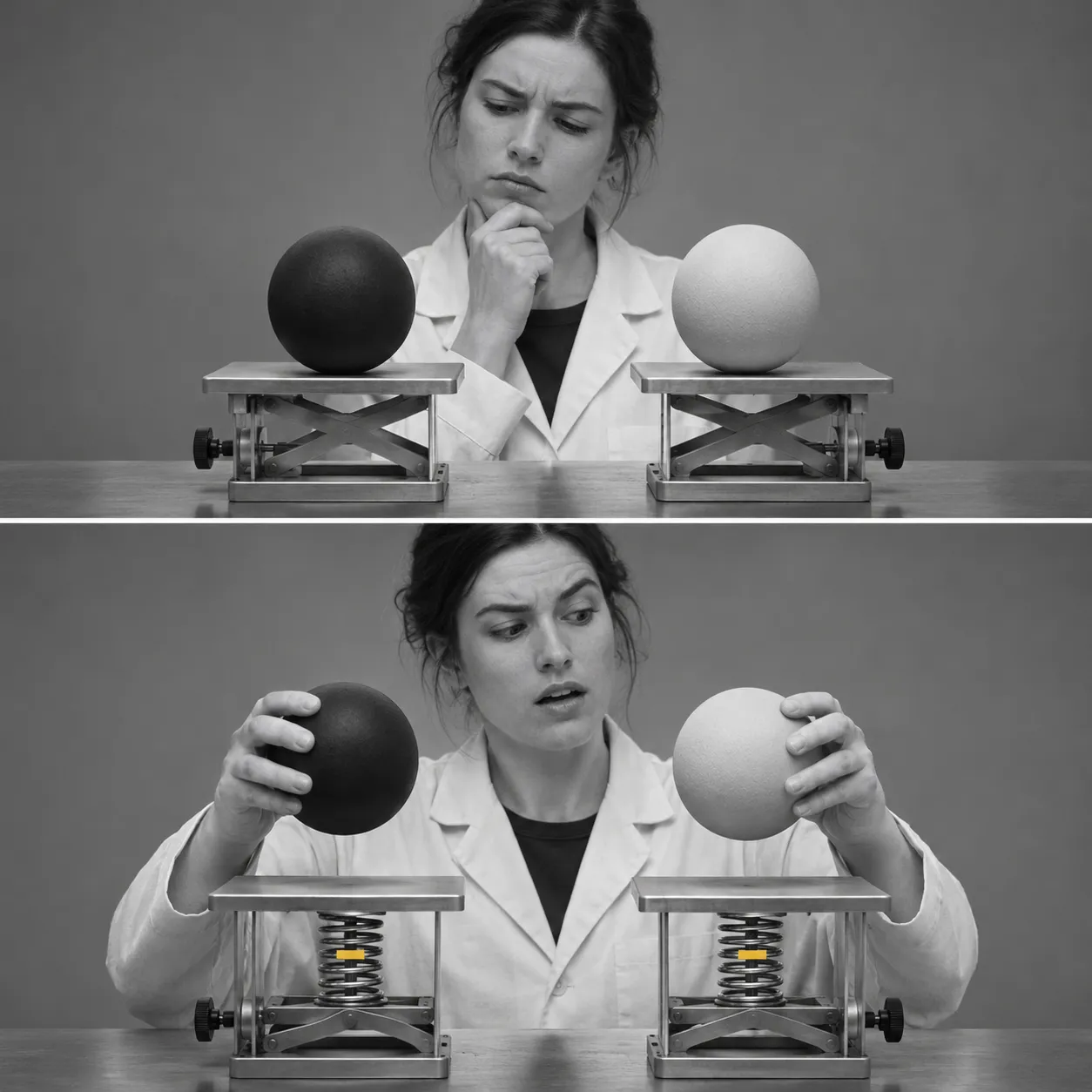
The finding that darker objects look heavier by sight and feel lighter once lifted. Peter Walker, Brian Francis and Leanne Walker reported it in Experimental Psychology in 2010 as a colour counterpart of the size-weight illusion. In the 2010 experiments, participants judged balls that differed only in colour.
What it is
The finding that darker objects look heavier by sight and feel lighter once lifted. Peter Walker, Brian Francis and Leanne Walker reported it in Experimental Psychology in 2010 as a colour counterpart of the size-weight illusion.
It sits close to Black Uniforms and Perceived Aggression in the wider body of research, and is best taken as one idea among several rather than a stand-alone rule.
In effect
In the 2010 experiments, participants judged balls that differed only in colour. By sight alone the darker balls were judged heavier, and the judgment reversed when the balls were lifted. The authors could not tell whether this reflects a perceptual association or the fact that English uses one word, light, for brightness and weight.
What it does not say
The finding comes from the studies named on this page and describes a pattern in those samples. It does not show that the pattern holds for every person, product or market, and it does not tell a brand what to do on its own. It is one input to a decision, to be weighed with other evidence.
Sources
- Walker, Journal of record: Experimental Psychology 57(6), 2010. https://doi.org/10.1027/1618-3169/a000057