Caregiver Sensitivity
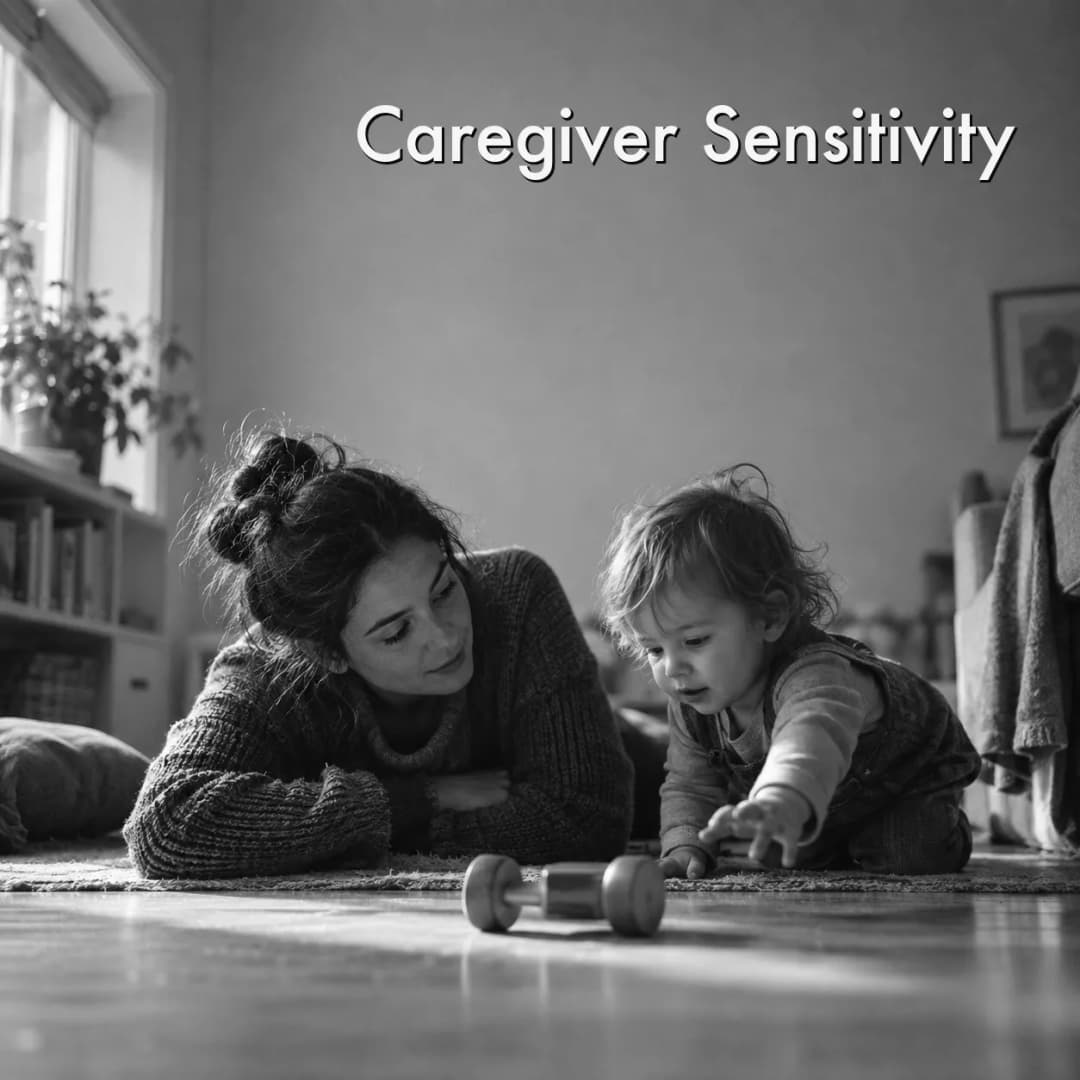
Noticing a baby's signal, reading it correctly, and responding promptly and appropriately. It is the best-evidenced cause of attachment security, it is what intervention programmes actually train, and it explains several times more about a child than that child's infant classification explains about the adult.
What it is
Mary Ainsworth arrived at it by watching rather than testing, first in Uganda in the mid-1950s and then in Baltimore. What she noticed was that mothers differed reliably in how accurately they read a baby, and that the babies differed correspondingly.
The construct has four parts, and the middle two are where people go wrong. Noticing that a signal has been given. Interpreting it correctly, which is not the same as responding warmly to the wrong reading. Selecting an appropriate response. And doing it promptly enough for the baby to connect the two.
That makes it a skill rather than a temperament, which is why it can be taught, and why the teaching works.
In effect
Marianne De Wolff and Marinus van IJzendoorn pooled sixty-six studies in 1997 and isolated the twenty-one that could answer the question cleanly: non-clinical samples, sensitivity observed rather than self-reported, and measured before or alongside the classification. Across those, sensitivity accounts for about six parts in a hundred of the differences in security. Their own word for that is moderately strong.
Set it against the comparison this site cares about. Infant classification predicts adult socioemotional outcomes at one to two parts in a hundred. What a caregiver is doing now explains several times more than what happened to a person decades ago.
The causal evidence comes from the trials. Pooling seventy randomised programmes, the ones that improved sensitivity also improved security, and the ones that worked were short and behavioural, often using video playback so a parent can see the signals they are missing. Long, intensive, insight-oriented programmes did worse.
What it does not say
It is not the only thing that matters. The same meta-analysis found other parenting dimensions weaker but not negligible, and the authors call sensitivity an important but not exclusive condition.
Six parts in a hundred is not a mandate for blame. It is a real effect of modest size, and the people who measured it were careful to say so.
And it is not a universal ideal. Heidi Keller's objection is that sensitivity presupposes a child who leads and an adult who follows, which inverts what counts as good parenting in communities where a child is taught to fit an existing order.
Sources
- De Wolff, M. S., & van IJzendoorn, M. H. (1997). Child Development, 68(4), 571-591.
- Bakermans-Kranenburg, M. J., van IJzendoorn, M. H., & Juffer, F. (2003). Psychological Bulletin, 129(2), 195-215.
- Ainsworth, M. D. S. (1967). Infancy in Uganda. Johns Hopkins University Press.
- Keller, H. (2018). PNAS, 115(45), 11414-11419.
- Where this came from
- No book in this library is the source of this concept. It entered the vault from What the Crib Actually Decides, built from primary sources rather than from a book.