Category Budgeting
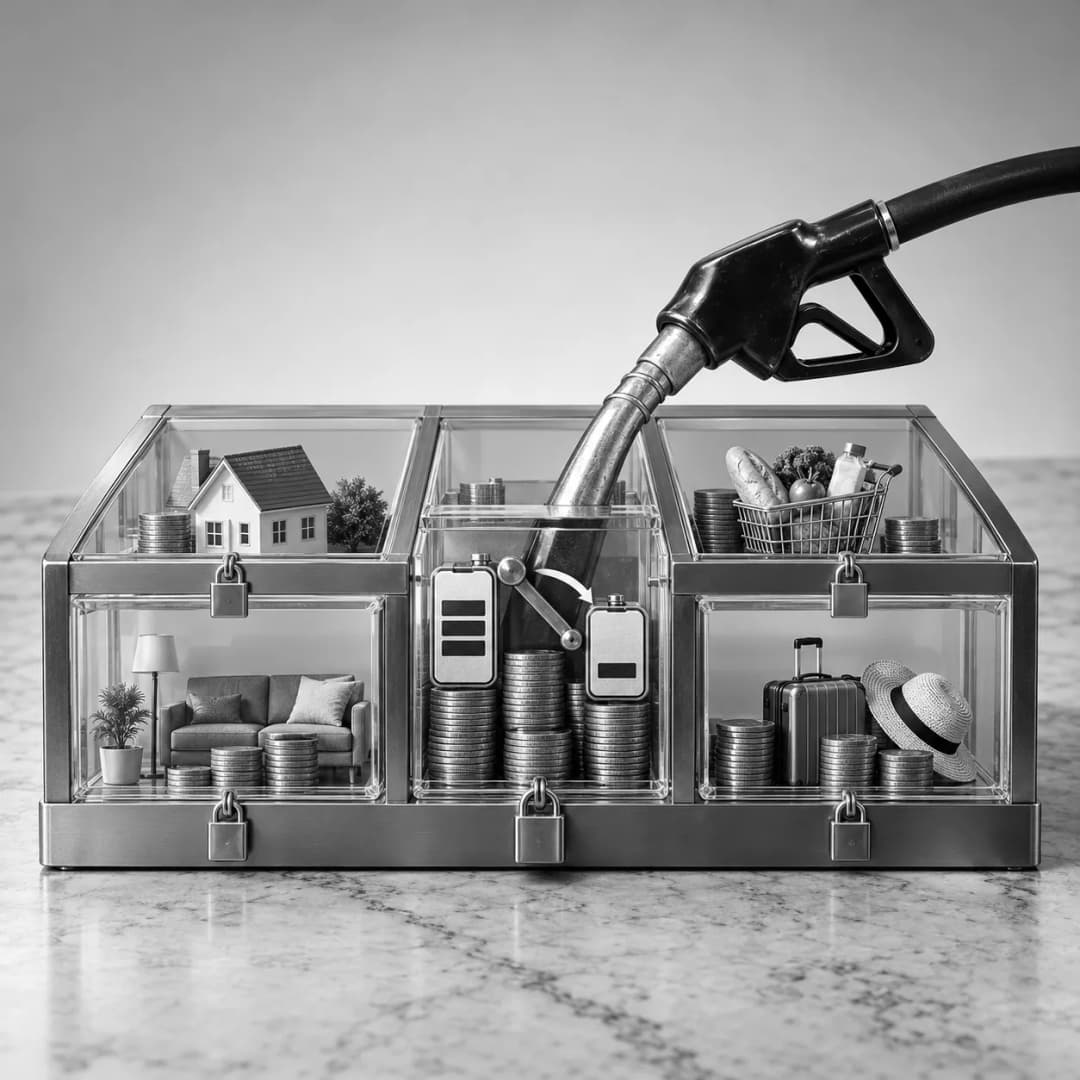
Spending governed by a budget for a category rather than by total wealth. The household has a figure in mind for petrol, or for groceries, or for going out, and when the price inside that category moves, the response comes out of the category rather than out of everything. It is the version of mental accounting with a testable shape, and it is the model that best fitted the petrol price-shock data.
What it is
Mental accounting as a framework describes accounts without specifying their boundaries in advance, which makes it hard to falsify. Category budgeting narrows it to a prediction: if a household runs a petrol budget, a rise in petrol prices should be absorbed inside petrol rather than spread across the whole basket. No originator is established here. The model is the one Justine Hastings and Jesse Shapiro found fitted their data best, and they do not claim to have originated it.
In effect
When petrol prices rise, drivers substitute down to a lower octane grade, and by more than an income effect could explain. Hastings and Shapiro built the test around parallel shifts in the prices of different quality grades of the same commodity, estimated it on panel microdata of petrol purchases, and rejected the hypothesis that households treat petrol money as fungible with other income across a wide range of specifications. Of the competing psychological models they fitted, a simple category budget fitted the time series well, with loss aversion and salience each capturing features of it.
What it does not say
The outcome measured was which grade people bought, not how much they spent in total, which is narrower than the result is usually reported as. It is one commodity, one country and one kind of purchase.
The deeper limit is that the paper had to compare three psychological models at all. The parent framework did not select one, which is the defensible form of the complaint that mental accounting is descriptive rather than predictive. The household count in the panel was not reached at the published record and is not stated here, and the working-paper version carries a different title, so a search will hand you two citations for one study.
Sources
- Hastings, J. S., & Shapiro, J. M. (2013). "Fungibility and Consumer Choice: Evidence from Commodity Price Shocks." The Quarterly Journal of Economics, 128(4), 1449-1498. doi:10.1093/qje/qjt018. Abstract read in full. A discrete-choice test of fungibility on panel microdata of petrol purchases; consumers substitute to lower octane when prices rise, beyond what income effects explain, and a simple model of category budgeting fits the data well with loss aversion and salience each capturing important features. The NBER working-paper version, w18248, carries the title "Mental Accounting and Consumer Choice: Evidence from Commodity Price Shocks". Household count not reached.
- Thaler, R. H. (1999). "Mental accounting matters." Journal of Behavioral Decision Making, 12(3), 183-206. doi:10.1002/(SICI)1099-0771(199909)12:3<183::AID-BDM318>3.0.CO;2-F. A review of seventeen problems rather than new data, which is part of why a predictive version of the framework was needed.
- Kahneman, D. Thinking, Fast and Slow, chapter 32, where mental accounting is credited to Richard Thaler, and Appendix B, the reprinted 1984 paper with the formal definition.