Clinical Versus Mechanical Prediction
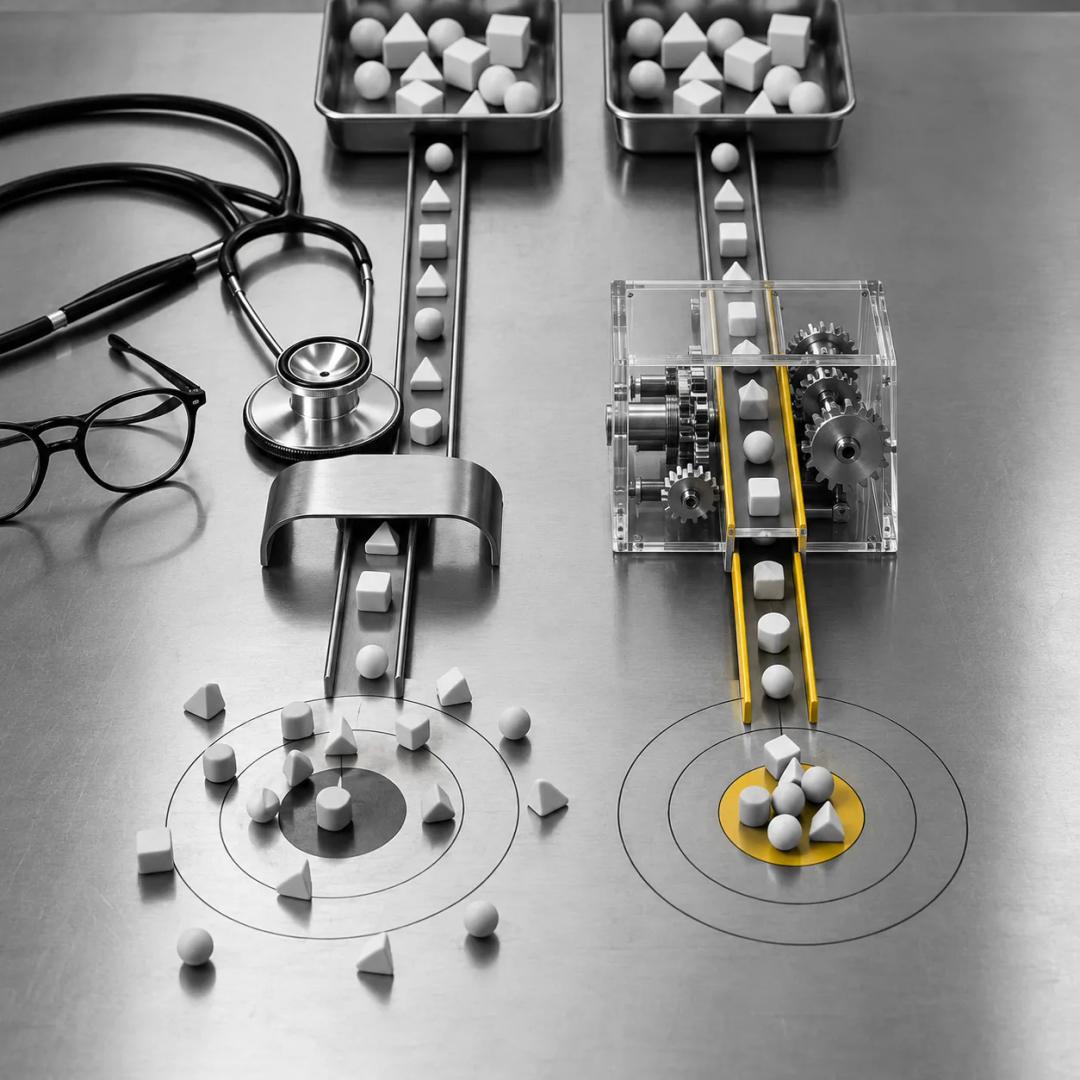
Clinical versus mechanical prediction is the long-running comparison between two ways of reaching a forecast from the same information. In the clinical way, a trained professional weighs the evidence in their head. In the mechanical way, a rule combines it by formula. Across decades of studies, the rule has matched or beaten the professional far more often than it has lost. The authors of Noise, Daniel Kahneman, Olivier Sibony and Cass Sunstein, argue that the main reason is consistency, not cleverness: a rule returns the same answer to the same case every time.
What it is
Every study in this tradition has the same four parts. There is a set of predictors, such as test scores, interview ratings or medical measurements. There is a target outcome that is later observed, such as job performance, a diagnosis or a grade. Professionals make predictions from the predictors. A rule, built from the same predictors, makes its own. The two are then compared on how well each tracked the outcome.
The tradition begins with a 1954 review by a psychologist who was himself a practising psychoanalyst. He examined twenty studies on questions such as academic success and psychiatric prognosis and concluded that simple mechanical rules were generally the better forecasters. The finding was uncomfortable, because combining information is what professional expertise is supposed to be for.
The authors report a later meta-analysis of 136 studies, covering questions as varied as the diagnosis of jaundice, fitness for military service and the satisfaction of marriages. Mechanical prediction was more accurate in 63 of them, the two were statistically tied in 65, and the professionals won in 8. In many of the studies the human judges had an advantage, because they held private information that was never given to the formula. Broken down by measure, across 93 studies of binary decisions the median hit rate was 68 per cent for clinicians against 73 per cent for formulas, and across 35 studies reporting correlations the median was .32 for clinicians against .56 for formulas.
In effect
The explanation in Noise rests on a distinction between bias and noise. A rule is not smarter than a professional who knows the field. What it lacks is the professional's arbitrary variation: the mood of the day, the order in which cases arrive, the particular reaction to one candidate. The authors describe a decisive demonstration of this. A statistical model can be built not of the world but of a single judge, using the judge's own past decisions as the target. In the work they describe, the average correlation between such a model and the judge it copied was .80, so the model is a faithful replica. Yet the model predicted real outcomes better than the judge did. In one replication, 98 participants predicted the grades of 90 students from ten cues, and for every one of the 98, the model of the participant outperformed the participant.
The authors give the arithmetic. If a person's forecasts correlate .50 with the outcome and half of the variance in those forecasts is noise, then removing the noise lifts the correlation to about .71. The model keeps the judge's consistent rules, including the valid ones, and drops the pattern of arbitrary reactions that cannot be replicated even by the judge.
The rule does not need to be sophisticated. A paper from 1974 proposed giving every predictor the same weight. In a test on the first-year grades of 90 graduate psychology students at one university, using ten variables, a fitted regression correlated .69 with the outcome in the sample it was built on, but only .57 when tested on new cases. Equal weights correlated .60. The practical point is that choosing the right variables matters more than weighting them precisely. In a study of 847 executive candidates assessed by consulting experts, ten thousand sets of random weights were tried on the experts' seven ratings. In one sample 77 per cent of the random rules beat the experts, and in the other two samples all of them did. The experts were poor in absolute terms, with a correlation of .15, and the authors take care to say that this does not show any model beats any human.
Short rules also work. A bail rule that used only a defendant's age and the number of missed court dates performed as well as statistical models with far more variables, and a two-input tool matched the validity of an existing tool that uses 137 variables.
What it does not say
It does not say that algorithms are accurate in absolute terms. The authors stress that in many fields the world is not predictable enough for anyone to do well, a condition they call objective ignorance. A formula that beats human judges can still be a poor forecaster, and the gap between the two is often small in practical terms.
It does not say that people will use the formula. The comparison has been replicated for seven decades with little change in everyday practice. The authors offer an account of why: a judge works towards a feeling that the evidence fits together, that feeling stands in for confidence in being right, and a formula cannot supply it. Studies of how people respond to algorithmic advice, such as the work on algorithm aversion and algorithm appreciation, show that trust depends on what people have seen the algorithm do, not only on its record.
It does not licence overriding a formula whenever a case feels different. The authors endorse an old test, the broken leg: a person may depart from the model when they hold decisive information the model could not have, and should not depart merely because they disagree. A model trained on past data can also repeat patterns in that data, which is the concern behind algorithmic bias, and the authors treat fairness as a live objection to mechanical prediction, not a settled matter. The practical conclusion they draw is a discipline of judgment, set out under decision hygiene, because wherever algorithms fall short of perfect, people will continue to make the decisions.
Sources
- Kahneman, D., Sibony, O., & Sunstein, C. R. (2021). Noise: A Flaw in Human Judgment.
- Logg, J. M., Minson, J. A., & Moore, D. A. (2019). "Algorithm appreciation: people prefer algorithmic to human judgment." Organizational Behavior and Human Decision Processes, 151, 90-103. doi:10.1016/j.obhdp.2018.12.005.
- Dietvorst, B. J., Simmons, J. P., & Massey, C. (2015). "Algorithm aversion: people erroneously avoid algorithms after seeing them err." Journal of Experimental Psychology: General, 144(1), 114-126. doi:10.1037/xge0000033.