Coactivation of Feelings
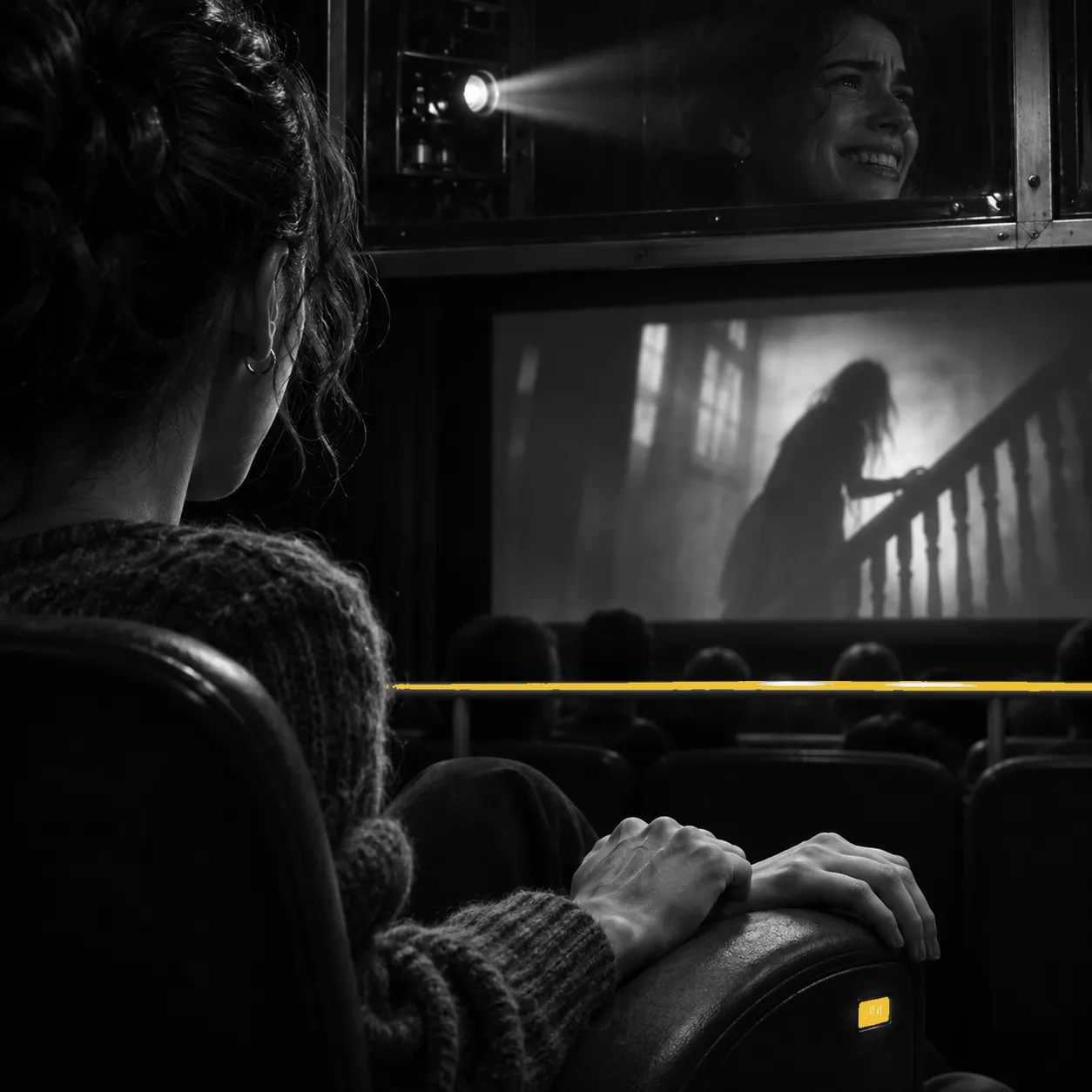
Coactivation of feelings is the presence of positive and negative feelings at the same time. Eduardo Andrade and Joel Cohen used the idea, together with a protective frame, in four studies of horror movie viewers (2007).
What it is
The common picture of emotion treats good and bad feelings as two ends of one scale, so that more of one means less of the other. Coactivation proposes that a person can feel both at once. A viewer watching a horror film may feel dread and delight together, and the second need not cancel the first.
Andrade and Cohen argued that coactivation, combined with a protective frame, accounts for horror consumption more economically than other explanations. They compared people who tend to approach or avoid horror movies and asked about their feelings before or after watching.
In effect
In the article on why we enjoy horror films, coactivation explains how fear and enjoyment can coexist in one sitting. The viewer is not tolerating the fear to reach the fun; the two arrive together.
What it does not say
It does not say that the mixed state is always pleasant, and it does not say how long it lasts. It also does not describe all mixed emotions, only those studied in the context of horror movies.
Where it comes from
The term is used in research on mixed emotions, the question of whether positive and negative feelings can be present together. Andrade and Cohen applied it to horror in a 2007 paper in the Journal of Consumer Research, volume 34, issue 3. They argued that coactivation of positive and negative feelings, combined with a protective frame, is a more parsimonious account of why people consume horror films than competing explanations. A protective frame is a sense of detachment, the knowledge that the threat is not real and cannot reach the viewer.
What the research found
The 2007 paper reports four studies in which consumers with approach or avoidance tendencies toward horror movies reported their feelings before or after watching one. The paper gives no figures here, and this site holds the claim at that level.
Two later studies add detail on how fear and enjoyment relate. Andersen, Schjoedt, Price, Rosas, Scrivner and Clasen, in Psychological Science in 2020, studied 110 visitors aged 12 to 57 at a haunted attraction, with heart rate monitoring, video of scare points and repeated self-reports. Enjoyment followed an inverted U against fear: it rose with fear up to a point and then fell. Feeling frightened tracked large-scale changes in heart rate in a straight line, and enjoyment followed an inverted U with small-scale fluctuations. The authors suggest the pattern reflects arousal that is just right.
Clasen, Andersen and Schjoedt, in Poetics in 2019, asked haunted house visitors to maximise or minimise their fear. Both groups used strategies that worked before the scare and in response to it, whether cognitive, behavioural or social. The thrill-seekers also used some heightening strategies and reported stronger fear, while enjoyment was similar across the groups. This is the management of fear that the article describes under fear dose management.
Where opinion differs
Researchers differ on how to explain enjoyment of fear. Some accounts hold that people tolerate fear to reach relief or a reward after it. Others hold that arousal itself is pleasant within a range. Andrade and Cohen's account places the explanation in the simultaneous presence of both feelings, made possible by detachment. The inverted U finding fits an arousal explanation as well as a coactivation one, and the studies read here do not set the accounts against each other directly. This site presents them side by side.
How this site uses it
The Why We Project uses coactivation of feelings in the article Why We Enjoy Horror Films to explain how fear and enjoyment arrive together. It is read alongside fear dose management and the protective frame.
Sources
- Andrade, E. B., & Cohen, J. B. (2007). Journal of Consumer Research, 34(3), 283-300.
- Andersen, Schjoedt, Price, Rosas, Scrivner and Clasen (2020). Psychological Science, 31(12), 1497-1510.
- Clasen, Andersen and Schjoedt (2019). Poetics, 73, 61-71.