Cognitive Offloading
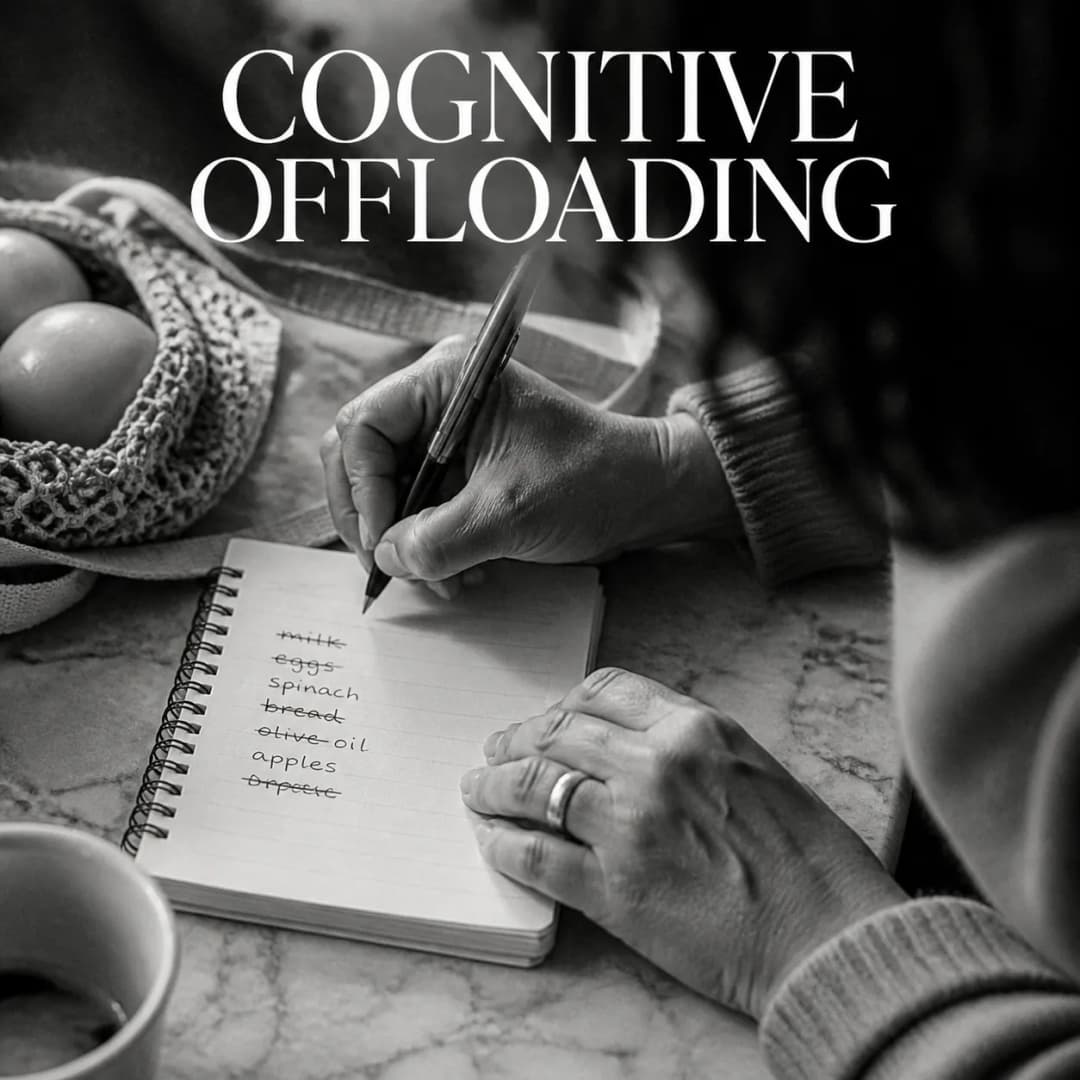
Cognitive offloading is using the world, or a device, to hold information so that the brain does not have to. Writing a shopping list, photographing a whiteboard, or trusting that a fact will still be searchable tomorrow. The behaviour is real, ordinary and very old. What keeps collapsing is the striking single-study evidence for its costs: the flagship demonstration failed replication twice, and the smartphone brain-drain finding did not survive meta-analysis. A 2024 meta-analytic review does find a genuine offloading effect, smaller and much more dependent on context.
What it is
The practice is older than the label by several thousand years. A tally mark offloads a count. An alphabet offloads a story that would otherwise have to be memorised and performed. A shopping list offloads a set of intentions so that the intentions do not have to be rehearsed on the way to the shop. In each case the information is placed in the environment, and the mental work shifts from holding the content to remembering where the content is and trusting that it will still be there. Evan Risko and Sam Gilbert are generally credited with popularising the modern term in 2016, and the vault holds that attribution with moderate rather than high confidence, which is worth stating on a page whose whole subject is the gap between a claim and its evidence.
What makes the concept contentious is not the behaviour. It is the assumption that usually travels with it, that offloading is a subtraction, and that something is being lost from the person in proportion to what is being handed to the device. That assumption has produced two of the most quoted findings in popular writing about the internet, and both of them are now in trouble.
The first is the Google effect, from Sparrow, Liu and Wegner's 2011 study in Science, in which participants told their typed facts would be saved recalled those facts markedly worse than participants told the facts would be erased. It failed a high-powered preregistered replication by Camerer and colleagues in 2018, at p = .26 in the first round and p = .45 pooled. It failed again in 2020, in a design built around the original author's own published suggestions about how it ought to be retested. Sparrow set out in 2018 what a fair retest would need to look like, so the question is open, and the finding cannot be cited as established.
The second is Adrian Ward's 2017 brain drain result, which reported that the mere presence of a person's own smartphone reduces available cognitive capacity, with participants performing worst when the phone was visible on the desk and best when it was in another room. A four-level meta-analysis of 166 effect sizes across 53 samples, with 4,368 participants, returns d = -0.02, with a confidence interval from -0.06 to 0.01. There is a significant effect for working memory specifically and nothing in any other domain. Böttger, Poschik and Zierer, publishing in Behavioral Sciences in 2023, likewise find little support. The detail that makes this one instructive rather than merely disappointing is that Nicholas Carr added the brain drain study to the 2020 afterword of The Shallows as new evidence that he had been right, and it then collapsed.
What survives is quieter and more useful. A 2024 meta-analytic review finds a real cognitive offloading effect, smaller than the 2011 demonstration and much more dependent on context. And Linda Henkel's photo-taking impairment effect, published in Psychological Science in 2014, is the better-behaved cousin of the whole family, mostly because of what it found in its control condition.
Henkel took undergraduates on a museum tour. They photographed some objects and only looked at others. The next day they remembered fewer details of the objects they had photographed. That result on its own would have been another quotable line about cameras eating memory. The control condition is what makes the study good: when participants zoomed in on a detail of an object rather than snapping the whole thing, the impairment vanished. So the effect is not about cameras. It is about divided attention during the act of looking, and Henkel says so. Carr keeps that nuance in The Shallows rather than dropping it, which is a point in his favour.
The question none of this literature has answered is whether offloading is a loss at all. Writing is offloading. So is the alphabet, the map, the ledger and the index. A capacity that is handed to a tool is not automatically a capacity destroyed, and the burden of showing otherwise sits with whoever is claiming a cost.