Collective Effervescence
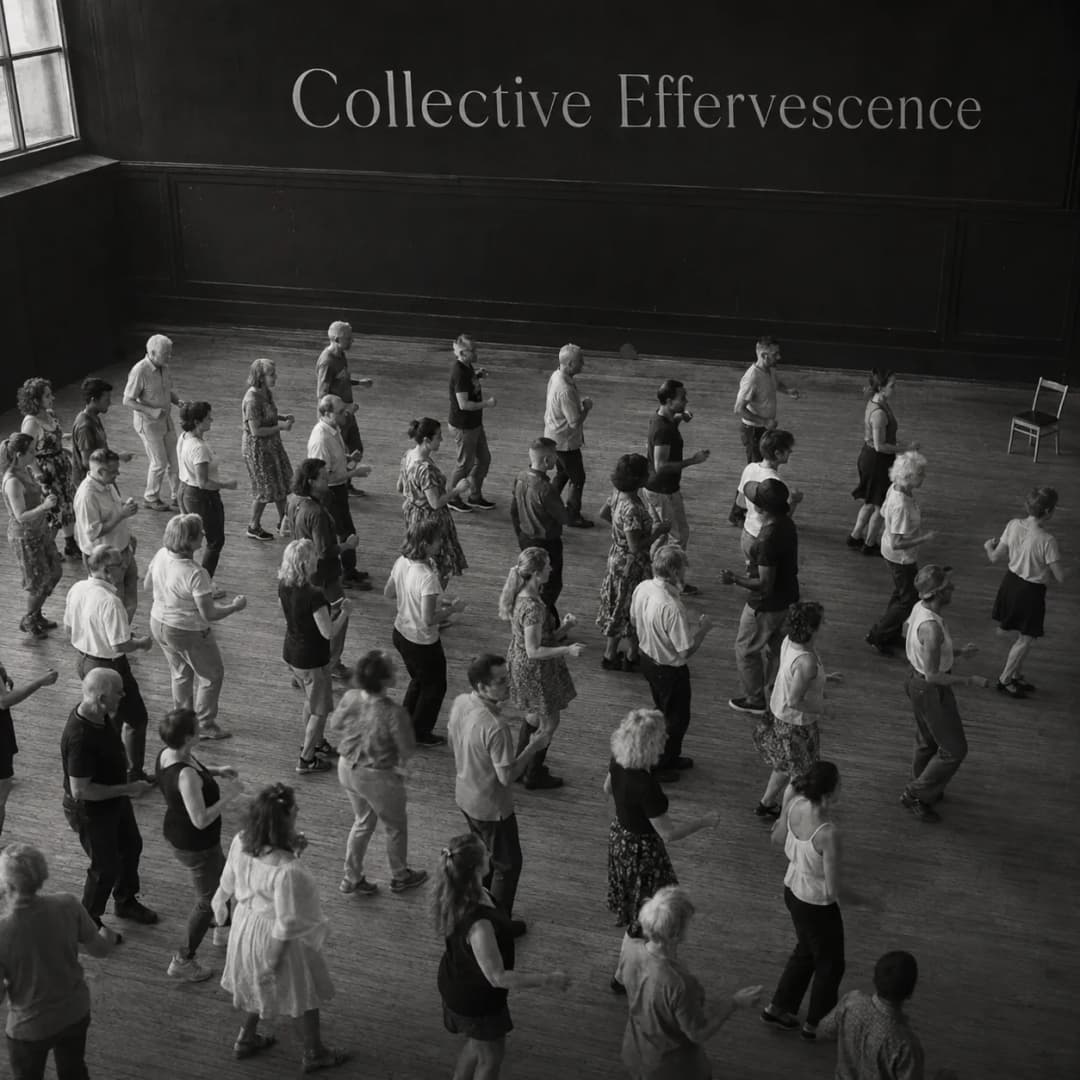
Collective effervescence is Emile Durkheim's name, from The Elementary Forms of Religious Life (1912), for the heightened state a group enters when it focuses on the same thing together, in physical proximity, with shared rhythm. Durkheim's argument is that this state, rather than belief, is what produces the sacred. It is a sociological thesis from 1912 and not a tested finding, and the one modern experiment that bears on its cognitive half came back null.
What it is
Durkheim's question in 1912 was where religion comes from, and his answer was not doctrine. It was assembly. When a group gathers, focuses on the same object or act, moves or chants or breathes in something close to time, something happens to the people in the room that does not happen to them individually. He called it effervescence: the felt sense of being more than oneself, of a force present in the gathering that is not attributable to anyone in it. His claim is that societies encounter their own collective power in these moments, misrecognise it as something external and sacred, and build religion on the misrecognition.
Whether or not the theory of religion holds, the description of the state has outlived it. Three ingredients recur wherever the term is used: synchrony of movement, sound or breath; attention focused on the same thing at the same time; and a shared story about why the room exists. A stadium chant has all three. So does a congregation singing, a political rally, a festival crowd, and several thousand runners packed into the same start corral waiting for the same gun.
That range is exactly what makes the concept useful and exactly what makes it slippery. It is a name for a state people recognise immediately from their own experience, which means it is very easy to apply and very hard to be wrong with. Durkheim measured nothing. He was writing sociology in 1912, from ethnographic material, in a tradition that did not run experiments, and treating his account as though it had the standing of a finding is a category error this page is trying not to make.
The cognitive claim usually placed underneath it is a different and more testable thing: that attending to something together produces a different result in each person than attending to it separately. That is joint attention, and its best objective test in adults, by Noam Mairon and colleagues in 2020, found no amplifying effect of shared attention on attention or memory, with Bayes factors between 0.13 and 0.64 supporting the null. The one solid social effect ran the other way: co-presence made people worse at the task, at d = 1.04.
That result does not refute Durkheim, and it is important to say why rather than to let the null do more work than it can. Mairon and colleagues never measured subjective feeling. Nobody was asked how anything felt, and the amplification literature they were testing against, Garriy Shteynberg's, concerns self-reported emotion under mediated co-presence. Effervescence is a claim about feeling. The study is a claim about performance. The door is open on the first and closed on the second, and the honest reading is that the felt state Durkheim named has not been tested rather than that it has been supported.
The vault's own attribution here needed fixing, and it is worth saying so in the open. Concepts/Collective Effervescence.md carried originator: Tim Wu in its frontmatter, with no year and high confidence, until 2 September 2026, while the body of the same note had said Durkheim all along. That is one of 72 notes in this vault found carrying the same signature: the author of the book a concept was extracted from, credited for the concept.
In effect
Research: the closest thing to a test, and what it could not reach
The Mairon study is the nearest anyone has come to putting a measuring instrument on the mechanism. Forty-two University of California, Berkeley undergraduates, in pairs, at opposite sides of a table, each about 90 centimetres from a shared screen, silently counting images of flowers for around ten minutes, measured behaviourally and with EEG.
Two people counting flowers in silence is not a congregation, and the authors do not claim it is. What the design does establish is that the cognitive version of the claim, the one that says shared attention sharpens attention or memory, does not hold in the setting where it is easiest to detect. What it cannot establish is anything about the state Durkheim was describing, because the study never asked. Anyone citing effervescence as though it had experimental backing is citing something that does not exist yet.
Everyday life: the corral, the terrace, the congregation
The state is recognisable without any theory attached to it. Several thousand runners pinned into the same start pen before a marathon. A terrace singing the same thing at the same moment. A room of people standing up together because the music changed. People describe these afterwards in language that is oddly consistent and oddly non-specific, which is characteristic of the thing being described and also the reason it resists measurement.
The everyday observation this vault takes from it is that shared experience bonds people faster than sustained remote contact does, and that retreats and events produce friendships that message threads do not. That is an observation about how people report their own relationships. It is not a finding, and nothing on this page tests it.
Commerce: the state as a product with a price
The clearest modern use of the concept is commercial, and it is the one this site wrote an article about. If effervescence is what a gathering produces, and gatherings are the scarce version of a thing that used to be given away on television for free, then effervescence is what a ticket buys. Priced simultaneity is the argument that this is what happened.
The figures behind it are trade and company reporting rather than research, and are labelled as such: Pollstar's 2025 year-end analysis found stadium tickets up 18.3 per cent to an average of $216.13 and the average stadium gross up 19 per cent on 2024, while grosses and ticket volumes overall fell. Sphere Entertainment reported $379 million from 1.7 million tickets at Sphere Las Vegas in 2025, in a building whose entire proposition is that you had to be inside it. Fewer people, paying more, for the events where the room is largest. That is a market behaving as though Durkheim were right. It is not evidence that he was.
What it does not say
It is not a research finding, and 1912 is not a citation for a mechanism. Durkheim was writing sociological theory from ethnographic material. He ran no experiment, defined no measure, and made no prediction that could fail. The vault records the note as unreviewed, which is accurate.
It has not been tested, and the study that touches it does not support it. The nearest experiment found no cognitive amplification from shared attention and a significant decrement in accuracy. It did not measure feeling, which is the dimension effervescence lives in, so the correct summary is that the claim is untested rather than that it is confirmed.
It does not transfer to mediated co-presence without an argument. Durkheim's account specifies physical proximity and shared rhythm. A broadcast has neither. Whether 137.8 million people watching the same thing in separate rooms produce anything Durkheim would recognise is an open question that this page cannot answer, and it is the same extrapolation problem, across roughly four orders of magnitude, that keeps joint attention at mixed.
It does not say that gatherings are good. The same mechanism is what a rally runs on, and crowd psychology in the Le Bon tradition describes the identical fact with the sign reversed: critical distance falling, responsibility diffusing, suggestibility rising. Durkheim's register is warmer than Le Bon's and they are describing overlapping territory. Neither register is evidence for the other.
A recognisable description is not a mechanism. Almost everyone can supply an example of effervescence from their own life, which feels like confirmation and is not. A concept that fits every case is a concept that predicts nothing, and this one is close enough to that condition to be handled carefully in anything published.
Who developed it
Emile Durkheim, in Les Formes élémentaires de la vie religieuse (1912), published in English as The Elementary Forms of Religious Life. The term and the argument are his. Tim Wu is where this vault met the idea, in The Attention Merchants, and until 2 September 2026 the vault's frontmatter credited him with it, which is the error the site's originator sweep exists to catch.
Sources
- Durkheim, E. (1912). The Elementary Forms of Religious Life. The originating text for both the term and the argument that assembly produces the sacred.
- Mairon, N., Nahum, M., Stolk, A., Knight, R. T. & Perry, A. (2020). "Behavioral and EEG Measures Show no Amplifying Effects of Shared Attention on Attention or Memory." Scientific Reports, 10, 8458. N = 42, pairs at a shared screen, silent flower-counting. No amplifying effect on attention or memory, Bayes factors 0.13 to 0.64; accuracy 94.35 per cent alone against 86.25 per cent shared, d = 1.04. Subjective feeling was not measured.
- Wu, T. (2016). The Attention Merchants. Knopf. Prime time as "a massive ritual of collective attention", pp. 91-94; joint attention, p. 115. Wu is where this vault met the concept, not its origin.
- Pollstar (2025). Year-end business analysis: stadium tickets up 18.3 per cent to an average of $216.13; average stadium gross $7.11 million a show, up 19 per cent on 2024, while grosses and ticket sales fell. Trade analysis, not research.
- Sphere Entertainment Co. (2026). Full-year 2025 results: $379 million from 1.7 million tickets at Sphere Las Vegas. Company reporting.
- Resources/Projects/Originator Sweep, 2026-09-02, for the attribution correction and the pattern it belongs to.
- Where this came from
- 3 books in this library carry this concept, which is corroboration worth knowing about, though these authors read each other and often draw on the same experiments, so it is not independent confirmation.