Colour-Appetite Claim
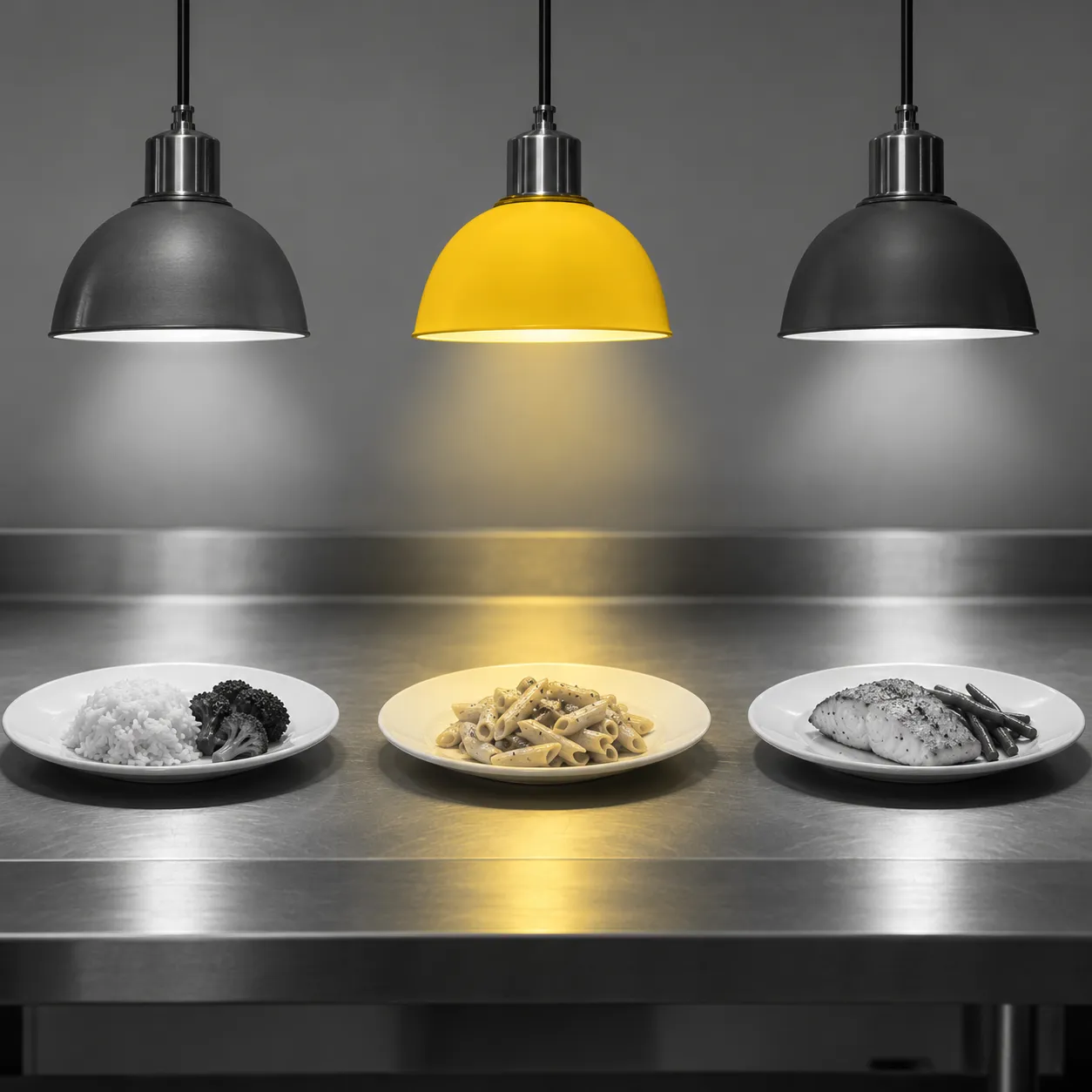
The colour-appetite claim is the popular belief that particular hues raise or lower appetite: red and yellow make people hungry, blue puts them off. It is usually offered as the reason fast-food chains look the way they do. The experiments that come nearest to it used red, blue and tinted food pictures, and their results are mixed. Nothing read for this page shows yellow raising hunger.
What it is
The claim has two parts that are often run together. The first is that a colour acts directly on appetite, so that a person looking at it, or sitting in light of that colour, wants more food or eats more. The second, which is much better supported, is that colour shapes what people expect food to taste like. Charles Spence's 2015 review in Flavour puts the second part strongly: colour is probably the most influential product-intrinsic cue for predicting how food and drink will taste, and a mismatch between colour and taste can produce a negative reaction. That is a claim about prediction, and it says nothing on its own about how hungry anyone is.
The first part is the colour-appetite claim proper, and it has no single origin that this site has traced. Its usual form is a sentence about red and yellow in restaurant signage. The originator field for the concept is left empty on purpose.
The claim also has a vocabulary problem. A name such as "yellow" covers colours that differ in lightness and saturation, and Karen Schloss, Christoph Witzel and colleagues showed in 2020 that effects ascribed to a hue often follow those two properties instead. Their paper concerned blue and sadness, not food, but the point carries: a claim that names a hue and no shade cannot be checked against a stimulus. Yellow is the case where the caveat bites hardest, because the authors note that yellows alone can be both light and saturated.
In effect
What the experiments found, in the order this site read them.
Graz, 2020. Carina Schlintl and Anne Schienle ran two experiments with 448 women aged 18 to 35. In the first, 217 women rated sweet food pictures shown in their original colours and tinted red, blue, or black and white; in the second, 231 women saw the food on white, red, blue or grey backgrounds. The rating was how much they wanted to eat the food right now, on a 7-point scale. Half of each sample was told beforehand that red increases appetite and blue suppresses it. All the coloured food images were wanted less than the originals. The red suggestion did not change ratings of red food, the suggestion lowered wanting further for blue and for black-and-white food, and coloured backgrounds had no effect. The authors concluded that red and blue did not have the predicted opposite effects. Yellow was not tested.
Red and intake. Oliver Genschow, Leonie Reutner and Michaela Wänke published a 2012 paper in Appetite titled "The color red reduces snack food and soft drink intake". Its abstract reports two studies: participants drank less from a red labelled cup than from a blue one, and ate less snack food from a red plate than from a blue or white plate. The authors read red as a subtle stop signal that works outside focused awareness. Reutner, Genschow and Wänke followed it in 2015 with a study in which red lowered the intake of unhealthy food more than healthier food, which they read as an adaptive response rather than a general one.
Blue and light. Sungeun Cho, Han-Seok Seo and colleagues reported in Appetite in 2015 that blue lighting decreased the amount of food consumed in men, but not in women. The abstract describes 112 participants, 62 men and 50 women, who ate a breakfast of omelettes and mini pancakes under white, yellow or blue lighting. Blue lighting decreased the amount eaten by men compared with the yellow and white conditions, and it lowered the hedonic impression of the food's appearance without lowering willingness to eat. The abstract reports no result that separates yellow from white, and this site has read the abstract, not the full text.
The wider literature. The introduction to the Graz paper describes findings on red raising and blue lowering appetite as inconsistent, and lists earlier studies that did not find the predicted effects. This page has read those only through that summary.
What it does not say
It does not say that yellow has no effect on anyone. The studies read here did not isolate it, which is a statement about the evidence and not about the colour.
It does not say colour is irrelevant to food. Colour reliably shapes expectations of taste, and the Graz result that tinted pictures were wanted less than the originals fits the idea that the colour a food is known to have matters. That is this site's reading, not a finding of the study.
It does not say learned associations explain the claim. Harvey Weingarten's 1983 study showed that sated rats ate when a cue paired with food appeared, and then ate less later, which makes learning a plausible route for any colour effect on hunger. Applied to colour it is an untested hypothesis. See Conditioned Hunger.
It does not generalise from the samples. The Graz participants were women, the outcome was a self-rating of wanting, and a self-rating is not eating. The lighting study found a difference by sex.
It is not a basis for packaging, paint or menu decisions on its own.
Sources
- Schlintl, C., & Schienle, A. (2020). 'Effects of coloring food images on the propensity to eat: a placebo approach with color suggestions.' Frontiers in Psychology, 11, 589826. doi:10.3389/fpsyg.2020.589826. Article text read.
- Genschow, O., Reutner, L., & Wänke, M. (2012). 'The color red reduces snack food and soft drink intake.' Appetite, 58(2), 699-702. doi:10.1016/j.appet.2011.12.023. Abstract read (PubMed 22245725).
- Reutner, L., Genschow, O., & Wänke, M. (2015). 'The adaptive eater: Perceived healthiness moderates the effect of the color red on consumption.' Food Quality and Preference, 44, 172-178. doi:10.1016/j.foodqual.2015.04.016. Abstract read.
- Cho, S., Han, A., Taylor, M. H., Huck, A. C., Mishler, A. M., Mattal, K. L., Barker, C. A., & Seo, H.-S. (2015). 'Blue lighting decreases the amount of food consumed in men, but not in women.' Appetite, 85, 111-117. doi:10.1016/j.appet.2014.11.020. Abstract read (PubMed 25447013).
- Spence, C. (2015). 'On the psychological impact of food colour.' Flavour, 4, 21. doi:10.1186/s13411-015-0031-3. Abstract read.
- Schloss, K. B., Witzel, C., & Lai, L. Y. (2020). 'Blue hues don't bring the blues: questioning conventional notions of color-emotion associations.' Journal of the Optical Society of America A, 37(5), 813-824. doi:10.1364/JOSAA.383588.
- Weingarten, H. P. (1983). 'Conditioned cues elicit feeding in sated rats: a role for learning in meal initiation.' Science, 220(4595), 431-433. doi:10.1126/science.6836286.