Colour-Emotion Associations
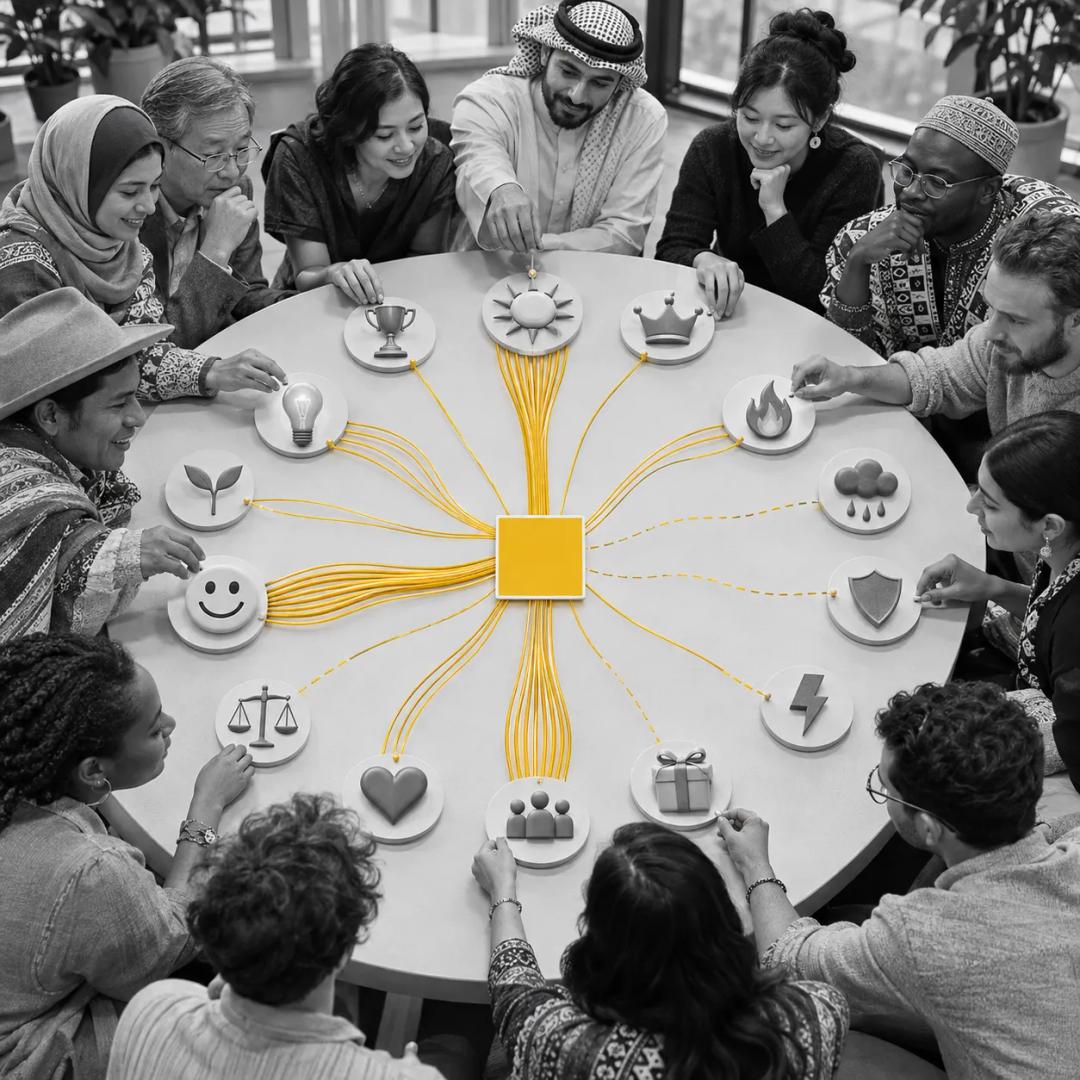
Colour-emotion associations are the learned links between colour terms and feelings, such as a colour being called calm, warm or cheerful. A 2020 study of 4,598 people in 30 nations, speaking 22 native languages, found association patterns that were highly similar across nations and also shaped by language and geography. The concept matters for branding because it is the evidence on whether a colour's meaning travels.
What it is
People readily say that colours feel a certain way. Colour-emotion associations are the pattern behind those statements, measured by asking participants to link emotion concepts to colour terms. Whether the pattern is part of a shared human architecture or is learned within each culture is an old question, and it bears on any brand that wants a colour to mean the same thing in more than one place.
The concept describes an association, not an effect. An association says that people link two things when asked. An effect would say that seeing the colour changes how they feel or act. The two are often confused in popular accounts of colour, and the research summarised here is about the first.
In effect
Domicele Jonauskaite and colleagues tested the associations in 2020. Participants from 30 nations, 4,598 in all and speaking 22 native languages, linked 20 emotion concepts to 12 colour terms. Pattern-similarity analysis found universal associations, with a high average similarity across nations, alongside local differences. A machine-learning algorithm could predict a participant's nation from the associations beyond what the universal patterns explained, and nations that were closer in language or geography were more alike. The authors concluded that robust universal patterns are further shaped by language and geography, and they noted implications for areas such as well-being and design.
For a brand, the practical reading is that a colour meaning that holds in one market is a sound starting assumption for the next, and a testable one. The shared core supports the starting point and the local variation is the reason to test.
The Why We Project article on green color psychology uses the study in this way, as a limit on assuming that green carries one meaning everywhere. The abstract of the study reports no green-specific finding, so the article draws no claim about green from it.
What it does not say
The study measures what people say about colour terms. It does not test whether a colour changes behaviour, and it does not test any brand. It reports patterns across nations in general, not a profile of any single nation or group. Because the abstract is the level of reading behind this page, details such as which colours and emotions showed the strongest links are left to the paper itself.
Sources
- Jonauskaite, D., and colleagues (2020). Universal patterns in color-emotion associations are further shaped by linguistic and geographic proximity. Psychological Science, 31(10). https://doi.org/10.1177/0956797620948810