Consumer Neuroscience
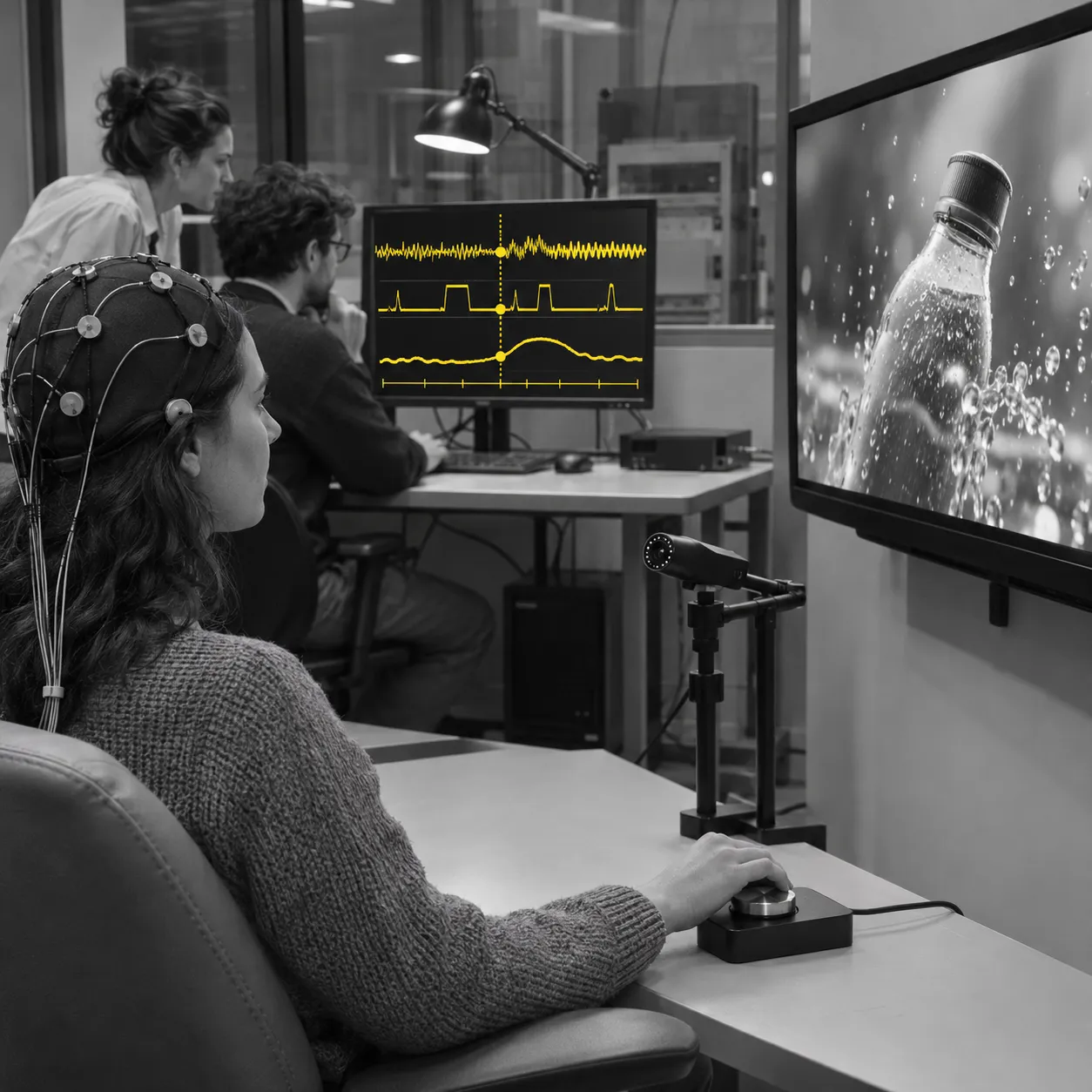
Consumer neuroscience is the academic name for research on the neural processes behind how consumers judge and decide. Hilke Plassmann and colleagues describe its first decade as a period of foundational work, published mostly in neuroscience journals, and argue that the field grows by carrying that basic science into marketing theory and practice. Neuromarketing is the closely related label for applying brain imaging to market research. The two names overlap, and a careful reader asks which sense is meant.
What it is
The label belongs to the research side of a wider conversation about what brain measurement can add to the study of buying. A 2015 paper in the Journal of Marketing Research by Plassmann and colleagues sets out the field's position at the end of its first decade. The authors describe that decade as one of foundational work on the neural processes underlying judgement and decision making. They note that most of it appeared in neuroscience journals rather than marketing ones. They then propose that the field now needs its basic science to extend into marketing theory and practice if it is to grow.
The same paper is organised around three things. It proposes five ways in which neuroscientific methods can be applied to marketing. It identifies three fundamental challenges that consumer neuroscientists face and offers possible solutions to each. It closes by describing how the field can complement marketing research and practice, which is a statement about addition and not replacement. The abstract is the level at which this page reads the paper, so the five applications and the three challenges are not listed here.
The vocabulary has a dated starting point. Ale Smidts gave an inaugural address at Erasmus University Rotterdam on 25 October 2002, on taking up a professorship in marketing research methodology, under a Dutch title that translates as Looking into the Brain: On the Possibilities of Neuromarketing. The Erasmus Research Institute of Management places the birth of the field around 2002 and credits the address with the first definition and the first academic publication on neuromarketing. The address was shortened for publication in the institute's inaugural address series.
A 2007 paper in the International Journal of Psychophysiology adds a second angle. It notes that brain imaging lets neuroscientists track when, where and how rapidly neural activity occurs, and that marketing researchers had largely overlooked this. It describes the application of brain imaging to market research as neuromarketing and records that the practice had caused debate among neuroscientists. Its own proposal was to read neuromarketing more widely than commercial studies of products and advertising, as a view of the marketing discipline as a whole, drawing on general neuroscience and neuroeconomics.
A 2010 review in the Harvard Review of Psychiatry looks at how the word is used. Its authors review the history of neuromarketing and survey company websites, and they report that definitions conflict, that firms offer varied technologies and that many employ academics. The practical reading is that two documents using the same word may describe different things.
In effect
The clearest published illustration of the research in use concerns audiences. A 2014 study in Nature Communications recorded viewers' brain responses to popular television content. The responses were highly consistent across people. The degree of consistency predicted how much viewers in a large sample said they liked or were interested in the shows, and it predicted these ratings more accurately for the larger audience than for the people whose brain data were recorded. A separate fMRI study linked this reliability of response to stronger activity in higher-order visual and auditory regions.
The value of the approach, on this evidence, is timing and scale. A recording follows a response while content is playing, where a questionnaire asks afterwards, and a signal shared across a small group can carry information about a much larger one. The study concerns stated ratings, so what it demonstrates is a relationship between a brain measure and a self-report measure at the level of an audience.
The other piece of working knowledge is a methodological one. A 2006 paper in Trends in Cognitive Sciences showed that reasoning backwards from the activity of a brain region to a mental process is only as reliable as the region's selectivity, meaning how often activity there reflects the process of interest compared with how often the region is active for other tasks. That inference is reverse inference, and consumer neuroscientists work around it with comparison conditions, converging measures and designs that test the decision itself.
Robert Sapolsky gives the same caution a wider setting in Behave. He lists neuromarketing among the neuro-prefixed fields that have multiplied and warns that more elaborate neurobiology does not by itself make a verification more reliable. A brain measure earns its place by what it adds to simpler ways of asking.
What it does not say
It does not say that a scan reads an individual buyer's mind. The audience study above supports claims about groups and about stated ratings, and nothing in it speaks to what one person wants.
It does not say that consumer neuroscience and neuromarketing are the same thing. The 2010 review found that definitions of neuromarketing conflict, and the Plassmann paper uses the academic name for a field defined by its questions. A reader who meets either word should look for the measurement used, the audience it was taken from and the decision it informs.
It does not say that the field is settled. The 2015 paper names three fundamental challenges and possible solutions, which is how a field describes work still in progress.
It does not say that brain measures replace conventional market research. The sources on this page describe the methods as complements to it.
Sources
- Plassmann, H., Venkatraman, V., Huettel, S. A., & Yoon, C. (2015). Consumer neuroscience: Applications, challenges, and possible solutions. Journal of Marketing Research, 52(4). doi:10.1509/jmr.14.0048.
- Smidts, A. (2002). Kijken in het brein: Over de mogelijkheden van neuromarketing. Inaugural address, Erasmus University Rotterdam, ERIM Inaugural Address Series.
- Erasmus Research Institute of Management. The History of Neuromarketing and Neuroeconomics (project page).
- Lee, N., Broderick, A. J., & Chamberlain, L. (2007). What is neuromarketing? A discussion and agenda for future research. International Journal of Psychophysiology, 63(2). doi:10.1016/j.ijpsycho.2006.03.007.
- Fisher, C. E., Chin, L., & Klitzman, R. (2010). Defining neuromarketing: Practices and professional challenges. Harvard Review of Psychiatry, 18(4). doi:10.3109/10673229.2010.496623.
- Dmochowski, J. P., Bezdek, M. A., Abelson, B. P., Johnson, J. S., Schumacher, E. H., & Parra, L. C. (2014). Audience preferences are predicted by temporal reliability of neural processing. Nature Communications, 5, 4567. doi:10.1038/ncomms5567.
- Poldrack, R. A. (2006). Can cognitive processes be inferred from neuroimaging data? Trends in Cognitive Sciences, 10(2). doi:10.1016/j.tics.2005.12.004.
- Sapolsky, R. M. (2017). Behave: The Biology of Humans at Our Best and Worst.