Coordination Loss
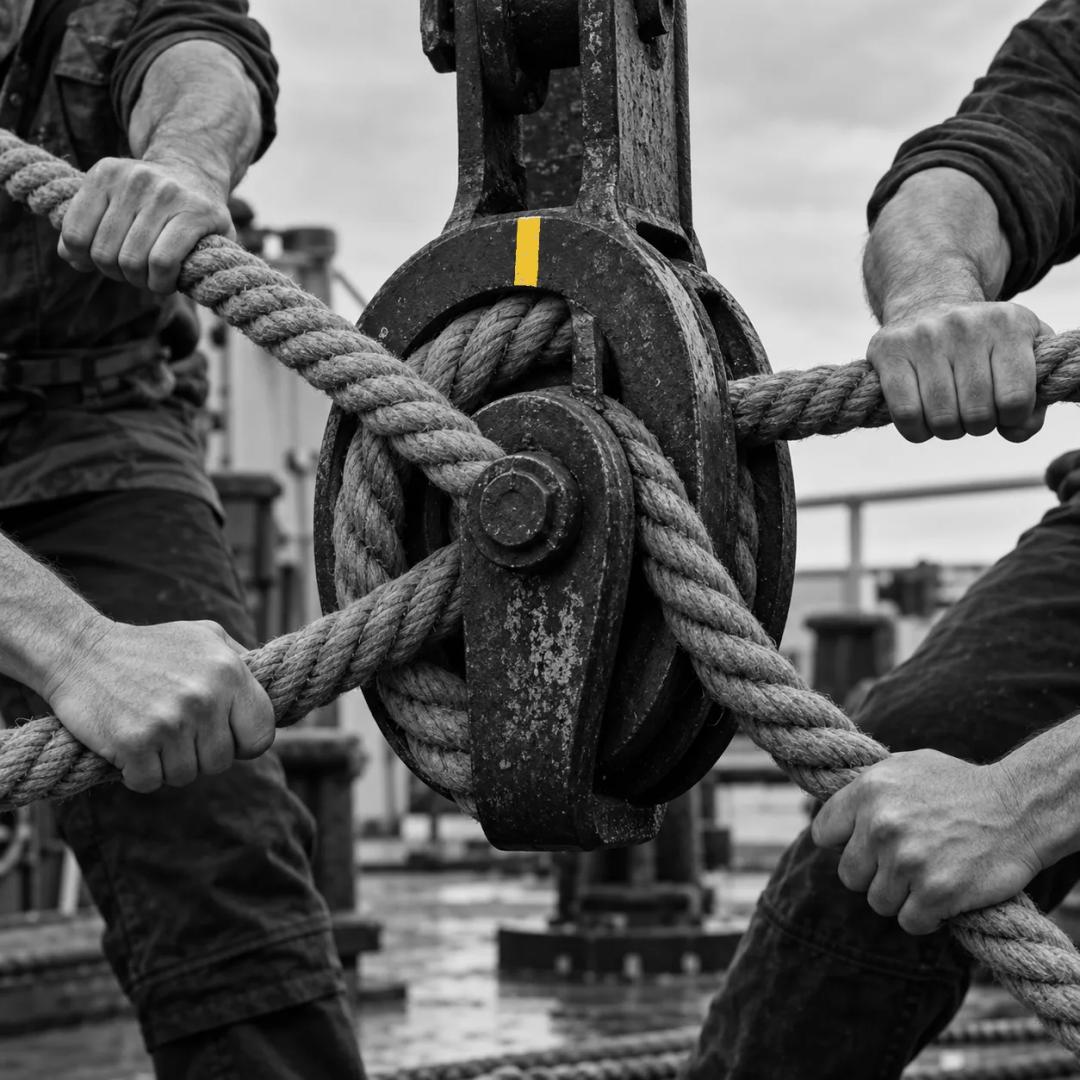
Coordination loss is the part of a group's shortfall that comes from members failing to combine their efforts in time and direction, not from any drop in how hard each of them tries. It was Maximilien Ringelmann's own explanation of his rope-pulling results, and it is one of the two sources of loss in Ivan Steiner's accounting of group productivity. The other source is lowered motivation, which is the part usually called social loafing. Telling the two apart matters because they call for different remedies.
What it is
Ringelmann was a French agricultural engineer at the institute at Grand-Jouan. His experiments ran between about 1882 and 1887 and were not published until 1913. According to David Kravitz and Barbara Martin's 1986 reconstruction, he was interested in how well workers pushed or pulled a load horizontally, depending on the method they used, and the comparison of individuals with groups was a secondary concern. The paper states his reading in one sentence: he interpreted the decrement in group performance in terms of coordination loss. It adds that he was aware of motivational factors as well.
The mechanism is mechanical. People on a rope cannot all pull at the same instant and in the same direction, so the total pull falls short of the sum of what each could pull alone, even when every one of them is trying. Nothing in that account requires anyone to hold back. The loss lives in how the efforts combine, and it would be there in a team of people who were all fully committed.
Ivan Steiner gave the idea its place in a general accounting in Group Process and Productivity (1972). In his formula a group's actual productivity equals its potential productivity minus what is lost to faulty process, and the losses have two sources: poor coordination and lowered motivation. Colin M. Fisher presents the formula of The Collective Edge, which is the seed for this site's article on the subject. The formula does not say how much of any particular shortfall belongs to which source. It names the two places to look.
The rope figures that Fisher reports show why the question is open. On his account a man pulling alone averaged 188 pounds, and a man in a group of seven averaged 143 pounds. That is about three-quarters of the solo effort per head. The arithmetic establishes that the group fell short of its potential. It cannot say whether the men on the rope pulled less hard, pulled out of step, or both, and Fisher's own endnote cautions that the original research basis is murky.
The separation was made by design in 1974. Ingham and colleagues, reporting in the Journal of Experimental Social Psychology, had blindfolded participants pull on a rope. Some pulled alone, and others believed they were pulling in a group although nobody else was pulling. Because no one else was pulling, there was nothing to coordinate with, so the coordination loss was removed by construction. The participants who believed they were in a group still exerted significantly less force, which isolates the motivational share. Later accounts of that literature treat both losses as real. That last statement comes from a reference summary and has not been checked against the paper itself.
In effect
The practical value of the concept is that it keeps a diagnosis from collapsing into a character judgement. When a group delivers less than its members could deliver separately, the first question is whether the work was organised so that their efforts could add up. Who pulls when, who hands work to whom, and whether people can see what the others are doing are all coordination questions, and a coordination loss is repaired by changing how the work is organised.
A motivation loss is repaired by changing what each person has at stake, for instance by making individual contributions visible or by making the outcome one that members care about. The two repairs do not substitute for each other. A manager who treats a coordination problem as a motivation problem is applying the wrong fix, and will see nothing improve however much encouragement is offered.
The concept also explains why the rope story deserves a more careful telling than it usually gets. The finding that is usually attached to Ringelmann's name is that people loaf in groups. The man who took the measurements read his numbers as a problem of coordination and recorded motivational factors as a further consideration. The word loafing came later, from the experiments of Bibb Latané and colleagues in the 1970s, which used cheering tasks and pseudogroups in which participants believed others were working alongside them.
Steiner's vocabulary is the link between the two periods. Because his formula already carried both coordination and motivation as sources of loss, the later experiments could be read as isolating the second term rather than overturning the first. The site's concept page on process losses and process gains sets out that vocabulary, and the page on social loafing covers the motivational term in detail.
What it does not say
It does not say that effort is irrelevant. Ringelmann himself was aware of motivational factors, and the 1974 rope study found a loss of effort when coordination was removed. Both sources are real, and a group can suffer from either or both.
It does not give a size. This site has no verified split of any group's shortfall into coordination and motivation, and the rope figures reported by Fisher are an illustration of a shortfall, not a measurement of its causes. The original basis for those figures is described in Fisher's endnote as murky, and the reconstruction by Kravitz and Martin is the right source for what Ringelmann actually reported.
It is not a finding of the 1974 study. That design is the reason the concept can be separated from motivation, but the claim rests on Steiner's accounting and on Ringelmann's own reading. The statement that coordination counts for more as groups grow is carried here as reported in a reference summary and should be read as provisional until the paper is checked.
It is also an accounting term, not a theory of why groups fail. Steiner's formula tells a reader where to look for lost output. It does not predict how large any loss will be.
Sources
- Kravitz, D. A., & Martin, B. (1986). "Ringelmann rediscovered: The original article." Journal of Personality and Social Psychology, 50(5), 936-941. doi:10.1037/0022-3514.50.5.936. The abstract records that Ringelmann interpreted the decrement mainly as coordination loss and was aware of motivational factors.
- Steiner, I. D. (1972). Group Process and Productivity. New York: Academic Press.
- Ingham, A. G., Levinger, G., Graves, J., & Peckham, V. (1974). "The Ringelmann effect: Studies of group size and group performance." Journal of Experimental Social Psychology, 10(4), 371-384. doi:10.1016/0022-1031(74)90033-X. Described here from a published summary of the design, not from the full paper.
- Fisher, C. M. (2025). The Collective Edge. New York: Avery. Ringelmann, Steiner's formula, and the endnote on the original data.