Craving
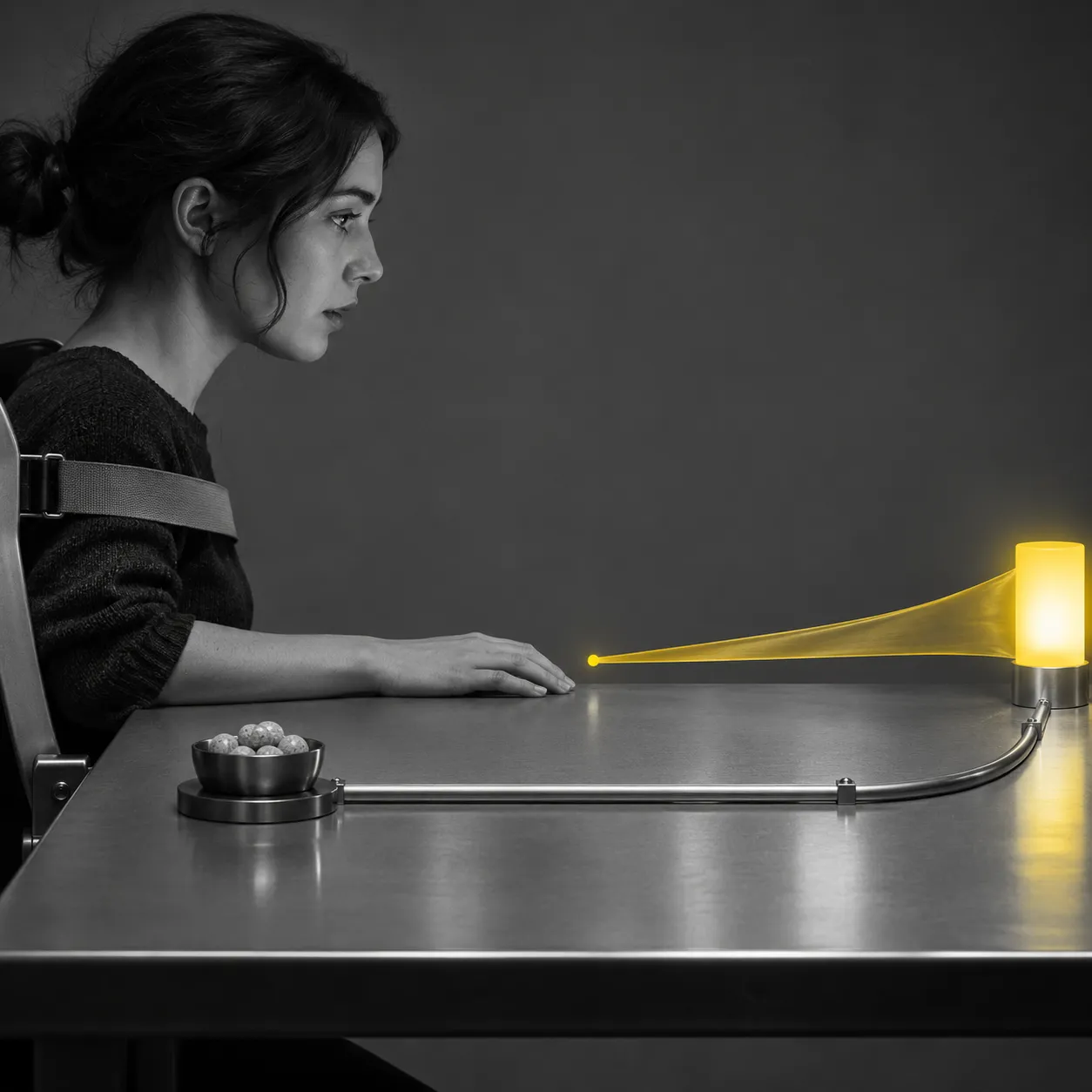
Craving is the step James Clear places between the cue and the response in his four-part habit loop. It is not part of the three-part habit loop that Charles Duhigg defined in 2012, and it does not appear in Wendy Wood's account of habits as context cue, response and reward. Which of these vocabularies a writer uses decides whether the word belongs in a description of a habit at all.
What it is
In Atomic Habits (2018), Clear describes every habit as passing through four stages: a cue, a craving, a response and a reward. The craving is the stage he calls attractive, the pull a person feels once the cue has been noticed and before anything has been done. His practical advice follows the same four stages. To build a habit, make the cue obvious, the craving attractive, the response easy and the reward satisfying. To break one, reverse each.
Duhigg's earlier definition has three parts: a cue, a routine and a reward. The Power of Habit later brings craving into the account and uses it in two ways. It describes craving as something that emerges as the loop repeats, and it describes craving as the force that powers the loop. Duhigg links the idea to research in which the activity of reward-related neurons in a monkey moves, with training, from the reward itself to the cue that predicts it, and he reads that shift as anticipation.
Wood's Good Habits, Bad Habits (2019) uses context cue, response and reward. It has no craving term. Her definition of a mature habit allows for a behaviour that keeps running without the ongoing presence of rewards, so in her account the motivation that built the habit is not what keeps it going.
In effect
In practice the craving step is a way of directing design effort. If craving is a stage, then a product, a routine or a message can be made more attractive at that stage, and a person can be advised to pair a behaviour with something they look forward to. This is the use Clear makes of it, and it is one reason the four-part version is widely taught.
The same step explains why writers disagree about where a habit lives. In a three-part loop the motivation sits in the reward, and the routine is whatever carries a person from cue to reward. In a four-part loop part of the motivation has moved earlier, to the moment after the cue. In Wood's version the cue acts without needing wanting at all, and once the habit has matured the reward may stop mattering to the behaviour.
The experiments described in What is a habit loop? give three views of the other parts. Barnes and colleagues (2005) recorded rats' striatal activity as a maze run became practised. Ji and Wood (2007) found that when habits were strong, stated intentions stopped predicting fast food and bus riding. Tricomi and colleagues (2009) found that adults trained for twelve sessions over three days pressed about as much for a snack they had had enough of as for one they had not. None of the three measured craving.
What it does not say
Craving as a named stage of the habit loop is a model's term, and the page records where each author places it. It does not say that craving has been measured in the studies above, or that the reward-related neural activity Duhigg describes is the same thing as a felt craving.
It also does not say that the three-part and four-part loops are rival findings. They are different descriptions of the same repeated behaviours, built for different purposes: Duhigg's for explaining habits to a general reader, Clear's for building and breaking them, and Wood's for the laboratory study of context and response. Where they differ is in vocabulary and emphasis, and a reader choosing between them can ask which question the description is meant to answer.
Tricomi and colleagues' result shows the limit of any reward-centred account. After heavy practice the behaviour in their task no longer followed the current value of its outcome, while the brain's response to reward delivery remained. A reward can stay signalled in the brain while no longer steering the behaviour.
Sources
- Duhigg, C. (2012). The Power of Habit.
- Clear, J. (2018). Atomic Habits.
- Wood, W. (2019). Good Habits, Bad Habits.
- Tricomi, E., Balleine, B. W., & O'Doherty, J. P. (2009). A specific role for posterior dorsolateral striatum in human habit learning. European Journal of Neuroscience, 29(11), 2225-2232. https://doi.org/10.1111/j.1460-9568.2009.06796.x
- Ji, M. F., & Wood, W. (2007). Purchase and consumption habits: Not necessarily what you intend. Journal of Consumer Psychology, 17(4), 261-276. https://doi.org/10.1016/S1057-7408(07)70037-2
- Barnes, T. D., Kubota, Y., Hu, D., Jin, D. Z., & Graybiel, A. M. (2005). Activity of striatal neurons reflects dynamic encoding and recoding of procedural memories. Nature, 437(7062), 1158-1161. https://doi.org/10.1038/nature04053
In these themes
- Habits and Routines
How behaviour becomes automatic, and how it changes.