Crossmodal Correspondence
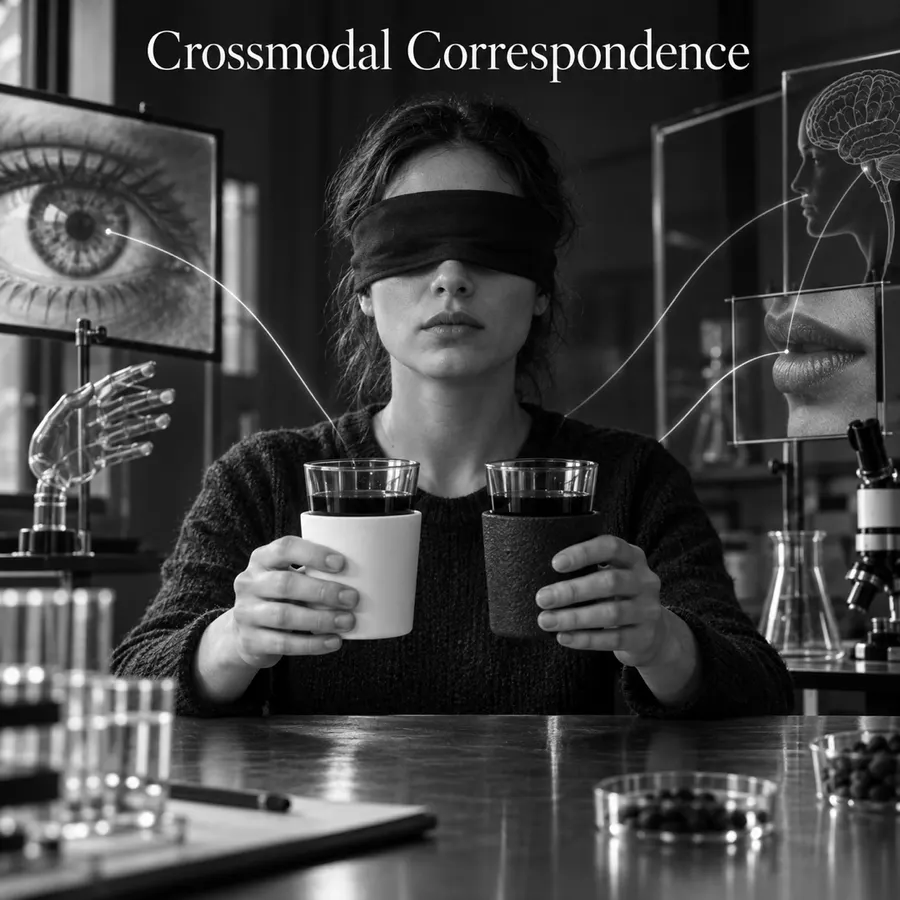
The senses are not filed separately. A colour, a shape or a weight met in one channel reliably sets an expectation in another, which is why what a thing looks like changes what it tastes like.
What it is
The term belongs to Charles Spence, whose laboratory at Oxford has spent two decades on the associations that run between the senses. His summary of the food case is unambiguous: colour is the single most important product-intrinsic sensory cue for setting expectations about how something will taste.
The part that gets dropped in transmission is what happens next. An expectation is not a verdict. Where the colour matches the taste, the expectation carries through into the experience. Where it does not, you get what the papers call a negatively valenced disconfirmation of expectation, which in ordinary language is a perfectly good product that somebody did not enjoy.
In effect
Café latte served from a white mug was rated less sweet than the same coffee from a transparent or blue one. Because the mugs differed slightly in shape, the study was repeated with identical glass mugs wearing coloured sleeves, and the effect held. The likely mechanism is contrast: the mug changes how brown the coffee appears, and how brown it appears feeds into how strong and how sweet it seems.
Cutlery behaves the same way. Yoghurt was rated denser and more expensive from a lighter spoon, and food was rated saltiest when eaten from a knife. The colour of the cutlery moved ratings only in combination with the colour of the food.
What it does not say
It does not say that any colour carries a taste. There is no wavelength that means sweet. What exists is a relationship between how the food looks against its background and what the brain predicts before the first mouthful, which is why the same white mug that suppresses sweetness in coffee will do something else with a pale dessert.
It does not license a rule. Plate colour and shape interact instead of adding up, and the researchers who found that say plainly the influence is not straightforward. Spence's own review adds that food colours mean different things at different ages and in different cultures, and that taster status, partly genetic, changes how strongly a person responds. A universal palette is incompatible with all of it.
Sources
- Spence, C. (2011). Crossmodal correspondences: A tutorial review. Attention, Perception & Psychophysics, 73(4), 971-995. doi:10.3758/s13414-010-0073-7
- Spence, C. (2015). On the psychological impact of food colour. Flavour, 4, 21. doi:10.1186/s13411-015-0031-3
- Van Doorn, G., Wuillemin, D., & Spence, C. (2014). Does the colour of the mug influence the taste of the coffee? Flavour, 3, 10. doi:10.1186/2044-7248-3-10
- Harrar, V., & Spence, C. (2013). The taste of cutlery. Flavour, 2, 21. doi:10.1186/2044-7248-2-21
- Where this came from
- No book in this library is the source of this concept. It entered the vault from Why Your Coffee Tastes Different in a White Cup, built from primary sources rather than from a book.