Crowding Multiplier
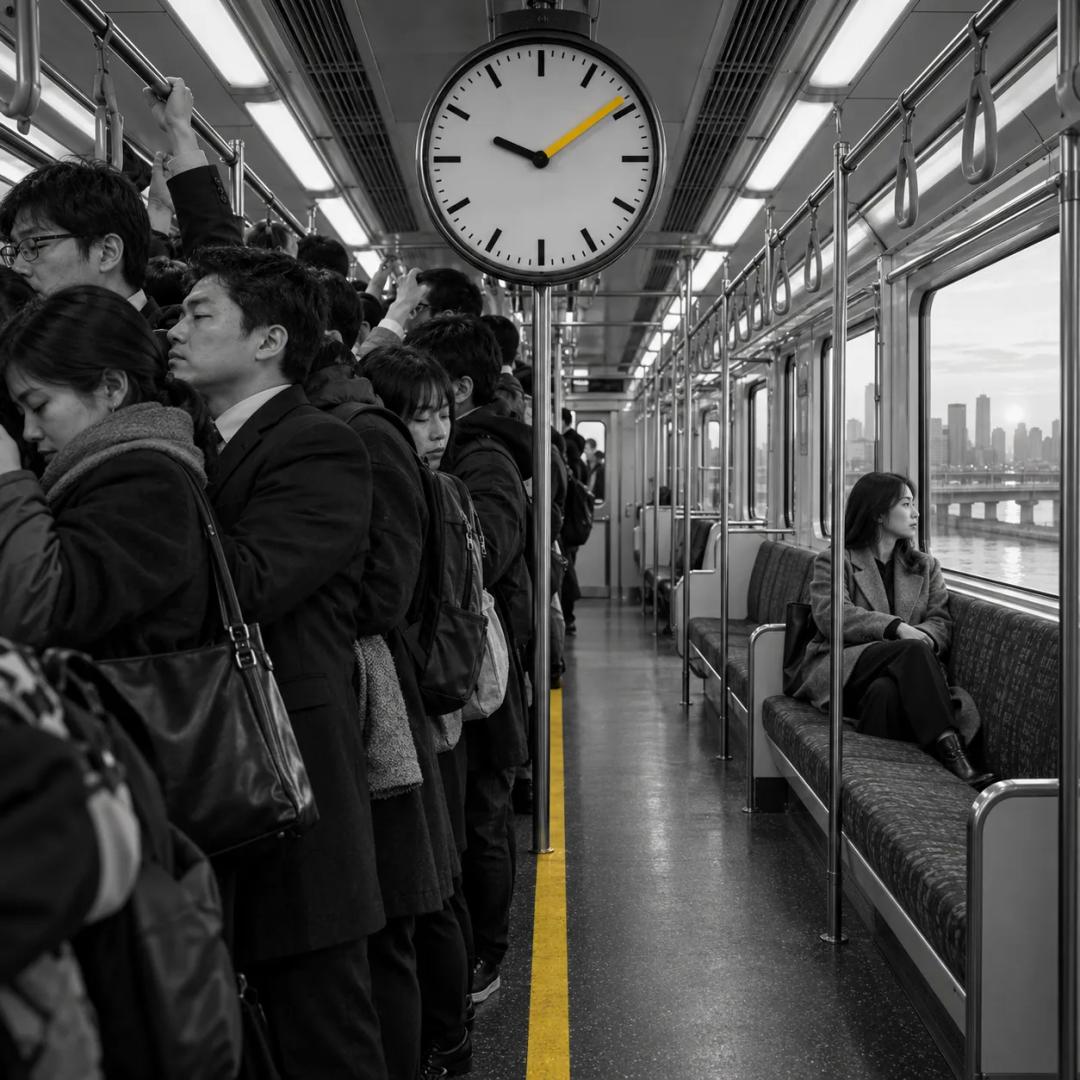
The crowding multiplier is the ratio of the value people place on time spent in crowded conditions to the value they place on the same time uncrowded. A multiplier of two means an hour in those conditions is valued as two hours of the comfortable kind. The best-known British synthesis, by Mark Wardman and Gerard Whelan in 2011, pooled 208 valuations from seventeen studies. It is a measure of how comfort is priced inside transport appraisal, and its pooled averages should be read as averages across studies and conditions and not as the price of standing.
What it is
Transport appraisal needs a money value for travellers' time, because time saved is usually the largest benefit in a business case. Travellers do not value all time equally. An hour on a quiet seat is not the same as an hour standing in a packed carriage. Researchers ask people to choose between journeys that differ in cost, duration and crowding, or observe choices made in practice, and then express the extra burden of crowding as a multiplier on the value of ordinary seated time.
The idea makes comfort and speed commensurable. A comfort improvement is not set against a time saving as a rival paradigm. It enters the same calculation as a reduction in the multiplier, so that making a crowded hour feel like a less crowded hour is worth the same as saving part of it.
In effect
The pooled results are specific. The seating multiplier averaged about 1.19, so an hour seated in a crowded carriage was valued like roughly an hour and a tenth of an uncrowded one. The standing multiplier averaged about 2.32, which means an hour standing in a crowded carriage was valued roughly like two and a third hours seated in an empty one. The authors noted that the standing figure is comparable to the multipliers conventionally applied to walking and waiting time.
These numbers answer a common complaint. If appraisal is said to ignore journey quality, the existence of this literature is part of the reply. A more defensible form of the complaint is that comfort is weighed inside a framework whose benefit side is still dominated by time. A request for a non-linear crowding function, in which the burden rises faster as a carriage fills, is the kind of improvement Wardman and Whelan themselves recommended.
In the article The Psychological Solution First this literature is the evidence that Rory Sutherland's central point, that perceived quality matters and can be improved cheaply, was already priced by the field before his book.
What it does not say
The pooled standing figure of 2.32 is an average across studies and conditions and is not the value of standing. Later work at observed peak densities finds lower numbers, around 1.18 to 1.24, and about 1.55 at three standing passengers per square metre. Any use of the pooled figure should say that it is an average over two decades of evidence.
It does not measure comfort directly. It measures a valuation of time under stated conditions.
It is British rail evidence and does not transfer unexamined to other modes or countries.
It says nothing about whether a comfort improvement is cheaper than a speed improvement. That is a cost question and not a valuation question.
The paper was read at the level of its abstract and bibliographic record. The bibliographic record was checked at OpenAlex.
Where it comes from
Valuations of crowding were produced by many British rail studies over about twenty years. Wardman and Whelan gathered them in a 2011 paper in Transport Reviews: seventeen studies, 208 valuations. They also pointed out that more recent work measures crowding as standing passengers per square metre and not as a load factor, which is a more precise description of what the traveller experiences. The paper belongs to the same research tradition as the British meta-analysis of values of travel time by Pedro Abrantes and Mark Wardman, which pooled 226 studies in 2011.
Where opinion differs
Analysts who favour behavioural, low-cost improvements to journeys read the multiplier as support: if crowding is costly to travellers, relief of crowding has value, and some relief may be obtained through information, seat-reservation signals and layout. Analysts focused on capital schemes point out that the multipliers still support investment that adds capacity, because adding trains reduces crowding directly. The two readings are compatible. The disagreement is about relative cost, which the multiplier does not settle.
How this site uses it
The Why We Project uses the multiplier as the standard example of comfort being priced in time's own currency. It is cited when an argument claims that planners ignore quality, and as a reminder to state whether a figure is an average or a value for a specified condition.
Sources
- Wardman, M., & Whelan, G. (2011). Twenty years of rail crowding valuation studies: Evidence and lessons from British experience. Transport Reviews, 31(3), 379-398. doi:10.1080/01441647.2010.519127. Bibliographic record verified at OpenAlex; abstract read.
- Abrantes, P. A. L., & Wardman, M. R. (2011). Meta-analysis of UK values of travel time: An update. Transportation Research Part A, 45(1), 1-17.
- National Audit Office (2012). The completion and sale of High Speed 1. HC 1834.