Cultivation
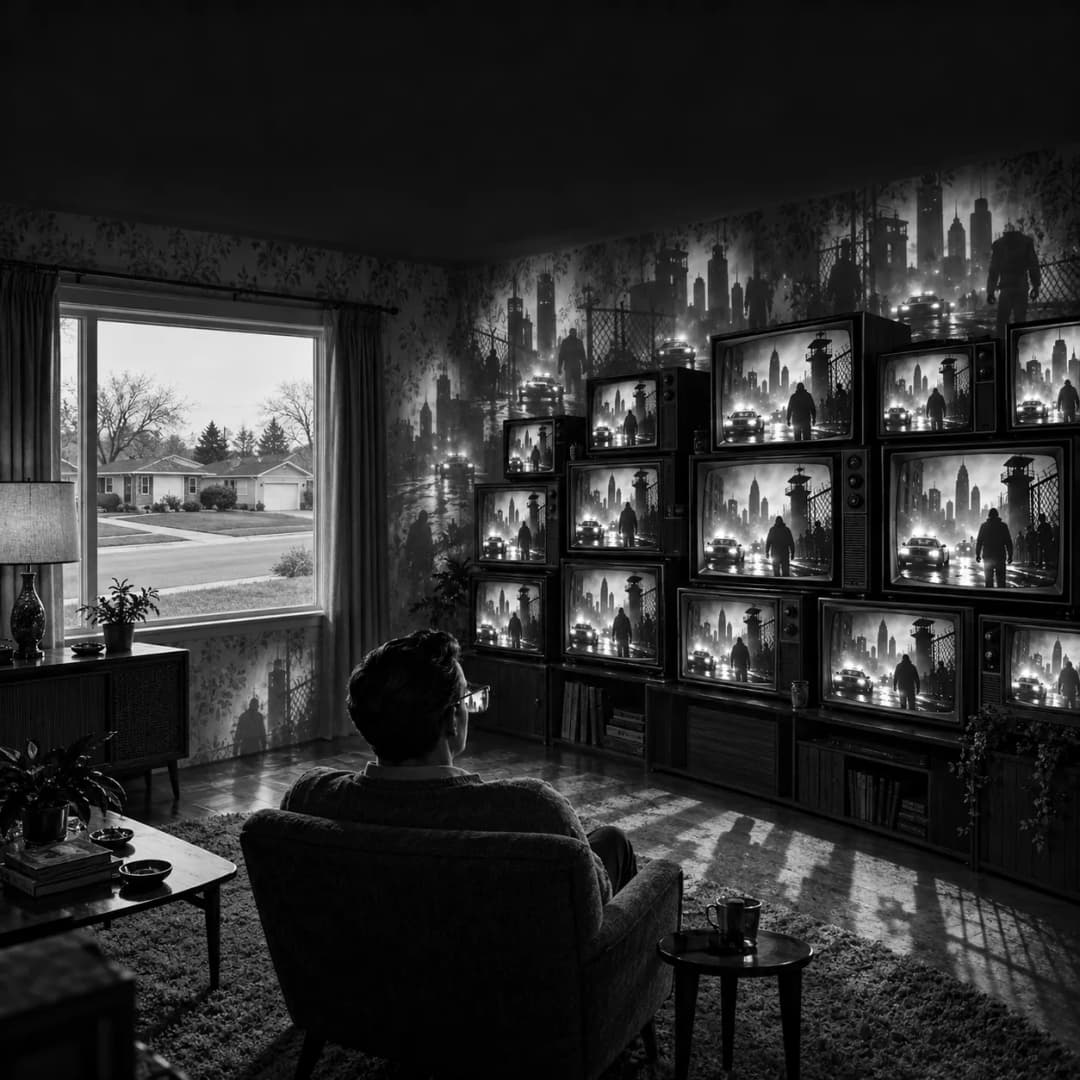
Cultivation is George Gerbner and Larry Gross's claim, published in 1976, that the cumulative volume of television a person watches shifts their beliefs about the world towards what television shows. The pooled estimate across the whole literature, reported by Erik Hermann, Michael Morgan and James Shanahan in 2021, is 0.107 across 3,842 effect sizes and 406 independent samples, a correlation of about one tenth. Those authors do not call that small. They call the relationship enduring, and in the same paper they report that the stronger effect weakens over time. Both halves are theirs and both belong on this page.
What it is
The Cultural Indicators programme George Gerbner ran at the Annenberg School had two halves bolted together, and only the first was a measurement of television: message-system analysis, meaning content coding of prime-time and weekend network drama to produce a Violence Index, and then a cross-sectional survey in which respondents reported how much television they watched and answered questions about the world, with the two correlated. There is no experiment and no manipulation of viewing anywhere in the origin paper, which is a description of the design rather than a hostile reading.
The founding assumption was a shared, repetitive, mainstream diet delivered by a handful of networks, which is why the programme measured total reported hours rather than exposure to particular shows, and when the first reanalyses arrived Gerbner, Larry Gross, Michael Morgan and Nancy Signorielli amended the theory in 1980 by adding mainstreaming and resonance. The phrase mean world syndrome belongs to the programme as its own shorthand for the pattern it claimed to find, and its first printing was not verified for this page, so no paper or year is attached to it here. L. J. Shrum's consumer-psychology work supplies the mechanism the survey work lacked, because on his account television stocks the set of examples available when somebody is asked a question about the world and the error is a failure to discount where those examples came from.
In effect
The pooled number needs saying in two parts rather than one: a correlation of about one tenth is small by any ordinary reading of an effect size, and that reading is this site's rather than the authors'. Their own framing is that effects remain stable over decades, implying an enduring relationship between television's message system and viewers' conceptions of social reality despite immense changes in the institutional structure and technology of television, which they read as support for the traditional perspective, and in the same paper they report that the stronger effect weakens over time, which they say gives at least partial support to the reformist one. Two moderators cut towards the critics, because effects are larger in smaller samples and in data collected by questionnaire than by other methods, and that is the pattern which usually indicates upward bias in a pooled estimate. The 2023 companion analysis of social media reports 0.123 across 460 effect sizes and 66 samples, the same order of magnitude in a medium with no shared schedule at all, and it is also the result that sits least comfortably with the original theory, since its effects are higher for exposure to specific types of content than for general use.
What it does not say
It does not say that television causes beliefs about the world, because nothing in the evidence base manipulated viewing: every exposure measure in the origin papers and in almost all of the pooled studies is self-reported and cross-sectional, so the direction is not identified by the design, and fifty years on the experiment that would settle whether watching makes people fearful or fearful people watch more has not been assembled from the sources available here. It does not say the theory has been refuted either, and the record cuts both ways, because Paul M. Hirsch rejected the hypothesis on reanalysis in 1980, Michael Hughes found the effects largely absent under nine simultaneous controls in the same year, Anthony N. Doob and Glenn E. Macdonald had already shown in 1979 that the correlation reproduces across Toronto neighbourhoods and becomes undetectable within them, and the pooled estimate four decades later is still positive and stable at about one tenth. The pooled figure also cannot be converted into a claim about an individual viewer, since it is an average across hundreds of samples and dozens of outcomes rather than the effect of watching television on any one belief. And nobody has tested the claim under streaming or on-demand viewing, which was searched for and not found, so the honest statement is that the theory's founding condition of a shared and repetitive diet no longer obtains and the test of what that does to the claim has not been run. An older and widely quoted pooled figure from the theory's own camp is unverified at source and is not printed here.
Sources
- Gerbner, G., & Gross, L. (1976). 'Living with Television: The Violence Profile.' Journal of Communication, 26(2), 172-199. doi:10.1111/j.1460-2466.1976.tb01397.x. Bibliographic record verified; no abstract was ever deposited, and three secondary sources give three different page ranges.
- Gerbner, G., Gross, L., Morgan, M., & Signorielli, N. (1980). 'The "Mainstreaming" of America: Violence Profile No. 11.' Journal of Communication, 30(3), 10-29. doi:10.1111/j.1460-2466.1980.tb01987.x.
- Doob, A. N., & Macdonald, G. E. (1979). 'Television viewing and fear of victimization: Is the relationship causal?' Journal of Personality and Social Psychology, 37(2), 170-179. doi:10.1037/0022-3514.37.2.170. Abstract read in full.
- Hirsch, P. M. (1980). 'The "Scary World" of the Nonviewer and Other Anomalies: A Reanalysis of Gerbner et al.'s Findings on Cultivation Analysis, Part I.' Communication Research, 7(4), 403-456. doi:10.1177/009365028000700401. Abstract read in full.
- Hughes, M. (1980). 'The Fruits of Cultivation Analysis: A Reexamination of Some Effects of Television Watching.' Public Opinion Quarterly, 44(3), 287-302. doi:10.1086/268597. Abstract read in full.
- Potter, W. J. (2014). 'A Critical Analysis of Cultivation Theory.' Journal of Communication, 64(6), 1015-1036. doi:10.1111/jcom.12128. Abstract read in full; verdicts not retrieved.
- Hermann, E., Morgan, M., & Shanahan, J. (2021). 'Television, Continuity, and Change: A Meta-Analysis of Five Decades of Cultivation Research.' Journal of Communication, 71(4), 515-544. doi:10.1093/joc/jqab014. Abstract read in full. 3,842 effect sizes, 406 independent samples, overall effect 0.107.
- Hermann, E., Morgan, M., & Shanahan, J. (2023). 'Cultivation and social media: A meta-analysis.' New Media & Society, 25(9), 2492-2511. doi:10.1177/14614448231180257. Abstract read in full. 460 effect sizes, 66 samples, overall effect 0.123.
- Shrum, L. J., Wyer, R. S., Jr., & O'Guinn, T. C. (1998). Journal of Consumer Research, 24(4), 447-458. doi:10.1086/209520, and Shrum, L. J., Burroughs, J. E., & Rindfleisch, A. (2005). Journal of Consumer Research, 32(3), 473-479. doi:10.1086/497559. Both abstracts read in full.