Curb-Cut Effect
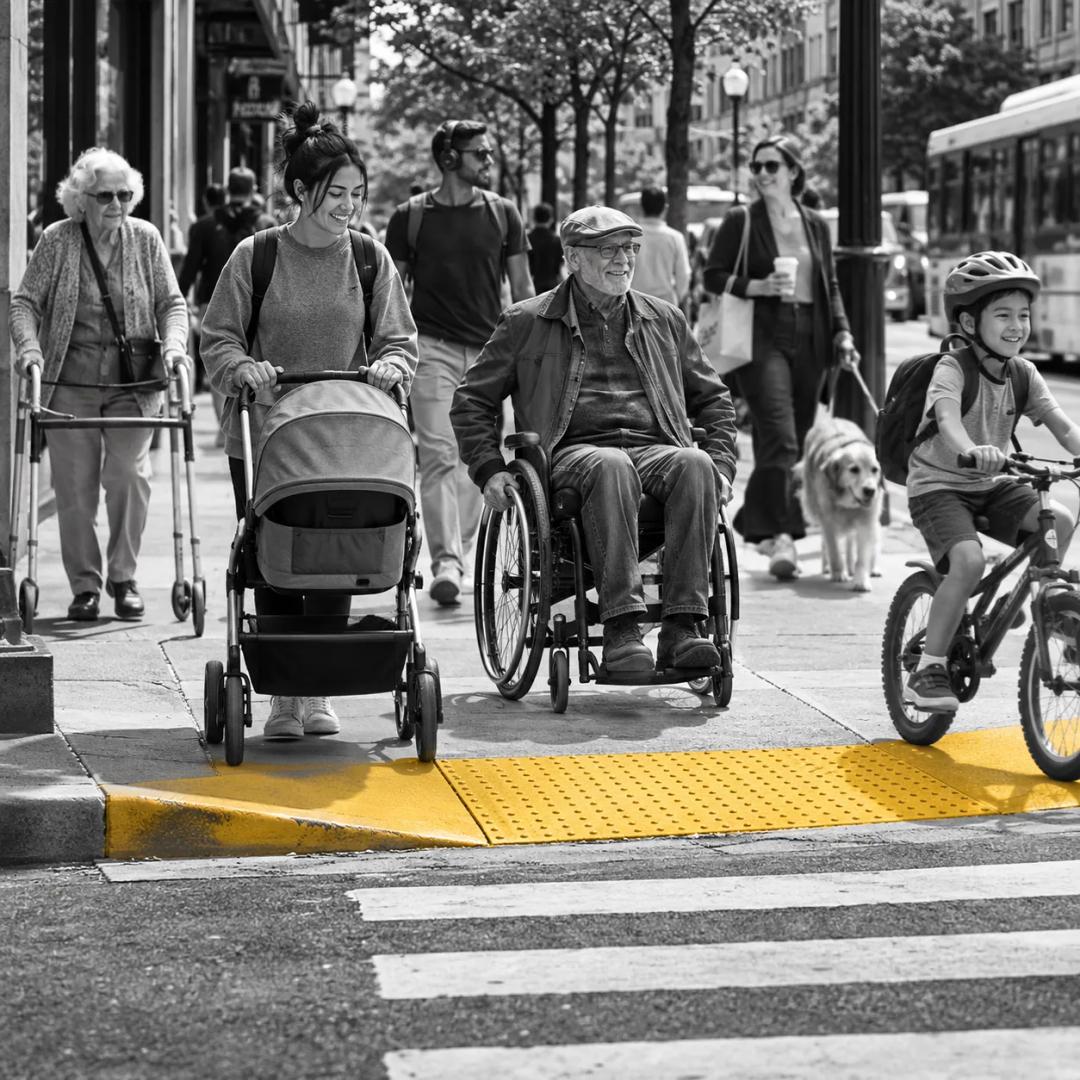
The curb-cut effect is the spillover in which a change made to remove a barrier for one group ends up helping many others. It is named for the ramps cut into street kerbs for wheelchair users.
What it is
Angela Glover Blackwell set out the idea in a 2017 essay in Stanford Social Innovation Review. She recounts that curb cuts first appeared in 1945 in a Michigan city, that disabled activists pressed Berkeley into its first official curb cut at an intersection in 1972, and that hundreds of thousands followed across the country.
She lists the people who use them: parents with strollers, workers with carts, travellers with luggage, runners and skateboarders. She also cites a 2007 newspaper report that at a shopping mall nine in ten unencumbered pedestrians went out of their way to use a curb cut.
In effect
The effect is used as a pattern across design. Same-language captions made for deaf and hard-of-hearing viewers benefit viewers in general, according to a 2015 review by Morton Ann Gernsbacher. Websites that meet accessibility guidelines thoroughly produced faster and more successful use by people without disabilities in a 2016 study by Sven Schmutz and colleagues.
Cliff Kuang, in User Friendly, uses the ramp as the standing argument for starting design from the people the average leaves out.
What it does not say
The effect is clearest where the fix removes a barrier that many people meet now and then. It is weaker where the goal sits further from the barrier. A 2017 meta-analysis of universal design for learning found an effective approach for the learning process of all students, but had not demonstrated an effect on educational outcomes. Blackwell wrote the essay about policy more widely, and only the street-ramp account is used here. The page makes no claim about diet or health.
Sources
- Blackwell, A. G. (2017). The curb-cut effect. Stanford Social Innovation Review, 15(1), 28-33. https://doi.org/10.48558/YVMS-CC96
- Gernsbacher, M. A. (2015). Video captions benefit everyone. Policy Insights from the Behavioral and Brain Sciences, 2(1), 195-202. https://doi.org/10.1177/2372732215602130
- Schmutz, S., Sonderegger, A., & Sauer, J. (2016). Implementing recommendations from web accessibility guidelines: Would they also provide benefits to nondisabled users? Human Factors, 58(4), 611-629. https://doi.org/10.1177/0018720816640962
- Capp, M. J. (2017). The effectiveness of universal design for learning: A meta-analysis of literature between 2013 and 2016. International Journal of Inclusive Education, 21(8), 791-807. https://doi.org/10.1080/13603116.2017.1325074
- Kuang, C., with Fabricant, R. User Friendly.