Decision Fatigue
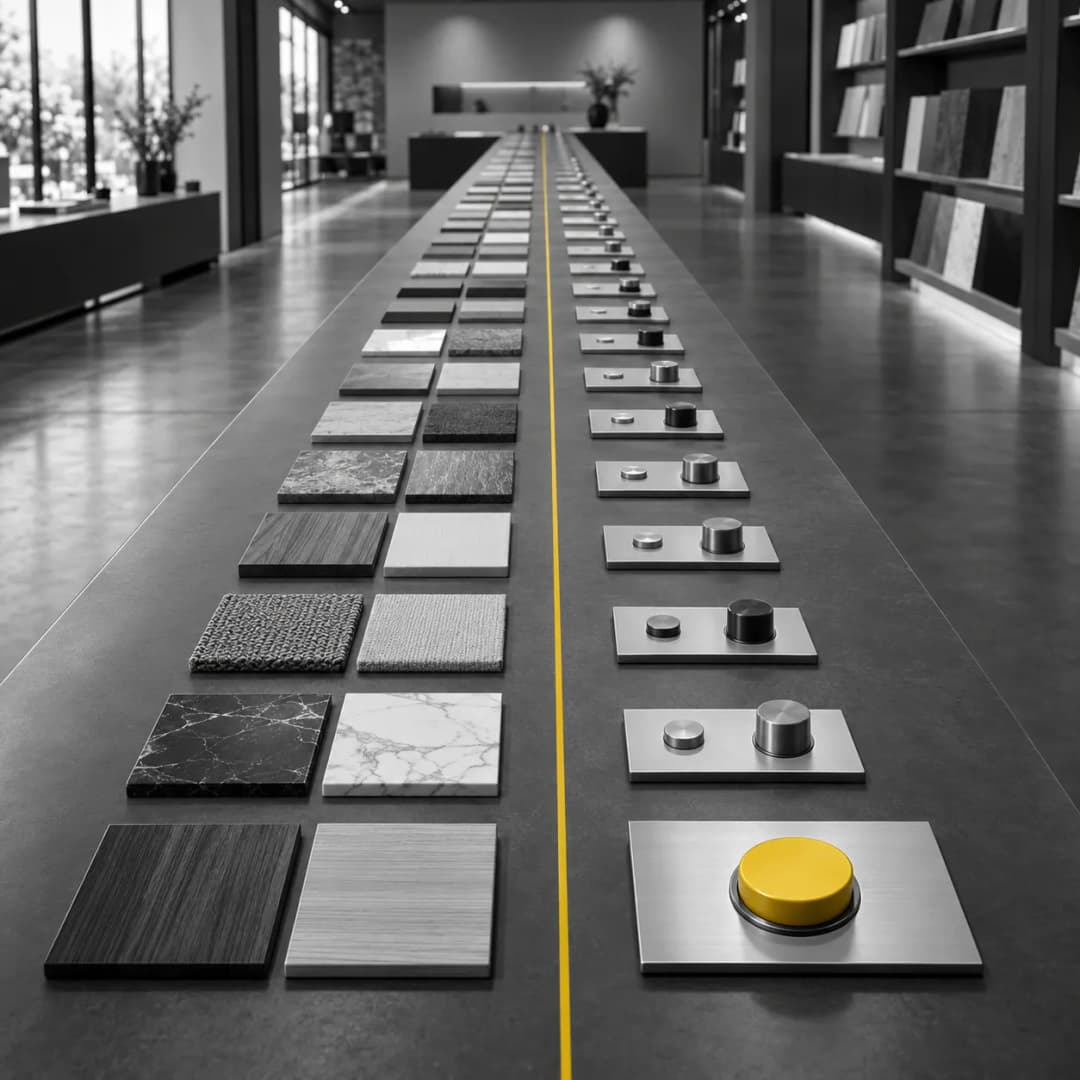
Decision fatigue is the claim that making many decisions uses up a limited mental resource, so that later decisions come out worse, lazier or more impulsive. It was proposed in 2008 and was given a real-world case by a parole study in 2011. The resource it relies on, ego depletion, failed a 36-laboratory test in 2021, and the parole case has a rival explanation. The pattern may be real, but the fuel tank explanation is in doubt.
What it is
Decision fatigue is usually described with a fuel tank. Every choice burns a little mental fuel, the tank runs low as the day goes on, and the choices that follow are made with less care. People then pick the default, the cheapest option, the quickest answer or no answer at all. The idea is intuitive, and it supports a family of everyday advice: wear a uniform, eat the same breakfast, decide once and stop deciding.
The scientific claim behind it is narrower. In 2008 Kathleen Vohs, Roy Baumeister and colleagues published a series of experiments in the Journal of Personality and Social Psychology under the title "Making choices impairs subsequent self-control". Participants who had made many choices gave up sooner on a hard task, endured less physical strain, procrastinated more and scored worse on arithmetic than participants who had only considered the same options. A study of shoppers who reported making many decisions pointed the same way. The authors argued that choosing draws on the same limited resource that self-control uses. That resource is the one proposed in earlier work on ego depletion.
The phrase decision fatigue bundles two things. One is a mechanism, that a shared resource is used up. The other is a pattern, that decisions late in a long sequence come out worse. The evidence for each is different, and most of the later argument is about keeping them apart.
The mechanism took the larger blow. In 2021 Vohs led a preregistered test of the depletion effect across 36 laboratories with 3,531 participants. The confirmatory analysis found no significant effect, at 0.06 standard deviations, and Bayesian analysis favoured the null hypothesis by about four to one. An exploratory analysis gave 0.08, small but statistically significant, with the data about equally likely under either hypothesis. That study tested the depletion effect in general and not choice-making alone, so it does not close the question for every task. It does remove the confidence with which the tank was once described.
The pattern is harder to dismiss, because tired or bored people plainly do sometimes decide worse. What is in doubt is the cause. A rationing account, set out by Robert Kurzban and colleagues in 2013 and echoed in Wendy Wood's description of control as a cost-benefit decision, says that effort is deployed when it is worth it and withheld when it is not. On that reading, late decisions look lazier because the payoff of deliberating has fallen, not because a resource has run dry.
In effect
In research: the parole judges
In 2011 Shai Danziger, Jonathan Levav and Liora Avnaim-Pesso analysed 1,112 parole rulings by eight judges in Israel. Favourable rulings fell from about 65 per cent at the start of a session to nearly zero by its end and recovered after a break. It was read as decision fatigue in the wild. Critics argued that case order was not random, and a 2016 simulation by Andreas Glöckner showed that a judge who ends sessions rather than start long cases would produce a decline of similar shape. The case is now treated as contested. See the Hungry Judge Effect.
In everyday life: uniforms and fixed routines
The advice to wear one outfit or eat one breakfast treats the day as a budget of decisions to protect. The advice may still be sensible, because routines save time and remove choices that were not worth making. What the research does not show is that each avoided choice saves a limited resource. If effort is rationed by what it is worth, the useful move is to spend attention on the choices that matter and to settle the rest by default.
In commerce: the order of choices
In 2010 Jonathan Levav, Mark Heitmann, Andreas Herrmann and Sheena Iyengar varied the order in which attributes were presented when people customised suits and cars, in one framed field experiment and two natural ones. Order changed what people configured and what they paid, mainly through how often they accepted the firm's suggested default. The finding is about sequence and defaults. It does not show that customers were fatigued, since order alone cannot separate exhaustion, a falling payoff and a wish to be done.
What it does not say
It does not say that people never decide worse when tired. It does not say that the 2011 parole result is false, only that it is disputed and should not be cited without its critique. It does not say that the 2021 multi-laboratory test settles every use of the idea, since it tested the depletion effect with two standard procedures. And it does not say that cutting choices is pointless. It says that the evidence for a draining tank is weak, and that a rationing account fits the pattern at least as well. The two accounts make different predictions when the stakes rise: a tank does not refill because the next choice matters, while a budget reallocates at once. The nearest test, by Mark Muraven and E. Slessareva in 2003, found that depleted participants with higher motivation performed better on a later self-control test than depleted participants with lower motivation, a result both accounts can claim.
Sources
- Vohs, K. D., Baumeister, R. F., Schmeichel, B. J., Twenge, J. M., Nelson, N. M., & Tice, D. M. (2008). Making choices impairs subsequent self-control: A limited-resource account of decision making, self-regulation, and active initiative. Journal of Personality and Social Psychology, 94(5), 883-898.
- Danziger, S., Levav, J., & Avnaim-Pesso, L. (2011). Extraneous factors in judicial decisions. Proceedings of the National Academy of Sciences, 108(17), 6889-6892.
- Glöckner, A. (2016). The irrational hungry judge effect revisited: Simulations reveal that the magnitude of the effect is overestimated. Judgment and Decision Making, 11(6), 601-610.
- Vohs, K. D., Schmeichel, B. J., Lohmann, S., et al. (2021). A multisite preregistered paradigmatic test of the ego-depletion effect. Psychological Science, 32(10), 1566-1581.
- Kurzban, R., Duckworth, A., Kable, J. W., & Myers, J. (2013). An opportunity cost model of subjective effort and task performance. Behavioral and Brain Sciences, 36(6), 661-679. doi:10.1017/S0140525X12003196
- Muraven, M., & Slessareva, E. (2003). Mechanisms of self-control failure: Motivation and limited resources. Personality and Social Psychology Bulletin, 29(7), 894-906.
- Levav, J., Heitmann, M., Herrmann, A., & Iyengar, S. S. (2010). Order in product customization decisions: Evidence from field experiments. Journal of Political Economy, 118(2), 274-299.
- Wood, W. (2019). Good Habits, Bad Habits: The Science of Making Positive Changes That Stick. Farrar, Straus and Giroux, pp. 63-64.