Deindividuation
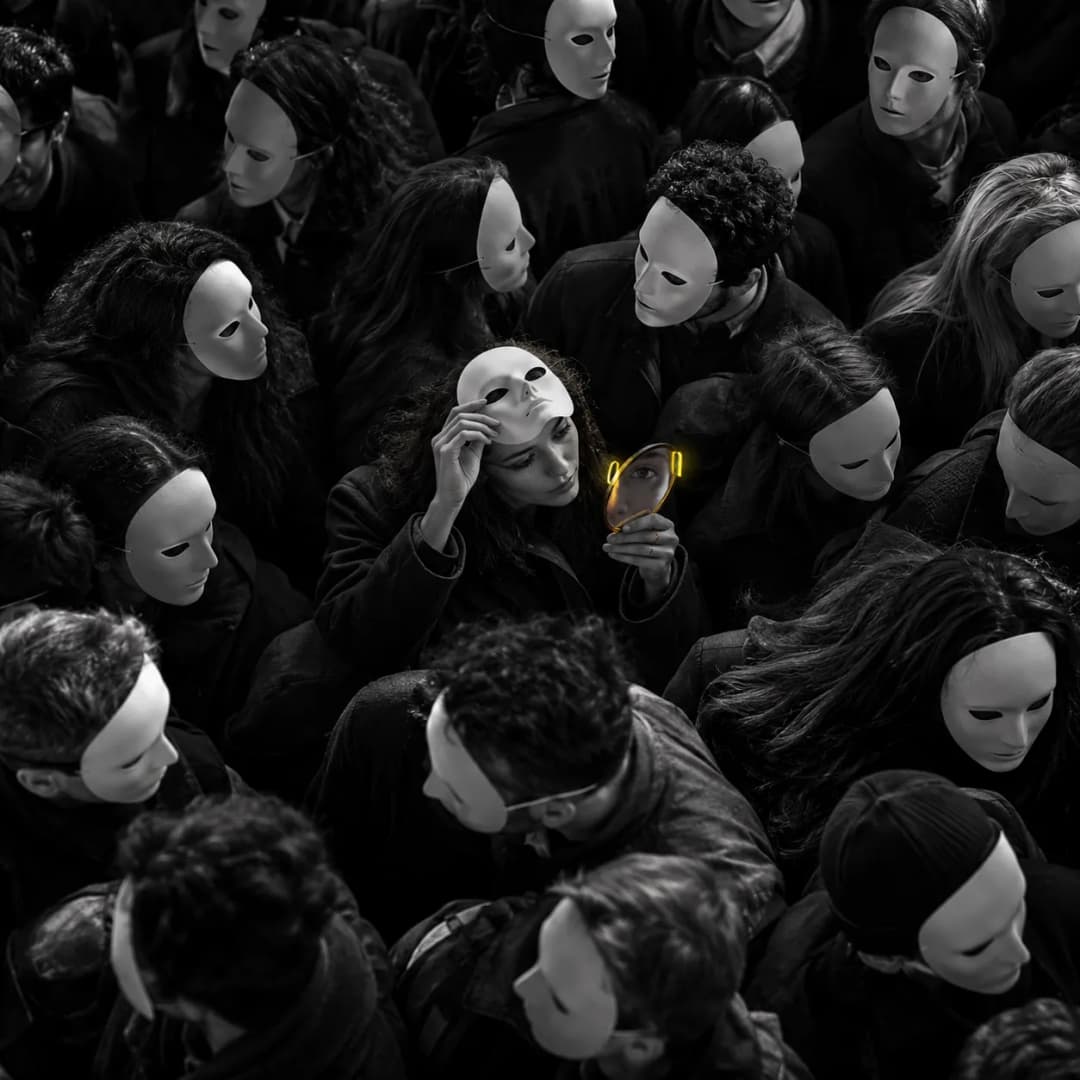
Deindividuation is the proposed loss of a person's sense of self when they are part of a group, studied in experiments that vary anonymity, self-awareness and group size. It is the research name for what the popular phrase crowd mentality describes. A 1998 meta-analysis of 60 independent studies by Tom Postmes and Russell Spears found little support for a deindividuated state, and found that behaviour followed the norms of the specific situation. The evidence status of the concept is contested.
What it is
The idea has two layers. The older layer is Gustave Le Bon's account of the crowd in his 1895 book Psychologie des foules. Michelle Baddeley, retelling that account in Copycats and Contrarians, separates two kinds of gathering in it: an organised crowd, which is people who happen to be in one place and can be large without being dangerous, and a psychological crowd, which forms an identity of its own that no single member could explain, with each person losing their sense of personal identity. The second kind is the one deindividuation tries to explain.
The newer layer is the experimental one. Deindividuation research typically manipulates three things: how anonymous people are, how self-aware they are, and how large the group is. The working assumption was that each of these could move a person into a deindividuated state, in which restraint weakens and behaviour that breaks social norms becomes more likely.
Postmes and Spears set out to test that assumption across the literature. Their paper, Deindividuation and antinormative behavior: A meta-analysis, appeared in Psychological Bulletin in 1998 (volume 123, issue 3, 238-259). It integrates 60 independent studies and reviews the evidence for deindividuation theory as an explanation of collective and antinormative behaviour.
In effect
The results, as the paper's abstract reports them, come in three parts. The studies gave little support for deindividuated antinormative behaviour. They gave little support for the existence of a deindividuated state. And behaviour was better explained by the norms of the specific situation than by general social norms: groups and individuals conformed more to situation-specific norms when they were deindividuated.
The authors read this as inconsistent with deindividuation theory and as supporting a social identity model of deindividuation effects, the model proposed in 1995 by Stephen Reicher, Spears and Postmes. On that model the effects once credited to a lost self are explained through the group a person is acting as a member of and the norms that group holds. The concept page for that model sets out the proposal in more detail.
For anyone using the phrase crowd mentality, the practical consequence is a change of question. The pooled studies do not show people in groups acting without rules. They show people tracking the rules of the situation they are in, and tracking them more closely when deindividuated. The article What is crowd mentality? follows that line from Le Bon to the field experiments on copying.
What it does not say
It does not say that people never behave differently in groups. Behaviour among others can differ from behaviour alone, and the meta-analysis tests one explanation of that difference, not the existence of it.
It does not say that every deindividuation study failed. The finding is about the pooled pattern across 60 studies, and the abstract describes support as little, not absent.
It does not give effect sizes or a study-by-study account on this page. Only the findings stated in the abstract are used here, and the individual studies were not reviewed.
It does not settle the social identity model. The meta-analysis fits that model better than deindividuation theory, and the evidence status of both remains open to later work.
Sources
- Postmes, T., & Spears, R. (1998). Deindividuation and antinormative behavior: A meta-analysis. Psychological Bulletin, 123(3), 238-259.
- Reicher, S. D., Spears, R., & Postmes, T. (1995). A social identity model of deindividuation phenomena. European Review of Social Psychology, 6, 161-198.
- Baddeley, M. (2018). Copycats and Contrarians: Why We Follow Others ... and When We Don't. Yale University Press.