Diffusion of Responsibility
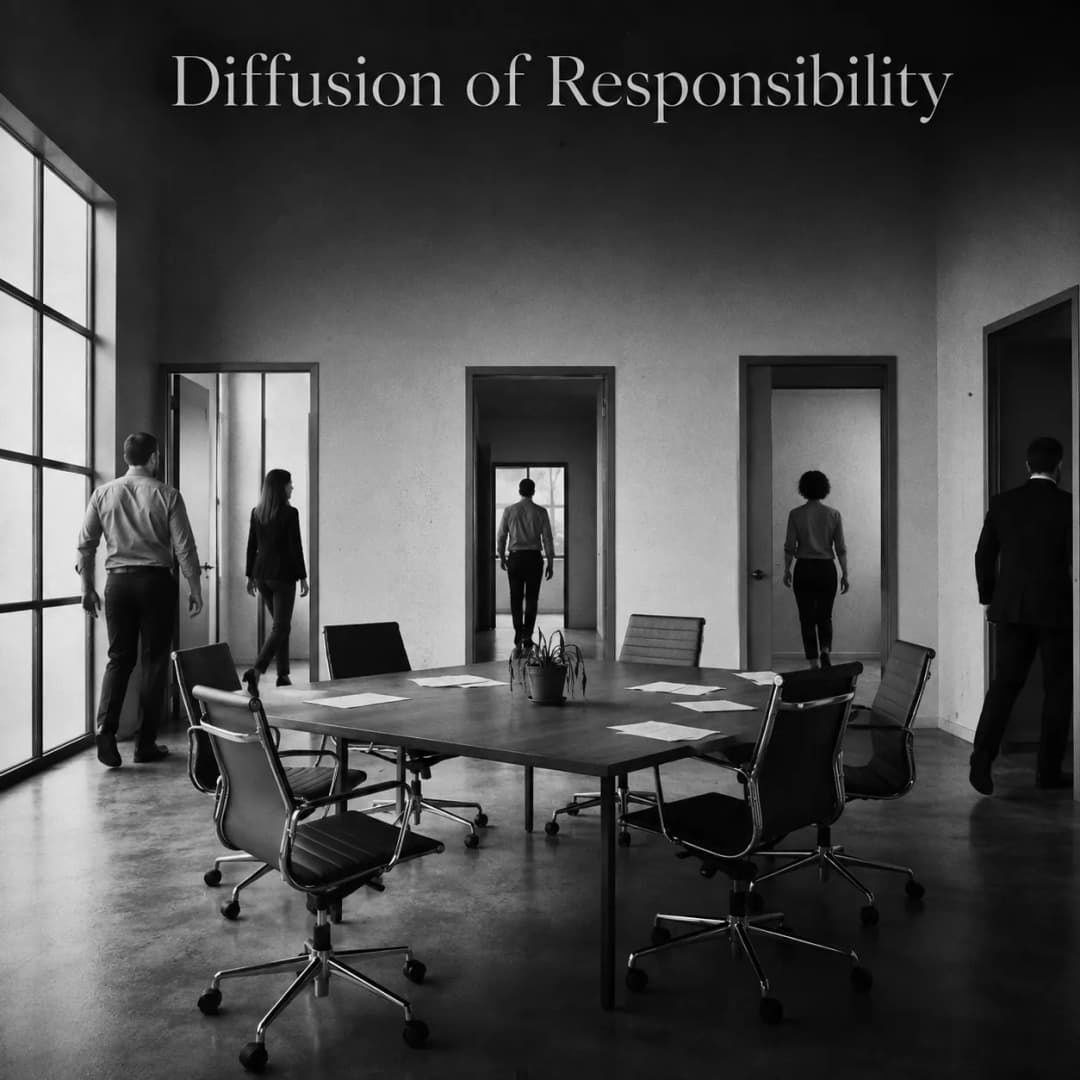
Diffusion of responsibility is the mechanism John Darley and Bibb Latané proposed for the bystander effect: as the number of witnesses to an emergency rises, responsibility spreads across the group instead of concentrating on any one person, and the probability that a given individual acts falls. It holds in the laboratory. It does not survive contact with 219 real street conflicts, where a greater number of bystanders was associated with a greater likelihood that somebody intervened.
What it is
A mechanism is an answer to the question of why, and it needs holding apart from the effect it explains. The effect is that individuals help less as bystanders are added. Diffusion of responsibility is one proposed reason for it: with one witness, the obligation to act has nowhere else to go, and with ten it can be spread thinly enough that nobody carries a full share of it. Darley and Latané proposed a second mechanism alongside it, that everyone reads everyone else for a cue about whether the situation is serious, which is closer to Social Proof. The two run together in most real situations and the experiments were not always designed to separate them.
The evidence for diffusion is the experimental work. In the intercom study, participants who believed they were the only person who could hear someone having a seizure helped quickly. Those who believed several others could also hear it helped more slowly, or not at all, and the delay scaled with how many bystanders they believed were present. The smoke-filled-room study found a comparable pattern with a physical hazard rather than a voice. The scaling is the part that makes the mechanism plausible rather than merely available: the effect tracked the believed number of others, which is what a diffusion account predicts and what an alternative story about mere distraction does not.
What has changed is the standing of the generalisation rather than the standing of the experiments. Philpot, Liebst, Levine, Bernasco and Lindegaard coded CCTV of 219 public conflicts in Amsterdam, Cape Town and Lancaster in 2020 and found intervention in nine out of ten incidents, with more bystanders associated with a greater likelihood that somebody stepped in. That is the opposite direction from the one the mechanism is usually invoked to predict.
The reconciliation is arithmetic and does not require anybody to be wrong. Each additional bystander may be individually less likely to move while the group as a whole becomes more likely to contain someone who will. A mechanism that operates on individuals can be entirely real and still produce a group-level outcome that runs the other way, and the sentence "responsibility diffuses, so nobody helps" collapses the two levels into one. The first half may hold and the second does not follow.
This page carries unreviewed in its frontmatter, and that is a statement about the vault's own verification of the mechanism rather than a verdict on Darley and Latané. What has been checked here is the effect, the field data and the founding story. What has not been checked, paper by paper against the primary sources, is the mechanism itself, and the honest position is to say so rather than to inherit its reputation.
In effect
Research: the intercom study and the scaling (Darley and Latané)
The intercom design is the cleanest evidence for the mechanism specifically. A participant hears what sounds like another person having a seizure over an intercom system, and the only variable is how many other people they believe are listening. Belief is the manipulation, which is what makes the result about responsibility rather than about anything happening in the room. Participants who believed they were alone helped fast. Those who believed others were listening helped slower or not at all, and the delay scaled with the believed number. A mechanism that responds to a believed headcount is a mechanism about who is obliged to act, which is what diffusion of responsibility names.
Everyday life: the email addressed to eight people
The everyday version has nothing to do with emergencies and is the reason the term is in general use. A request goes to a group rather than a person, and it sits there. Each recipient can see that seven others received it, none of them has been named, and the cost of assuming somebody else will pick it up is nil. Organisations solve this by assigning an owner, which is diffusion of responsibility treated as a design problem rather than a moral one. The generalisation from staged emergencies to inboxes is not something Darley and Latané tested, and it is offered here as a recognisable illustration rather than as evidence.
Commerce: single-owner assignment in operations
Incident management practice in software operations makes the mechanism explicit and then engineers against it. An alert that pages a whole team can be seen by everyone and acted on by nobody, so mature on-call systems name a single individual as the responder for a defined window, with an explicit escalation path if that person does not acknowledge. The structure is a direct inversion of the intercom manipulation: instead of letting the number of people who can hear the alarm rise, it forces the count back to one. The practice long predates any of this research being cited in it, which is worth saying. The convergence is a point in the mechanism's favour, not a study.
What it does not say
It does not say that crowds do not help. The best field evidence available says the opposite: intervention occurred in nine of ten real public conflicts, and more bystanders made it more likely, not less.
It does not say that responsibility is the only mechanism. Darley and Latané proposed social influence alongside it, everyone reading everyone else for a cue, and in most real situations the two cannot be separated by observation.
It does not license a group-level prediction from an individual-level effect. A per-person decline in the probability of acting is compatible with a rising probability that somebody acts, and this is the single most common error made with the concept.
It is not verified to this site's standard. The unreviewed status is deliberate. The bystander effect and the field reversal have been checked against their primary sources. The mechanism has not been, and until it is, nothing here should be quoted as settled.
Who developed it
Bibb Latané, with John Darley, proposed the mechanism alongside the bystander experiments of the late 1960s. The two names are cited together for this work, and the vault records Latané as originator with medium confidence, which reflects a genuine uncertainty about who first stated the mechanism in this form rather than about who ran the experiments.
Sources
- Darley, J. M. & Latané, B. (1968). The bystander intervention experiments, including the intercom-seizure and smoke-filled-room designs.
- Philpot, R., Liebst, L. S., Levine, M., Bernasco, W. & Lindegaard, M. R. (2020). "Would I Be Helped? Cross-National CCTV Footage Shows That Intervention Is the Norm in Public Conflicts." American Psychologist. N = 219 incidents; intervention in nine of ten; more bystanders associated with greater likelihood of intervention.
- Manning, R., Levine, M. & Collins, A. (2007). "The Kitty Genovese Murder and the Social Psychology of Helping: The Parable of the 38 Witnesses." American Psychologist, 62(6), 555-562. The founding anecdote, which the archive does not support.
- Where this came from
- One book in this library carries this concept. A concept resting on a single popular retelling is roughly twice as likely to be contested, mixed or unverified as one two or more books carry, so treat it as unchecked until it has been taken to a primary source.