Drawing Power of Crowds
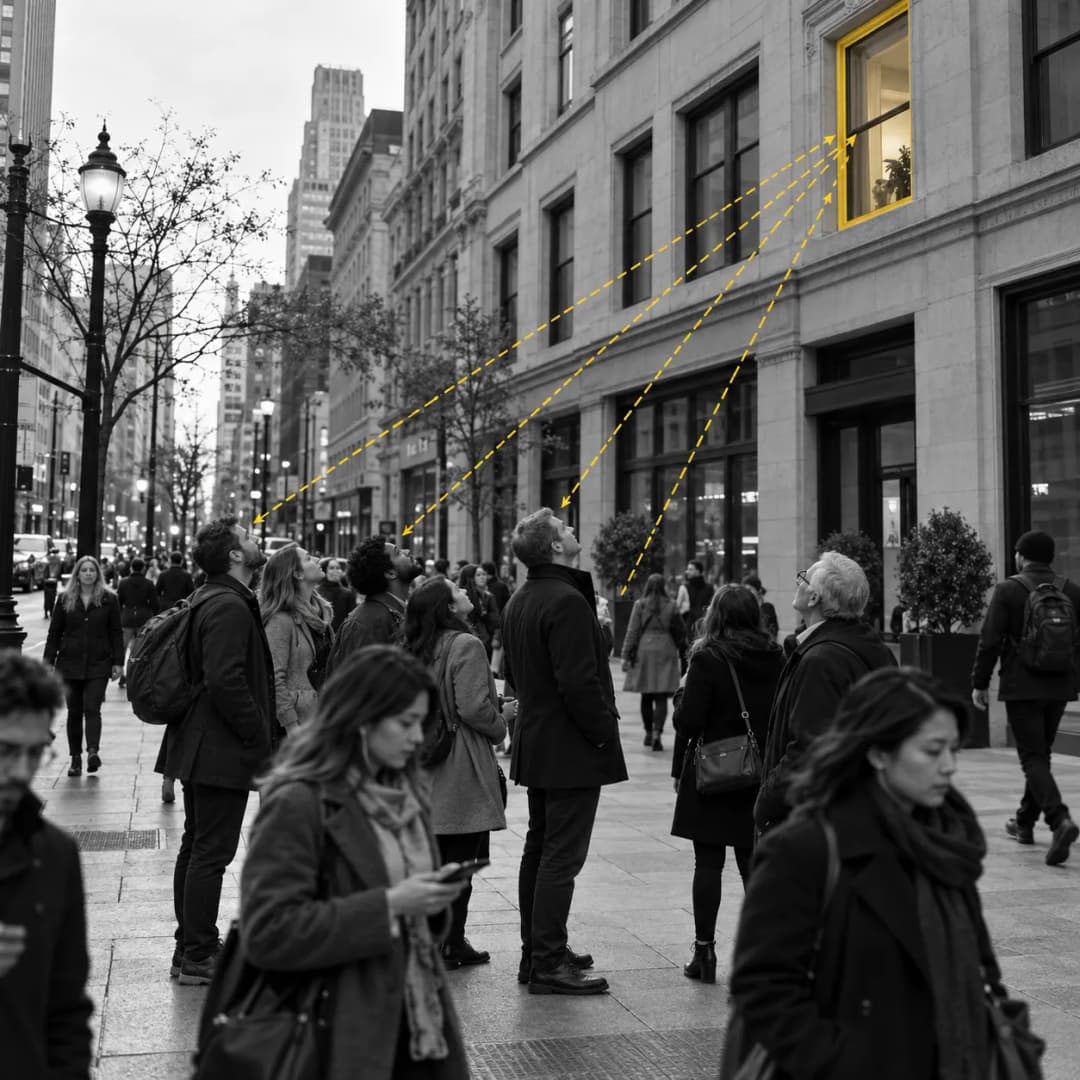
The drawing power of crowds is the finding that the share of passers-by who stop and look at something rises with the number of people already looking. Milgram, Bickman and Berkowitz reported it from a New York street in 1969. A 2012 follow-up led by Andrew Gallup found the copying was real but saturated with group size and was too weak to produce a sudden tipping point. What spreads through a crowd in these studies is attention. Nothing in them shows that anyone came to want what the crowd was looking at.
What it is
The original is a short note in the Journal of Personality and Social Psychology, titled "Note on the Drawing Power of Crowds of Different Size" (1969, volume 13, issue 2, pages 79 to 82). The design was a field experiment. On a busy New York pavement, confederates, people working with the experimenters, stopped and stared up at a sixth-floor window. The experimenters filmed from that window, so the behaviour of the passers-by could be counted afterwards. The variable was the number of confederates staring. Accounts of the study agree on the direction of the result: as the number of people looking up grew, more passers-by copied them, and the pull rose quickly across the first few members of the group.
The exact percentages for each group size are not given on this page. The figures that circulate in secondary accounts were not checked against the paper, so none are repeated here.
The follow-up is Gallup and colleagues (2012), "Visual attention and the acquisition of information in human crowds", in the Proceedings of the National Academy of Sciences, volume 109, issue 19, pages 7245 to 7250. The authors tracked the movement and head direction of 3,325 pedestrians in real crowds. In the first study, confederates gazed up at a point on a building, as in Milgram's design. Passers-by were more likely to copy the gaze as the group grew, but the effect levelled off for larger groups, and attention spread unevenly through the space. The authors built a model from these results. It predicted that gaze-copying does transfer attention between people, but not strongly enough to trigger the sudden, threshold-like spread that earlier crowd models had predicted. In a second study the confederates behaved suspiciously, and the results supported the model: visual interaction happened mainly within about two metres, and although copying was weak, it helped people notice something relevant. A science-press account of the work adds that, on average, 27 per cent of passers-by looked in the same direction as the confederates, and that people walking towards the confederates were about half as likely to look up as people beside or behind them. Those two details come from the press account, not from the abstract.
In effect
The result matters for any setting where a crowd is visible before its reason is. A queue outside a shop is the commonest case. The first thing a queue does to a passer-by is the thing Milgram measured: it makes them look. The 2012 study narrows what that can be worth. Copying a glance was weak, it depended on the physical setting and on how close people were, and it did not spread like a chain reaction. A large crowd does not draw proportionally more attention than a medium one.
Looking is also cheap. A glance costs a second and commits the looker to nothing. The studies measure that cheap behaviour, and they stop at it. Whether a person who looked then joined, bought or wanted anything is a different question, and the effects that bear on it, a queue read as a signal of quality and a line that holds the people inside it, come from different literatures. The article Does a Long Queue Make People Want In keeps the three apart. The case for treating copying as sometimes sound reasoning is made in When Copying Is the Rational Move.
For a business, the practical reading is modest. A visible crowd at the door is likely to raise the number of people who notice the shop, particularly within a couple of metres of it and particularly among people who are not walking straight towards it. It is a reason to expect more glances, and not on its own a reason to expect more customers.
What it does not say
It does not say that a bigger crowd always draws more. The 2012 work found the effect levelled off, which challenges the tipping-point reading sometimes given to Milgram's data.
It does not say anything about wanting. The behaviour counted is stopping and looking, or copying a head direction. Neither study asked the passers-by what they thought of the thing they looked at, and in Milgram's design there was nothing to want: the confederates were looking at a window.
It does not describe every crowd. Both designs used confederates on a pavement, with pedestrians who were on their way somewhere. Responses in the 2012 study depended on the physical setting, the social context and the passer-by's sex, so a result from one street is not a constant.
It does not separate imitation from inference. A passer-by who looks up may be copying a gesture or may be reasoning that people look at things that matter. The studies here do not distinguish the two.
Sources
- Milgram, S., Bickman, L., & Berkowitz, L. (1969). Note on the drawing power of crowds of different size. Journal of Personality and Social Psychology, 13(2), 79-82. doi:10.1037/h0028070. Held at citation and secondary-account level; the paper's tables were not read.
- Gallup, A. C., Hale, J. J., Sumpter, D. J. T., Garnier, S., Kacelnik, A., Krebs, J. R., & Couzin, I. D. (2012). Visual attention and the acquisition of information in human crowds. Proceedings of the National Academy of Sciences, 109(19), 7245-7250. doi:10.1073/pnas.1116141109. Abstract read; the full text was not obtained.
- Science-press account of Gallup and colleagues (2012), National Geographic, 23 April 2012, for the 27 per cent figure and the walking-towards detail.