Drip Pricing
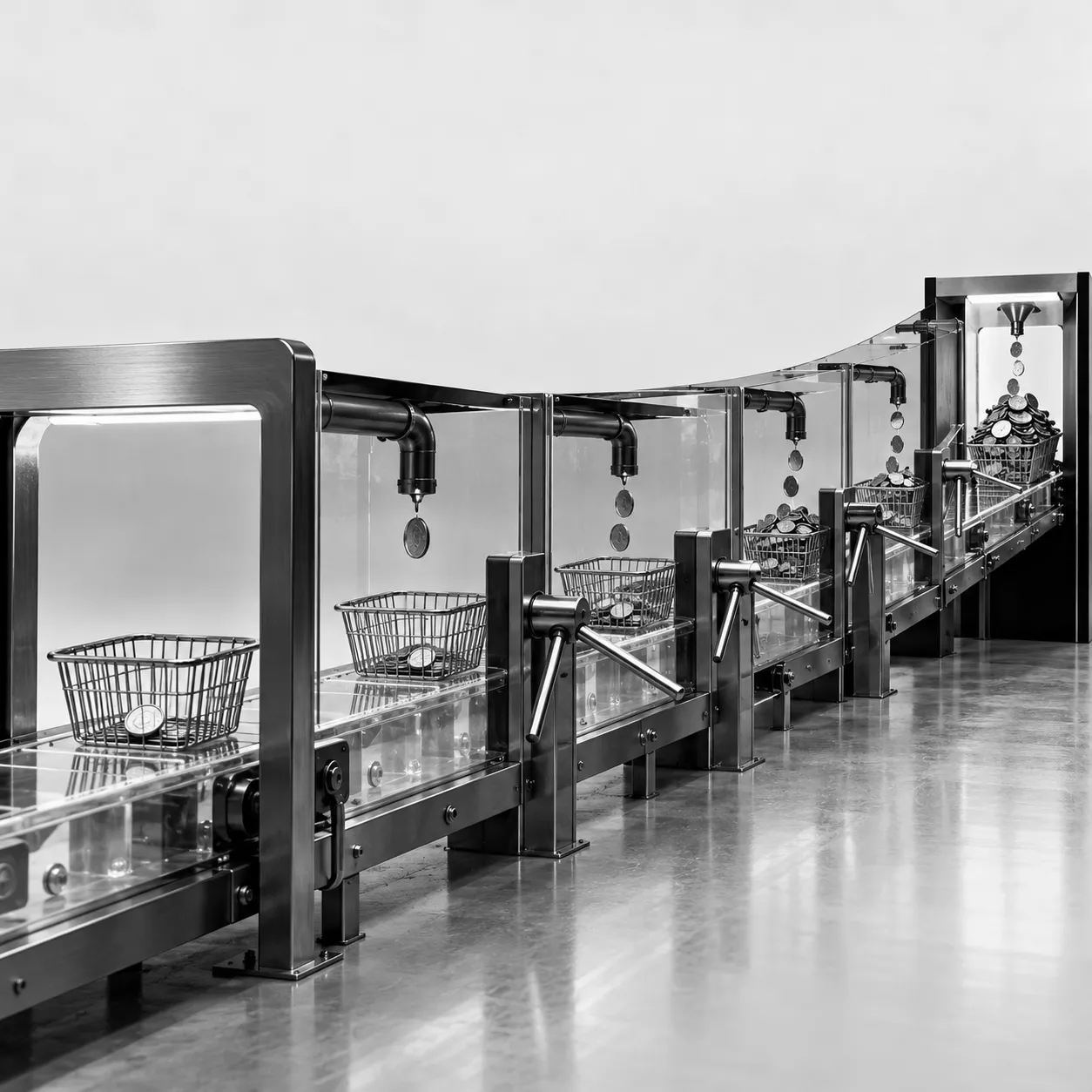
Advertising part of a price and holding the rest back until the buyer is almost finished. The headline number is real, it is simply not the number you will pay, and the missing part arrives at the screen where restarting feels most expensive. The field evidence is strong on what it does to revenue and silent on whether buyers end up worse off, and this page keeps those two apart.
What it is
The working definition here is Thaler and Sunstein's in Nudge: to advertise only part of a price up front and withhold other parts until customers move towards finalising their choices, or even until they check out. The book states it without citing anybody for it, so the vocabulary is theirs and the evidence is elsewhere.
It is not the same thing as partitioned pricing, where the components are all disclosed but never totalled. The distinction matters because shrouding is the right frame for a fee you first meet at checkout and the wrong one for a delivery charge announced in a banner.
In effect
StubHub ran both regimes at once on randomised halves of its own traffic for ten days in August 2015, across several million users, one half shown all-in prices with an explicit notice that fees were included and the other half shown lower prices with a fifteen per cent fee revealed at checkout. The concealed version earned about a fifth more. Roughly a seventh more people bought at all, and each buyer spent about five per cent more per ticket, largely by moving up to better seats.
The behavioural detail is better than the headline. Buyers meeting the fee late scrolled more, were much more likely to view several listings, and were far more likely to abandon at the final screen. The ones who stayed were worth more. Shelle Santana, Steven Dallas and Vicki Morwitz add the complementary result from six booking-scenario studies: when surcharges are dripped, people tend to select the option with the lower base price and higher total, and then keep it even after the total is shown and they are offered the chance to start again, and even though they are relatively dissatisfied with it. Their proposed reasons are high perceived search costs, self-justification, and a mistaken belief that every firm charges similar fees.
What it does not say
It does not say experience immunises shoppers, and it does not say experience is irrelevant. The revenue effect fell to about fifteen per cent for users with ten or more prior visits rather than disappearing, and the same paper reports that buyers did not learn to anticipate the correct fee level even after the platform had moved everyone to fees at checkout.
It does not say that dripping harms consumers overall. The authors of the field experiment explicitly decline a welfare verdict and name a two-sided externality they cannot resolve, so a regulator asserting harm and this experiment measuring revenue are two separate voices. It also does not say late fees cost a seller loyalty: on this platform, buyers who met the fee late were slightly less likely to churn over the following year, a result the authors flag as confounded and do not settle.
And the scope is narrow. One platform, one product category, a percentage fee, ten days in 2015. A flat fee would not have produced the seat-upgrade channel at all.
Sources
- Blake, T., Moshary, S., Sweeney, K., & Tadelis, S. (2021). "Price Salience and Product Choice." Marketing Science, 40(4), 619-636. doi:10.1287/mksc.2020.1261. Full text read. The StubHub field experiment, with a second event-level experiment from 2012 reported inside the same paper. Disclosure in the paper's own terms: Tadelis worked and consulted for eBay from August 2011 to February 2016, the research postdates that period and was not funded by eBay, and StubHub supplied the data.
- Santana, S., Dallas, S. K., & Morwitz, V. G. (2020). "Consumer Reactions to Drip Pricing." Marketing Science, 39(1), 188-210. doi:10.1287/mksc.2019.1207. Abstract and methods read. Six airline or hotel booking studies, four with consequential incentive-compatible choices; samples of 408, 397, 93, 805, 402 and 400. The authors note their participants are relatively inexperienced consumers rather than experts.
- Rasch, A., Thöne, M., & Wenzel, T. (2020). "Drip pricing and its regulation: Experimental evidence." Journal of Economic Behavior & Organization, 176, 353-370. doi:10.1016/j.jebo.2020.04.007. Full abstract read. Laboratory duopoly markets with a ban condition; consumer surplus lower and seller profits higher under drip pricing.
- Alma Economics for the UK Department for Business and Trade (2023). "Estimating the prevalence and impact of online drip pricing." Published 4 September 2023. Executive summary and methodology read at source. 525 online and mobile providers across four sectors, one purchase made from each; 46 per cent included at least one dripped fee other than delivery, rising to 72 per cent in transport and communication and falling to 15 per cent in retail; estimated additional consumer spending of £595 million to £3.5 billion a year. Delivery fees are excluded by design, because they are expected and may be optional, and that exclusion has to be stated wherever the figures are used.
- Thaler, R. H., & Sunstein, C. R. Nudge: The Final Edition, for the definition, and for shrouded attributes, credited there to Gabaix and Laibson (2006).
In these themes
- Pricing and Value
How we decide what something is worth, and what a price tells us before we buy.