Dwell Time Versus Felt Time
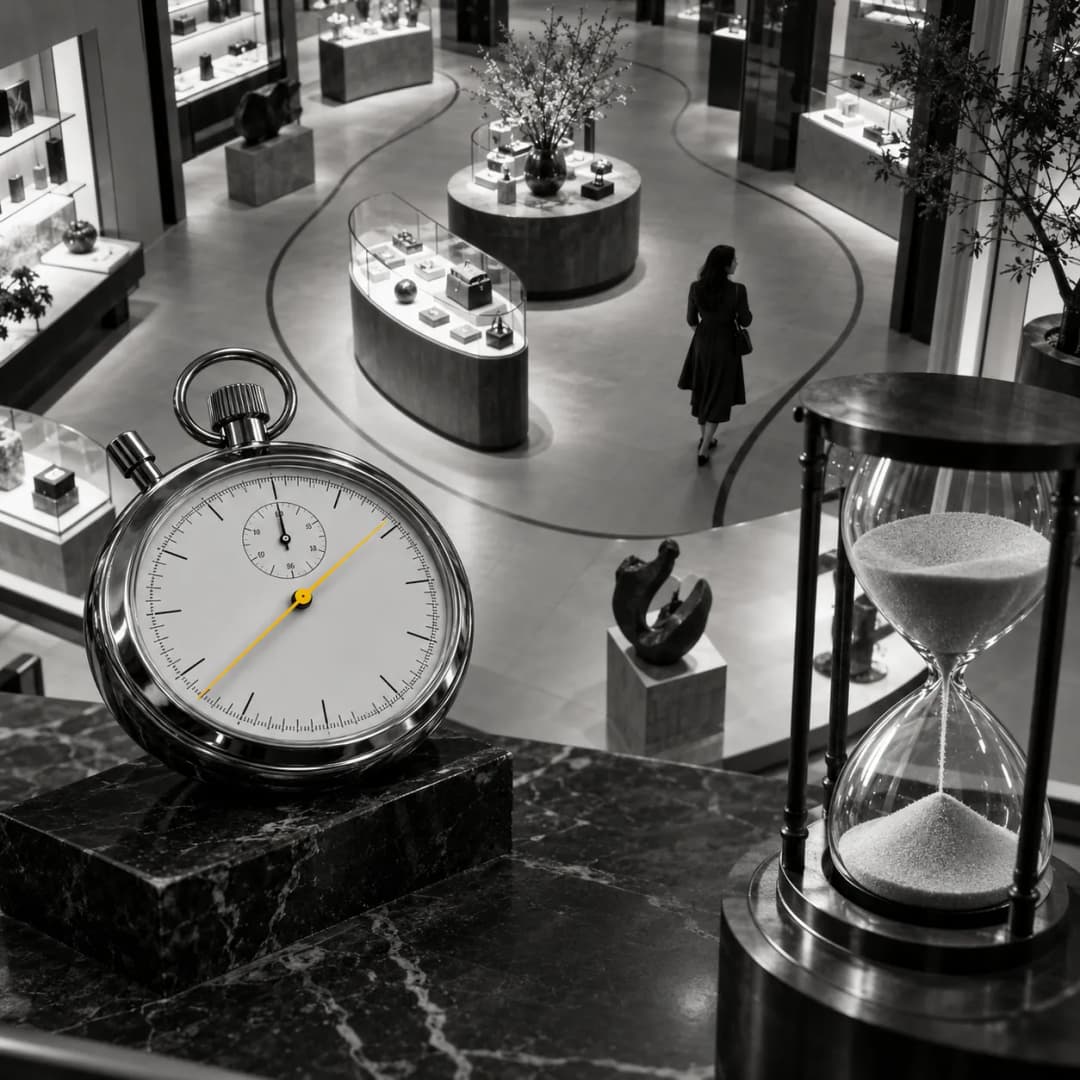
Dwell time is how long a shopper is in a place by the clock, from entry to exit. Felt time is how long that stay seems to have been. Retail research often treats a longer stay as a good outcome and then measures something else, usually ratings or intentions. Colour has been shown to change felt time on a screen. Whether it changes dwell time in a shop has hardly been tested, and the two measurements cannot stand in for each other.
What it is
Dwell time is a quantity with a clock behind it. A shopper comes in, a shopper goes out, and the difference is the visit. However a study records it, by an observer, a till log or a door count, it is a behaviour, and it is the only one of the two that a retailer can bank.
Felt time is a judgement. It is how long something seemed to take, and it can run ahead of or behind the clock. People asked to rate a wait are reporting an experience of it. Nothing in that report says how long they stayed.
The distinction matters because retail atmosphere research leans on an unstated chain: a pleasant environment improves mood, improved mood lengthens the stay, and a longer stay raises spending. Each link can be measured. Most studies measure the first and assume the rest. The largest pooled analysis of music, scent and colour in retail, published by Holger Roschk and colleagues in 2017, sorted its outcomes into arousal, pleasure, satisfaction and behavioural intentions. Time spent was not one of the four.
Ratings and time can come apart in the same study. The founding laboratory experiment on ambient scent, by Eric Spangenberg, Ayn Crowley and Pamela Henderson in 1996, raised almost every evaluation it measured and found no change in time in the store. A room can be liked more and occupied for exactly as long.
In effect
A wait that felt shorter
Gerald Gorn and colleagues published the clearest colour result on felt time in the Journal of Marketing Research in 2004. They varied the background colour of a web page while it loaded, and they varied it on three dimensions of colour: hue, value and chroma. On each dimension, colours that produced more relaxed feelings led people to perceive the download as faster. The number of times a participant waited also changed relaxation and perceived speed, which the authors take as support for the colour result. Colour also affected how people evaluated the website and how likely they were to recommend it. The abstract does not name the colours that were rated most relaxing.
A visit that was shorter
A 2012 study in Color Research and Application, by O. Barli and colleagues, is the nearest shop evidence on dwell time that we found. Its abstract reports 440 men and 478 women aged 20 to 60, two kinds of lighting (soft and bright) and five interior colours (blue, yellow, green, red and white). Time spent in the store was positively associated with soft lighting and negatively associated with a red interior. Green and time spent each had a statistically significant positive effect on product purchase. We have read only the abstract. It gives no effect sizes and does not describe the shop or the way time was recorded.
Diners who stayed
Ronald Milliman's 1986 restaurant study, in the Journal of Consumer Research, is the model of how dwell time is normally studied. Its abstract reports that variations in music tempo significantly affected purchases and length of stay. Textbook accounts draw the commercial lesson that a restaurant with a bar gains from slower music, while one that depends on quick turnover does better with faster music. The same stay is good or bad depending on how the business earns its money, so a longer visit is not a result in itself.
Why arousal does not settle it
A colour that raises arousal does not predict a longer or a shorter visit. A stirred-up shopper might circulate for longer or head for the door, and nothing in the arousal account says which. The warm colours in the 2017 pool raised arousal, but pleasure and intentions to buy or visit did not move reliably. The step from a felt state to a number of minutes has to be tested, not inferred.
What it does not say
It does not say that colour fails to change dwell time. The honest position is that the evidence is thin: the pooled colour analysis did not analyse time spent, and the one shop study that recorded it is known here from its abstract alone.
It does not say that felt time is unimportant. A wait that feels shorter may well make a stay easier to extend, and a shopper's sense of how long they have been in a place plausibly affects when they decide to leave. That is a reasonable hypothesis. In the colour literature it has not been tested in a shop.
It does not say that a longer visit is a better one. Milliman's restaurants show that the value of a long stay depends on the business, and a longer visit is a different outcome from a larger basket, which most colour studies reach only through stated intentions.
Finally, the screen result does not travel automatically. In the 2017 pool the arousal effect of warm colour was about ten times larger in online settings than in physical retail, so a result from a loading page is a weak basis for decisions about a shop floor.
Sources
- Gorn, G. J., Chattopadhyay, A., Sengupta, J., & Tripathi, S. (2004). Waiting for the Web: How screen color affects time perception. Journal of Marketing Research, 41(2), 215-225. doi:10.1509/jmkr.41.2.215.28668. Read at the level of the abstract.
- Barli, O., Aktan, M., Bilgili, B., & Dane, S. (2012). Lighting, indoor color, buying behavior and time spent in a store. Color Research & Application, 37(6), 465-468. doi:10.1002/col.20695. Read at the level of the abstract.
- Roschk, H., Loureiro, S. M. C., & Breitsohl, J. (2017). Calibrating 30 years of experimental research: a meta-analysis of the atmospheric effects of music, scent, and color. doi:10.1016/j.jretai.2016.10.001. Journal of Retailing, 93(2), 228-240. Accepted manuscript read.
- Milliman, R. E. (1986). The influence of background music on the behavior of restaurant patrons. Journal of Consumer Research, 13(2), 286-289. doi:10.1086/209068. Abstract read.
- Spangenberg, E. R., Crowley, A. E., & Henderson, P. W. (1996). Improving the store environment: do olfactory cues affect evaluations and behaviors? Journal of Marketing, 60(2), 67-80. doi:10.2307/1251931.