Economic Threat Priming
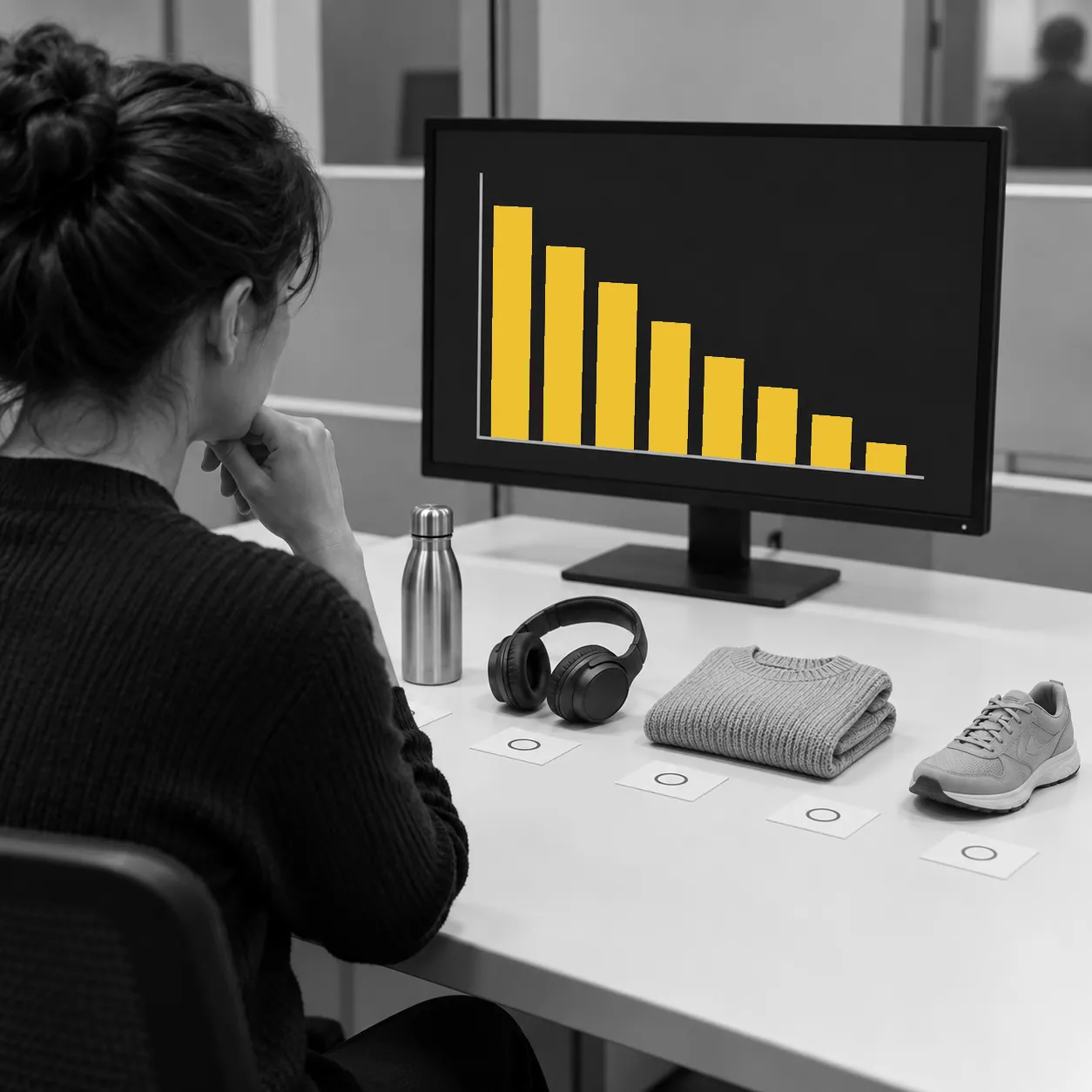
Economic threat priming is a laboratory method: participants are shown recession news or images, and a control group is shown something unrelated, before both groups rate how much they want a set of products. It is how the experimental case for the lipstick effect was built. The label is a description used on this site; Hill and colleagues (2012), who ran the experiments, speak of recession cues. The method tests what people say they want after a reminder of economic hardship. It does not test what anyone buys.
What it is
A priming experiment in this setting has three parts. A group of participants is shown cues that suggest economic decline. A control group is shown a neutral item. Both groups then complete the same rating task, so that any difference between them can be put down to the cue.
Hill, Rodeheffer, Griskevicius, Durante and White used two kinds of cue. In one experiment, participants read a news article about the recession, while the control group read an article about architecture. In the others, participants saw a slideshow of images such as unemployment lines and foreclosure signs. The authors ran a pretest on the news article and found that it lowered readers' estimates of how many people have good jobs and incomes, but did not change their estimates of how many people are physically attractive. That is the check a priming design needs: the cue was meant to change perceived economic conditions and nothing else.
The outcome in each experiment was desire to buy. Participants rated products from two groups, goods that enhance appearance, such as jeans, lipstick, make-up and perfume, and control goods with no appearance function, such as a stapler, a computer mouse, a laptop and dish soap. Comparing the two groups of products is what lets the design separate a general loss of appetite for spending from a shift in what people want.
In effect
In the second study of the 2012 paper, 154 university students, 82 women and 72 men, read either the recession article or the architecture article. Recession cues lowered men's desire for both kinds of product. For women they lowered desire for the control goods and raised desire for the appearance-enhancing ones. The paper's authors present this as the first experimental demonstration of the lipstick effect.
A third study used 76 unmarried female students and the slideshow cue. Desire for beauty products rose and desire for control products fell. The women in the recession condition also placed more weight on a partner's financial stability, and a statistical mediation analysis suggested that this preference carried part of the effect on beauty products. The direct effect remained marginally significant after that adjustment, so the authors accept that other pathways may also be at work. Mood did not differ between the conditions, which counts against a simple account in which the cue made women feel worse and shopping made them feel better.
A fourth study, with 64 unmarried women aged 18 to 20, split the products by price. The recession cue raised desire for luxury beauty products and did not raise desire for discount beauty products. The participants' own social class did not change the result, which the authors read as evidence against an account built on social roles alone.
A fifth study, with 72 unmarried female students, showed advertisements for jeans, perfume and boots. Some carried slogans about attracting a mate and some carried neutral slogans. Recession cues raised interest in the mating versions only, and the effect was strongest among women who had reported, about two weeks before the experiment, that they were highly motivated to attract a long-term partner.
Taken together, the five studies give a consistent laboratory pattern in women. The sections of the paper that report it also contain the real-world side of the argument, 232 months of American unemployment and retail spending data from January 1992 to April 2011, in which the share of spending on personal care and cosmetics rose with unemployment. That part is correlational and is a different kind of evidence from the priming experiments.
What it does not say
It does not say that people buy more beauty products in a recession. A priming experiment measures stated desire after a cue, and the cue is a news article or a slideshow, not the experience of losing a job. Whether stated desire carries over to purchases is a separate question, and it is the one that the later spending studies took up.
It does not cover men. The 2012 paper's second study included men, whose desire fell for both kinds of product, and the authors did not examine men's responses further. The remaining studies used women only.
It does not establish the motive. The mediation result in the third study points to women's preference for partners with resources, but Netchaeva and Rees (2016) report that women with high economic concern also used appearance products to make a good impression at work, with the professional motive the stronger of the two. MacDonald and Dildar (2020), working from household spending data, found that the rise in cosmetics spending among women aged 18 to 40 held regardless of marital or employment status and favoured a substitution account, in which women cut back on clothing. The priming method cannot settle between these, because each account predicts the same rise in stated desire.
The samples were university students, and the authors list the limits of their own design: the real-world study is correlational, one mediation effect was only marginal, and cultural influences were outside the paper's scope. The vault holds the effect as contested, and the priming experiments are one part of why: they are the strongest evidence for a narrow claim, not for the popular one.
Sources
- Hill, S. E., Rodeheffer, C. D., Griskevicius, V., Durante, K., & White, A. E. (2012). Boosting beauty in an economic decline: Mating, spending, and the lipstick effect. Journal of Personality and Social Psychology, 103(2), 275-291. https://doi.org/10.1037/a0028657
- Netchaeva, E., & Rees, M. R. (2016). Strategically stunning: The professional motivations behind the lipstick effect. Psychological Science, 27(8), 1157-1168. https://doi.org/10.1177/0956797616654677
- MacDonald, D., & Dildar, Y. (2020). Social and psychological determinants of consumption: Evidence for the lipstick effect during the Great Recession. Journal of Behavioral and Experimental Economics, 86, 101527. https://doi.org/10.1016/j.socec.2020.101527