EEG Preference Prediction
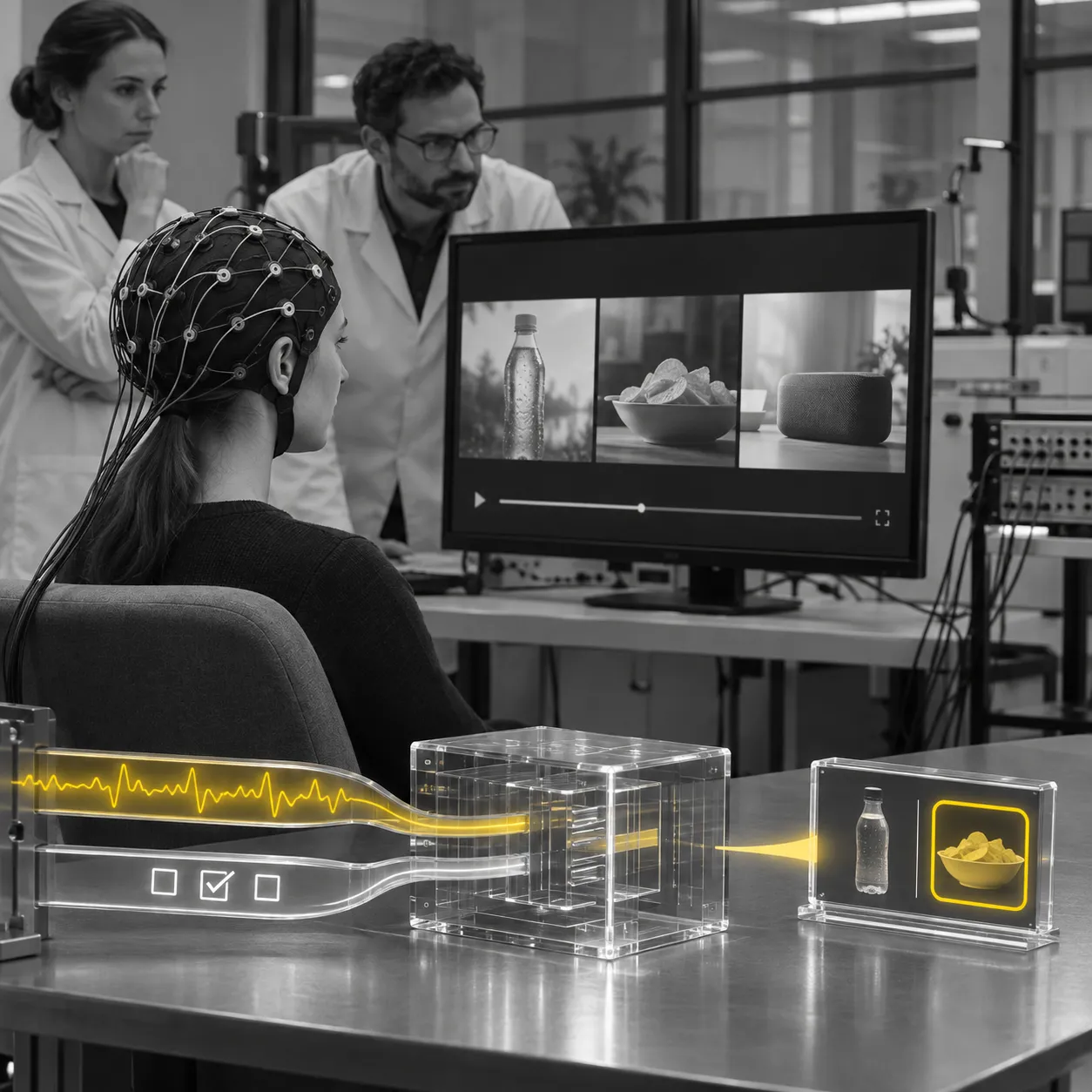
Using features of an electroencephalography recording, taken while people view marketing material, to predict their preferences or later choices. Boksem and Smidts report that beta and gamma oscillations recorded during movie trailers added information about preference beyond stated preferences. Telpaz, Webb and Levy report that a midfrontal signal recorded while people viewed products tracked the choices they made later between pairs of those products. Hakim and Levy review the field and ask studies to show that neural measures add predictive value beyond traditional methods.
What it is
Using features of an electroencephalography recording, taken while people view marketing material, to predict their preferences or later choices. Boksem and Smidts report that beta and gamma oscillations recorded during movie trailers added information about preference beyond stated preferences. Telpaz, Webb and Levy report that a midfrontal signal recorded while people viewed products tracked the choices they made later between pairs of those products. Hakim and Levy review the field and ask studies to show that neural measures add predictive value beyond traditional methods.
It sits close to Neuromarketing, Incremental Validity, Frontal Alpha Asymmetry and Reverse Inference in the wider body of research, and is best taken as one idea among several rather than a stand-alone rule.
In effect
Models that included the EEG measures predicted choice better than models with stated preferences alone in the movie trailer study.
What it does not say
The finding comes from the studies named on this page and describes a pattern in those samples. It does not show that the pattern holds for every person, product or market, and it does not tell a brand what to do on its own. It is one input to a decision, to be weighed with other evidence.
Sources
- Boksem, Journal of Marketing Research 52(4), 2015. https://doi.org/10.1509/jmr.13.0572
- Telpaz, Journal of Marketing Research 52(4), 2015. https://doi.org/10.1509/jmr.13.0564
- Hakim, WIREs Cognitive Science 10(2), 2019. https://doi.org/10.1002/wcs.1485