Electrodermal Activity
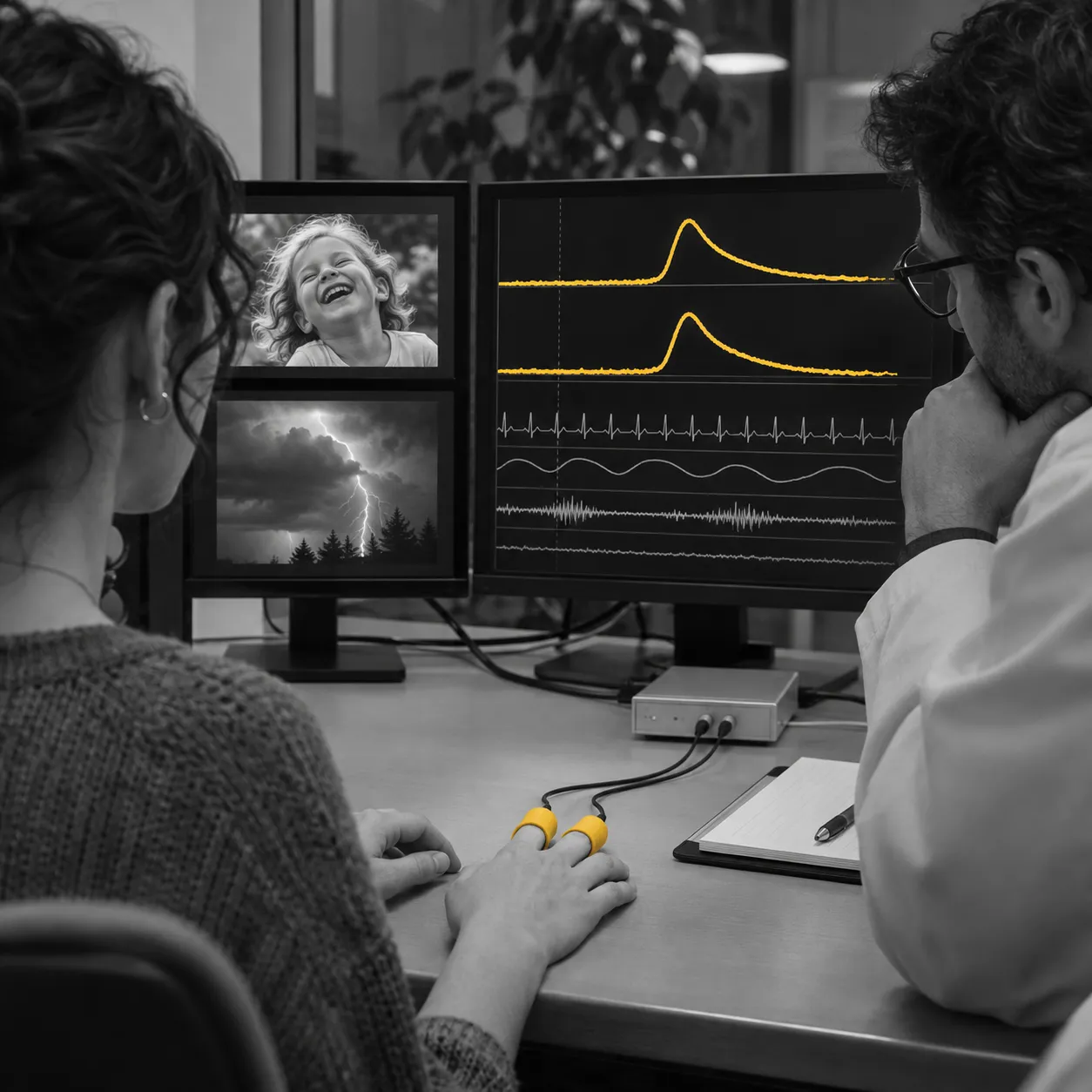
Small changes in how well the skin conducts a faint electrical current, used as a measure of arousal and also called galvanic skin response. It marks that something stirred a person, and on its own it does not show whether the feeling was pleasant or unpleasant. In a picture-viewing study reported in Emotion in 2001, Margaret Bradley and colleagues found that skin conductance responses varied with arousal and were largest for the pictures rated most arousing, which included unpleasant and pleasant content.
What it is
Small changes in how well the skin conducts a faint electrical current, used as a measure of arousal and also called galvanic skin response. It marks that something stirred a person, and on its own it does not show whether the feeling was pleasant or unpleasant.
It sits close to Neuromarketing, Emotional Arousal and Construct Validity in the wider body of research, and is best taken as one idea among several rather than a stand-alone rule.
In effect
In a picture-viewing study reported in Emotion in 2001, Margaret Bradley and colleagues found that skin conductance responses varied with arousal and were largest for the pictures rated most arousing, which included unpleasant and pleasant content. In 2012 a committee of the Society for Psychophysiological Research published recommendations on recording and reporting electrodermal data, covering three recording techniques.
What it does not say
The finding comes from the studies named on this page and describes a pattern in those samples. It does not show that the pattern holds for every person, product or market, and it does not tell a brand what to do on its own. It is one input to a decision, to be weighed with other evidence.
Sources
- Bradley, Emotion 1(3), 2001. https://doi.org/10.1037/1528-3542.1.3.276
- Greenwald, Journal of Personality and Social Psychology 97(1), 2009. https://doi.org/10.1037/a0015575
- Cronbach and Meehl, Psychological Bulletin 52(4), 1955. https://doi.org/10.1037/h0040957
- Psychophysiology 49(8), 2012. https://doi.org/10.1111/j.1469-8986.2012.01384.x