Emotion Fingerprints
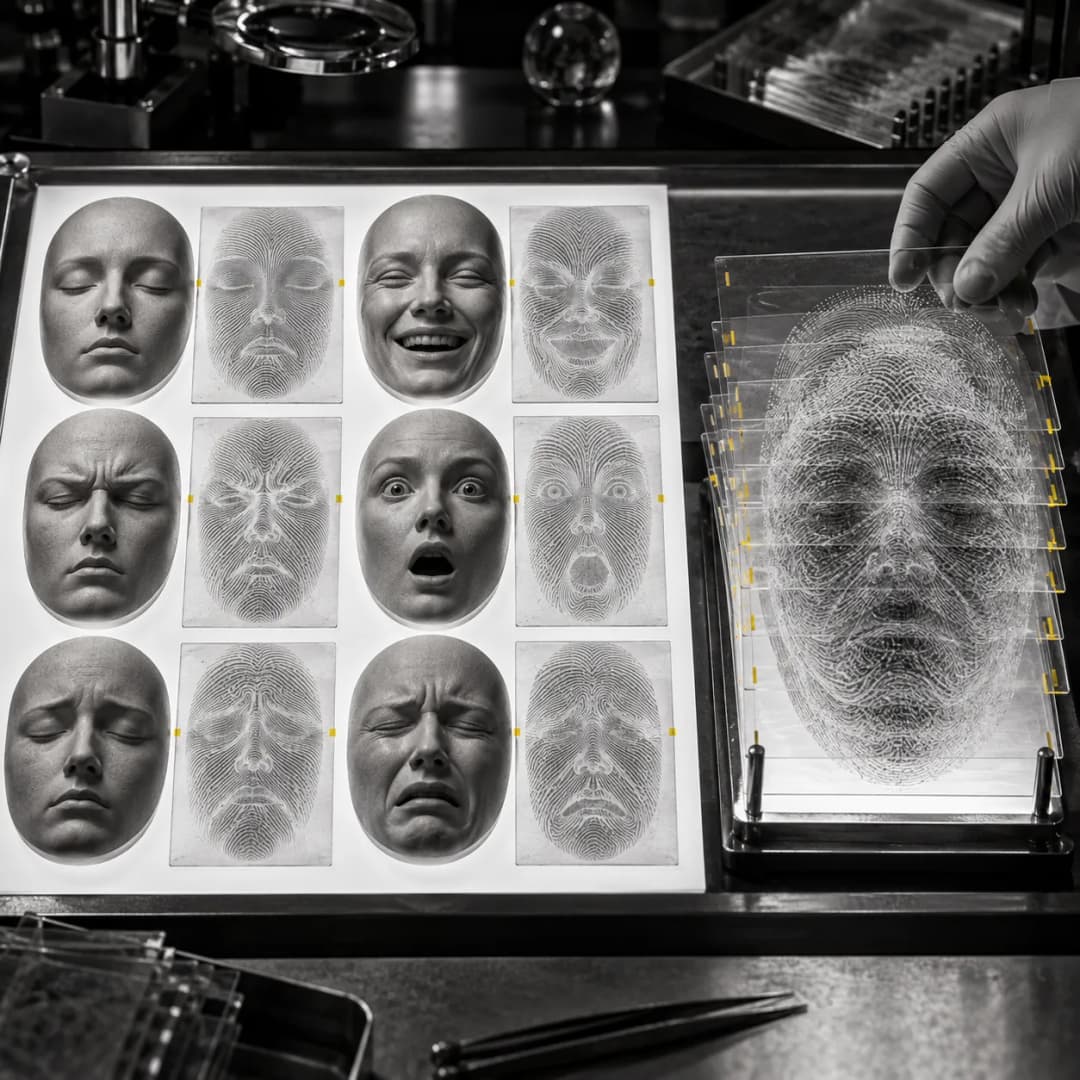
An emotion fingerprint would be a bodily and facial signature specific to one emotion category, so that observing the signature told you the state. The 2019 consensus review, led by Lisa Feldman Barrett, finds that the predicted facial configurations do occur with the predicted emotion above chance, and are not reliable or specific enough across contexts, individuals and cultures to count as diagnostic displays of any emotional state. The opposing case argues for many more categories rather than for the original six.
What it is
The fingerprint idea is attractive because it would make emotion measurable without asking anybody anything. If a scowl were to anger what a fingerprint is to a person, a camera would be an instrument.
The claim has a precise test, and the 2019 consensus review sets it out as four criteria. Reliability: given the state, does the configuration appear more often than chance? Specificity: does it accompany that state and not several others, at better than chance? Generalisability: does the pattern hold in infants, in congenitally blind people and in remote cultures? Validity: does the configuration track a measure of emotion that does not depend on anybody's subjective report?
The review's finding is narrow and double-edged, and both halves are required. The six categories are each expressed with a particular configuration of facial movements "more reliably than would be expected by mere chance". And instances of those categories are not expressed with movements "sufficiently reliable and specific across contexts, individuals, and cultures to be considered diagnostic displays of any emotional state".
Its summary scorecard is the most useful single object in the document. For spontaneous adult expression, in the laboratory and in the field, it rates reliability weak and specificity unknown. Recognition is rated moderate to strong when people pick from a short list of emotion words, and weak to moderate when they describe what they see in their own words. The bands it scores against, 70 to 90 per cent counting as strong support and 20 to 39 per cent as weak, are taken from the method's defenders' own published thresholds, and the review records that validity is almost never addressed at all.
The opposing case is not a defence of six prototypes, and it deserves its full strength. Alan S. Cowen and Dacher Keltner had 1,794 raters judge 1,500 naturalistic photographs and found 92 per cent reliably identified with at least one of twenty-eight categories, at agreement levels they show are comparable with the meta-analytic figures for posed prototypes, and those judgements survived the erasure of scenery, objects, clothing and jewellery. In 2021 Cowen and colleagues reported sixteen expression types across six million videos from 144 countries, with each type's associations to context 70 per cent preserved across twelve world regions. Their companion reply, in the same journal issue as the review, concedes in print that emotions are not expressed in six prototypical patterns of facial-muscle movement. What they defend is a larger space of facial and bodily configurations, and their objection is that a test built on six categories, which they calculate capture at most about 30 per cent of the systematic variance, understates what a face conveys.
The review, for its part, says it is "not a referendum on the 'basic emotion' view". On how many categories a face carries and how far they travel, the science is open, and this page leaves it open.
In effect
In research: the same engine, three stimulus sets
Sabrina Stockli and colleagues put two widely licensed classifiers through three tasks. One scored 97 per cent on standardised posed photographs from three databases, 63 per cent on real people imitating those same photographs, and 10 per cent on real people imitating fear. The second scored 73, 55 and 1 per cent. A system drops from 97 to 10 without getting any worse at seeing. The thing that changed is what it was scored against, which is precisely what a fingerprint claim has to rule out.
In everyday life: the face that was pulled into a shape
Louisa Kulke and colleagues ran a preregistered comparison in which twenty students imitated happy, angry and neutral portraits while electrodes recorded the cheek and brow muscles, and the software's smile-minus-frown score tracked the muscle score closely. That is a real positive result, and it draws the line exactly: software and muscle sensor agree that a face has moved into a smile. Neither registers whether the person is pleased.
In commerce and policy: a measurement doubt written into statute
The European Union's AI Act defines an emotion recognition system as one for identifying or inferring emotions or intentions from biometric data, and has prohibited inferring emotions in workplaces and education institutions since 2 February 2025, with an exception for systems placed on the market strictly for medical or safety reasons. The legislature's stated reason sits unusually close to the review: "Among the key shortcomings of such systems are the limited reliability, the lack of specificity and the limited generalisability." Nothing in the Act restricts retail, advertising or market research.
What it does not say
It does not say faces carry no information about emotion. The review's own finding is that the predicted configurations occur above chance, and the opposing literature reports many more categories recovered at useful agreement levels from naturalistic images.
It does not say the six-category scheme was a fraud or that its researchers were careless. Paul Ekman's own 2014 survey of 248 emotion scientists, with the instrument vetted by his best-known critic, reported five categories as empirically established rather than six, which is the tradition correcting itself in public.
It does not settle how many emotion categories there are, nor how far they travel. That is a live disagreement between serious researchers and this page describes evidence only.
And the reading level bounds everything above. The review runs to sixty-eight published pages and the first twenty-four were read for this publication, holding the executive summary, the four criteria and Table 2, the expression-production review for adults, the automated-algorithm section and Table 3. The perception review at published pages 24 to 42 was not read, and the recommendations section could not be reached after six attempts, so nothing here describes what the review recommends.
Sources
- Barrett, L. F., Adolphs, R., Marsella, S., Martinez, A. M., & Pollak, S. D. (2019), "Emotional Expressions Reconsidered: Challenges to Inferring Emotion From Human Facial Movements", Psychological Science in the Public Interest 20(1), 1-68, doi:10.1177/1529100619832930. Read to published page 24 of 68 as described above.
- Cowen, A. S., & Keltner, D. (2020), "What the face displays: Mapping 28 emotions conveyed by naturalistic expression", American Psychologist 75(3), 349-364, doi:10.1037/amp0000488. Full text read.
- Cowen, A. S., Keltner, D., Schroff, F., Jou, B., Adam, H., & Prasad, G. (2021), "Sixteen facial expressions occur in similar contexts worldwide", Nature 589(7841), 251-257, doi:10.1038/s41586-020-3037-7. Abstract read in full, plus the contributions, funding and competing-interests statements; the body was not read in full. The authors record Google Research support and declare no competing interests.
- Cowen, A., Sauter, D., Tracy, J. L., & Keltner, D. (2019), "Mapping the passions", Psychological Science in the Public Interest 20(1), 69-90. Full text read. Companion status confirmed at source.
- Stockli, S., Schulte-Mecklenbeck, M., Borer, S., & Samson, A. C. (2018), Behavior Research Methods 50(4), 1446-1460, doi:10.3758/s13428-017-0996-1. Full text read.
- Kulke, L., Feyerabend, D., & Schacht, A. (2020), Frontiers in Psychology 11, 329, doi:10.3389/fpsyg.2020.00329. Full text read, open access, preregistered.
- Ekman, P. (2016), "What scientists who study emotion agree about", Perspectives on Psychological Science 11(1), 31-34, doi:10.1177/1745691615596992. Full text read, including the survey instrument.
- Regulation (EU) 2024/1689, the Artificial Intelligence Act, Articles 3, 5 and 6 and recital 44, with the European Commission's own summary page read in full at source on 21 October 2026.