Empty Restaurant Syndrome
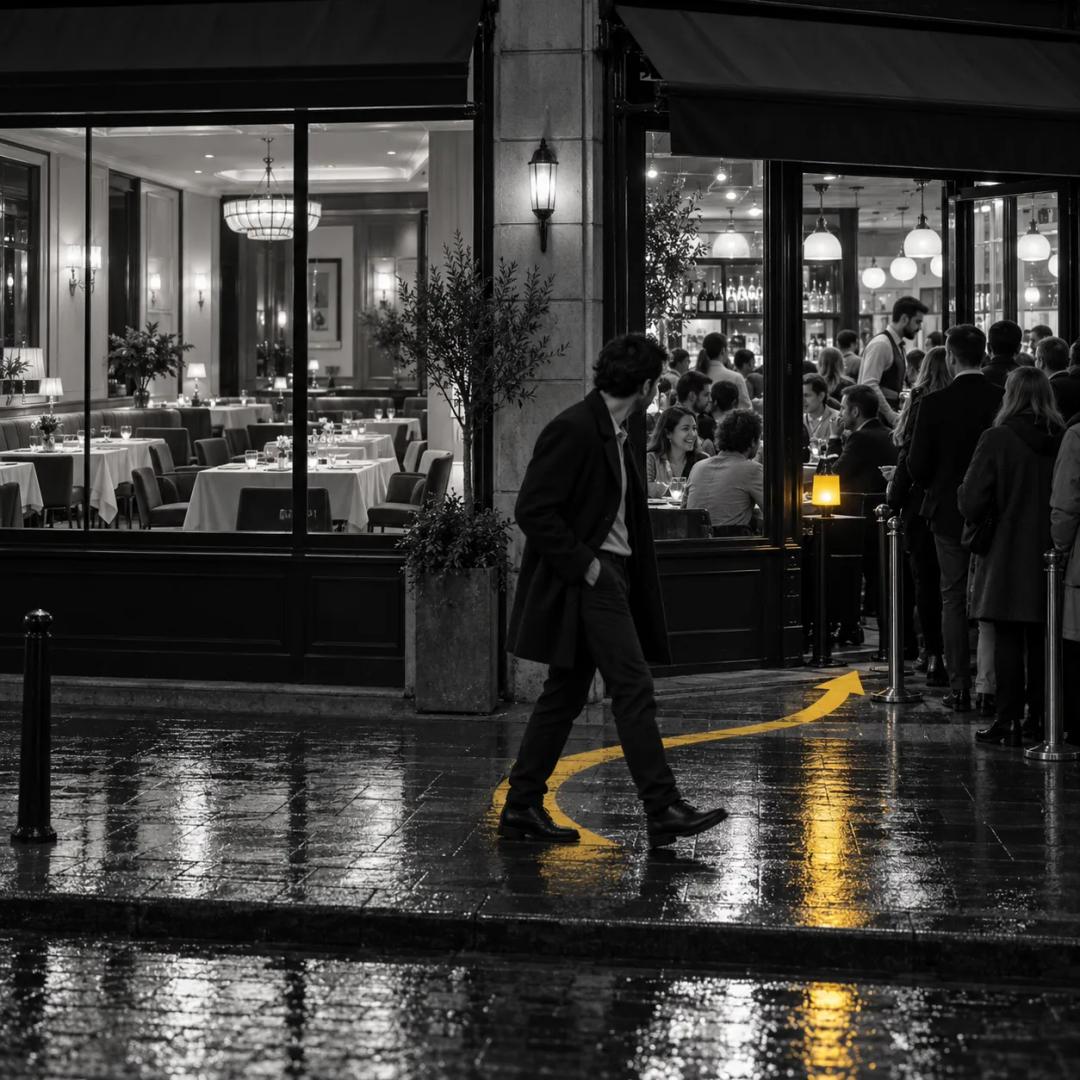
Empty restaurant syndrome is Mirko Kremer and Laurens Debo's name for a pattern in which people who do not know a product's quality read a short wait as a warning and leave, even though there is no line to put them off. The mechanism is a chain of inference. Customers who do know the quality queue for the good product and avoid the poor one, so waits become evidence, and a short wait stops looking like convenience and starts looking like absence of demand. Their 2016 paper in Management Science develops and tests the theory.
What it is
The paper is "Inferring Quality from Wait Time", Management Science, volume 62, issue 10, pages 3023 to 3038 (2016), with a DOI of 10.1287/mnsc.2015.2264. Its starting point is a market in which some consumers know a product's quality and others do not. Informed consumers act on what they know. Because they join the good product and skip the poor one, low-quality products tend to have short waits and high-quality products long ones. The uninformed consumers can see the waits but not the quality, so they treat the wait as a signal.
From that follow three results the abstract states. A long wait can raise perceived quality while the customer still buys. A short wait can lower perceived quality, so that people leave even when there is no line, which the authors call the empty restaurant syndrome. And purchase frequency may even increase with wait time. The authors develop an observational-learning theory and test it. In their data, uninformed consumers bought less often at short waits when informed consumers were present, and a relatively small number of informed consumers was enough to produce the effect.
A replication archive hosted by the University of Texas at Dallas lists the paper and rates one of its core findings, the lower purchase rate at a short wait when informed consumers are present, as a full replication. That listing covers one condition of the design, a high prior probability of good quality, and not every result in the paper.
In effect
For a shop owner the syndrome inverts the usual advice about waiting. Long waits are normally treated as a cost to be removed. Under this theory a long wait is also evidence of demand to the people who cannot judge the product for themselves, and removing it removes the evidence. The same logic explains why a quiet room can stay quiet: the first few uninformed customers read the quiet as a verdict, leave, and keep it quiet for the next group.
The theory has an important precondition. It needs informed consumers, people who already know the product is good, and it needs them to choose first. A queue made of people who knew nothing does not carry the signal. That is why the effect is a statement about information, and not a statement that crowds are persuasive in themselves. A related line of work, Veeraraghavan and Debo's 2009 model of joining longer queues, reaches a similar conclusion for the case where customers choose between two lines.
The syndrome also sits beside Gary Becker's 1991 argument about restaurant pricing. If demand rises with the quantities others demand, a restaurant has a reason to let a line stand. Kremer and Debo supply the information story for why: the line and the empty room are the same message with the sign reversed. See Does a Long Queue Make People Want In.
What it does not say
It does not say that long waits are good for business. The model concerns what a wait signals to people who cannot judge quality, and a wait still costs the customers who stay in it. A different paper, Zhou and Soman (2003), looks at what happens to people already in a line and finds that more people behind them make the wait feel better, which is a separate mechanism.
It does not say that a queue can be manufactured. The signal works because informed customers produced the wait. A queue staged to look like demand is not what the theory describes, and the theory does not say whether such a queue would work.
It does not say the effect is large everywhere. The tested result concerns purchase frequency at short waits when informed consumers are present, and the replication archive covers one condition. Real shops differ in how many customers are informed, how visible the wait is and how much it costs to stay.
The page also rests on the abstract and on the replication archive's summary. The full text of the paper was not obtained.
Sources
- Kremer, M., & Debo, L. G. (2016). Inferring quality from wait time. Management Science, 62(10), 3023-3038. doi:10.1287/mnsc.2015.2264. Abstract read; full text not obtained.
- Replication archive entry for Kremer and Debo (2016), University of Texas at Dallas, listing the short-wait result as a full replication under a high prior of quality.
- Veeraraghavan, S., & Debo, L. G. (2009). Joining longer queues: Information externalities in queue choice. Manufacturing & Service Operations Management, 11(4), 543-562. doi:10.1287/msom.1080.0239. Abstract read.
- Becker, G. S. (1991). A note on restaurant pricing and other examples of social influences on price. Journal of Political Economy, 99(5), 1109-1116. doi:10.1086/261791. Abstract read.