Expected Satiation
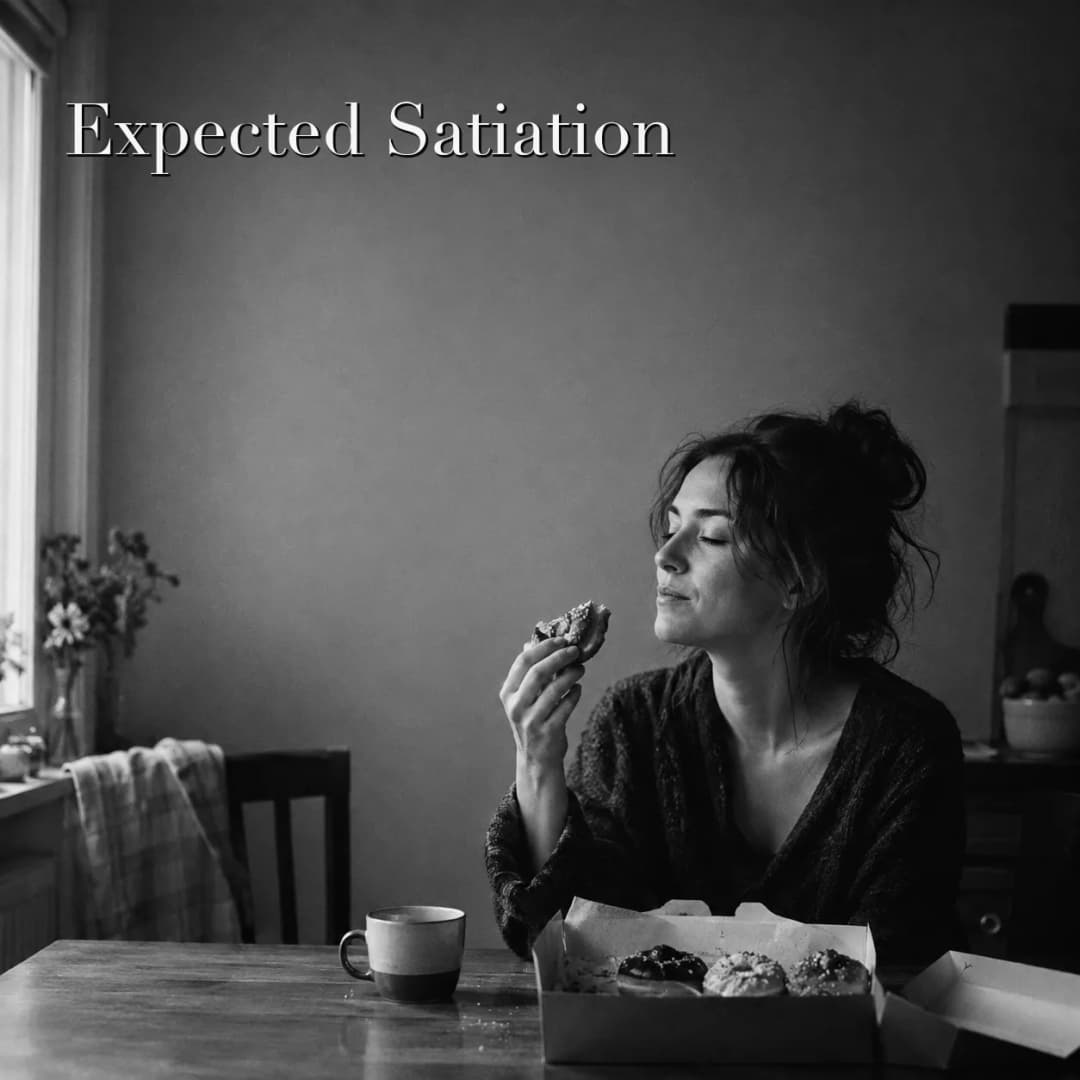
Expected satiation is how filling a person believes a food will be, judged before they have eaten any of it. The belief is learned from previous experience with that particular food rather than read off its energy content, and it predicts how much somebody serves themselves better than how much they like the food does. Expected satiety is the related belief about how long the fullness will last. The programme belongs to Jeffrey Brunstrom and colleagues.
What it is
A familiar food carries a well-calibrated expectation, built up over many meals. You know what a plate of it does to you. An unfamiliar food carries no such expectation, so the guess gets made from how it looks and from whatever it resembles, and it can be badly wrong in either direction.
That is one reason the same amount of energy can be served, and eaten, in very different quantities depending on what form it arrives in. The deciding is done before the first mouthful, on the basis of a belief.
In effect
Research: the belief beats the liking
Brunstrom's 2009 paper reported that expected fullness, rather than liking, determined the size of the meal people selected. His 2011 review set out the broader case, that meal size in humans is substantially a matter of pre-meal planning built on learned expectation. The expectation rises with familiarity, which is what makes it learning rather than perception.
The honest limit
Nobody has shown that learned expectation overrides physiology in a healthy person across days. Compensation happens. And most of this work measures a single meal in a laboratory, which is the right way to isolate the effect and the wrong way to describe a week.
A second limit runs through this whole area: much of the hunger measurement is a self-rated scale rather than a measure of what was actually eaten. That does not invalidate the finding, and it does mean the outcome is often somebody's report of a feeling.
Both sides, then the line
For it. A clear, replicated laboratory finding with a counter-intuitive result, that what you expect matters more than what you enjoy, and a plausible mechanism, learning from repeated experience of the same food.
Against leaning on it. Single meals, laboratory settings, self-rated outcomes, and no demonstration that any of it holds across days once the body has had a chance to correct.
Where we land, September 2026. Expectation is a real input into portion size, formed before eating and learned from experience. It is a description of how the decision gets made, and it is not a lever anybody should be handed.
What it does not say
It does not say you can think yourself full. The belief predicts the portion selected, and it is not a demonstration that expectation replaces what the body does afterwards.
It is not a technique. Nothing on this page should be turned into an instruction about what to eat, how much, or in what form.
It does not hold across days. The evidence is single meals in laboratories, and compensation over longer stretches is not accounted for.
It says nothing about weight. No claim connecting expected satiation to body weight appears here, and none is supported by the sources cited.
The sources were read at abstract and review level. The 2009 paper was read at abstract level and the 2011 review at review level, which is recorded so nobody treats this page as a close reading of either.
Sources
- Brunstrom, J. M., et al. (2009). "How many calories are on our plate? Expected fullness, not liking, determines meal-size selection", Obesity. Abstract only.
- Brunstrom, J. M. (2011). "The control of meal size in human subjects: a role for expected satiety, expected satiation and premeal planning", Proceedings of the Nutrition Society. Abstract and review-level reading only.
- Vault record for Why You Are Hungry an Hour After a Big Lunch, article 19, 2026-09-11. Evidence status primary-cited, originator Jeffrey Brunstrom and colleagues, 2009, confidence high. Handling: descriptive only.
- Where this came from
- No book in this library is the source of this concept. It entered the vault from Why You Are Hungry an Hour After a Big Lunch, built from primary sources rather than from a book.