Experimenter Expectancy
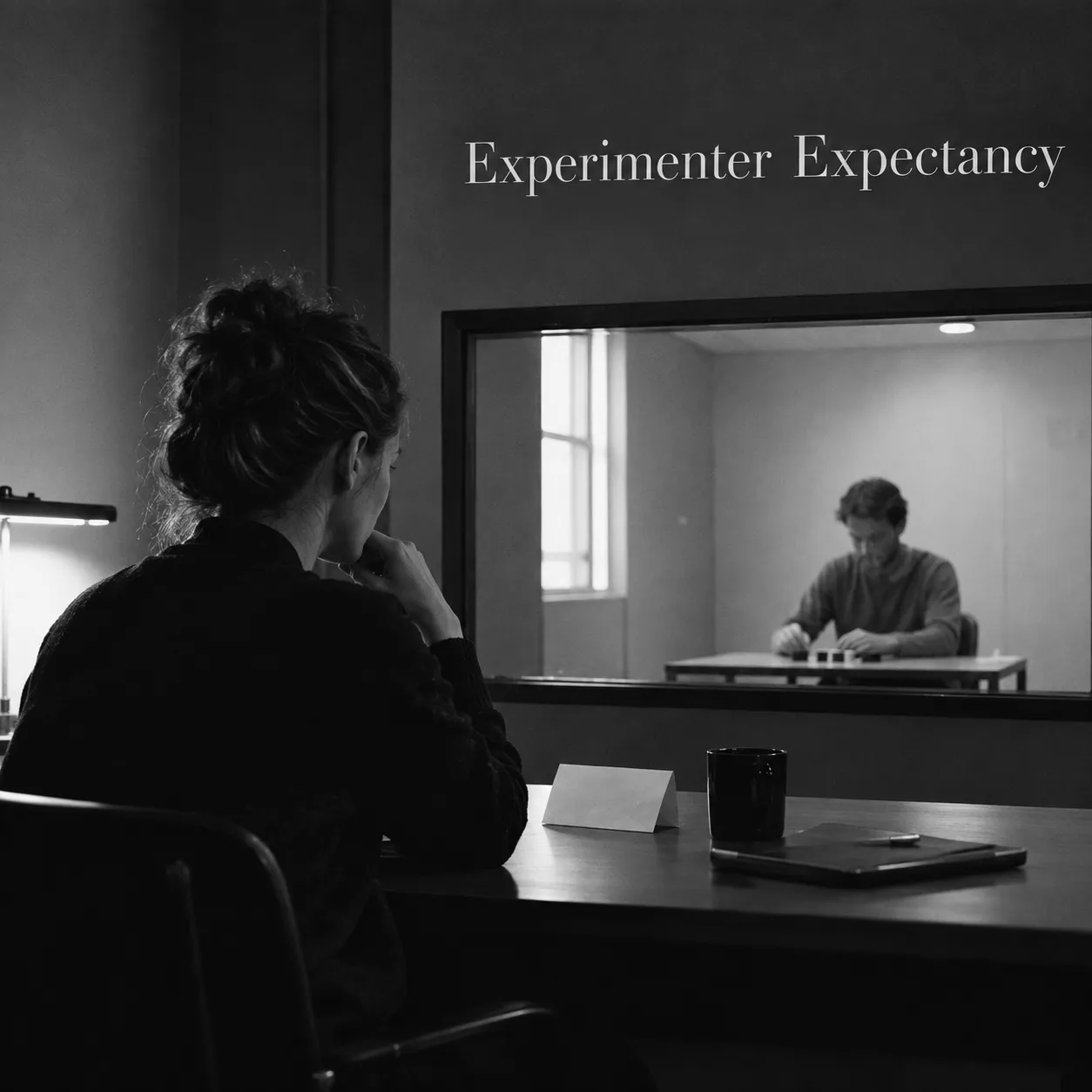
An experimenter who expects a particular result tends to get it. The standard reading is that they record the data with a thumb on the scale. The stronger and better-evidenced version is that the participant's behaviour actually changes.
What it is
Robert Rosenthal documented the effect from the early 1960s: experimenters told to expect one pattern of results obtained it, through cues in manner, timing and emphasis that neither party could articulate afterwards. It is the reason double-blind procedure exists, and the reason a study that is single-blind is only half protected.
The mechanism is not mysterious and it is not deliberate. An experimenter who believes a participant is about to walk slowly moves differently at the door, times the handover differently, and speaks with a different rhythm. None of that has to be conscious to be transmitted.
In effect
The cleanest demonstration is Stéphane Doyen's 2012 replication of the elderly-priming study, which built expectancy in as a factor rather than controlling it away.
Fifty participants, ten experimenters running five each. Half the experimenters were told that primed participants would walk more slowly. Half were told they would walk faster. Walking time was recorded twice, once by a hand-held stopwatch and once by infrared timing gates.
On the stopwatch, the classic priming effect appeared in the slow-expectancy condition and reversed in the fast one, which is what you would predict from measurement bias alone.
On the infrared gates, which have no expectations, the effect still appeared in the slow-expectancy condition and was absent in the fast one. There was also a main effect of experimenter condition on how fast people actually walked.
That second result is the one that matters and the one most retellings drop. The experimenters did not just record slower times. They produced slower participants.
What it does not say
It does not show that priming is nothing. Doyen and colleagues' own framing is that priming and expectancy act together, and the paper is often cited for a stronger claim than it makes.
It does not apply to studies that were properly blinded. The 1996 walking study separated the greeter from the timer and kept both blind to condition, which is a real answer to this objection, and which is why the argument moved on to sample size rather than staying here.
And it is not a claim about honesty. Every version of this effect is compatible with everyone involved behaving in good faith, which is precisely what makes procedural blinding necessary rather than optional.
Sources
- Doyen, S., Klein, O., Pichon, C.-L., & Cleeremans, A. (2012). "Behavioral priming: it's all in the mind, but whose mind?" PLoS ONE, 7(1), e29081.
- Bargh, J. A., Chen, M., & Burrows, L. (1996). JPSP, 71(2), 230-244. The blinded original.
- Rosenthal, R. (1963). "On the social psychology of the psychological experiment." American Scientist, 51(2), 268-283.
- Where this came from
- No book in this library is the source of this concept. It entered the vault from What Forty-One Participants Buys, built from primary sources rather than from a book.