Expert Blind Spot
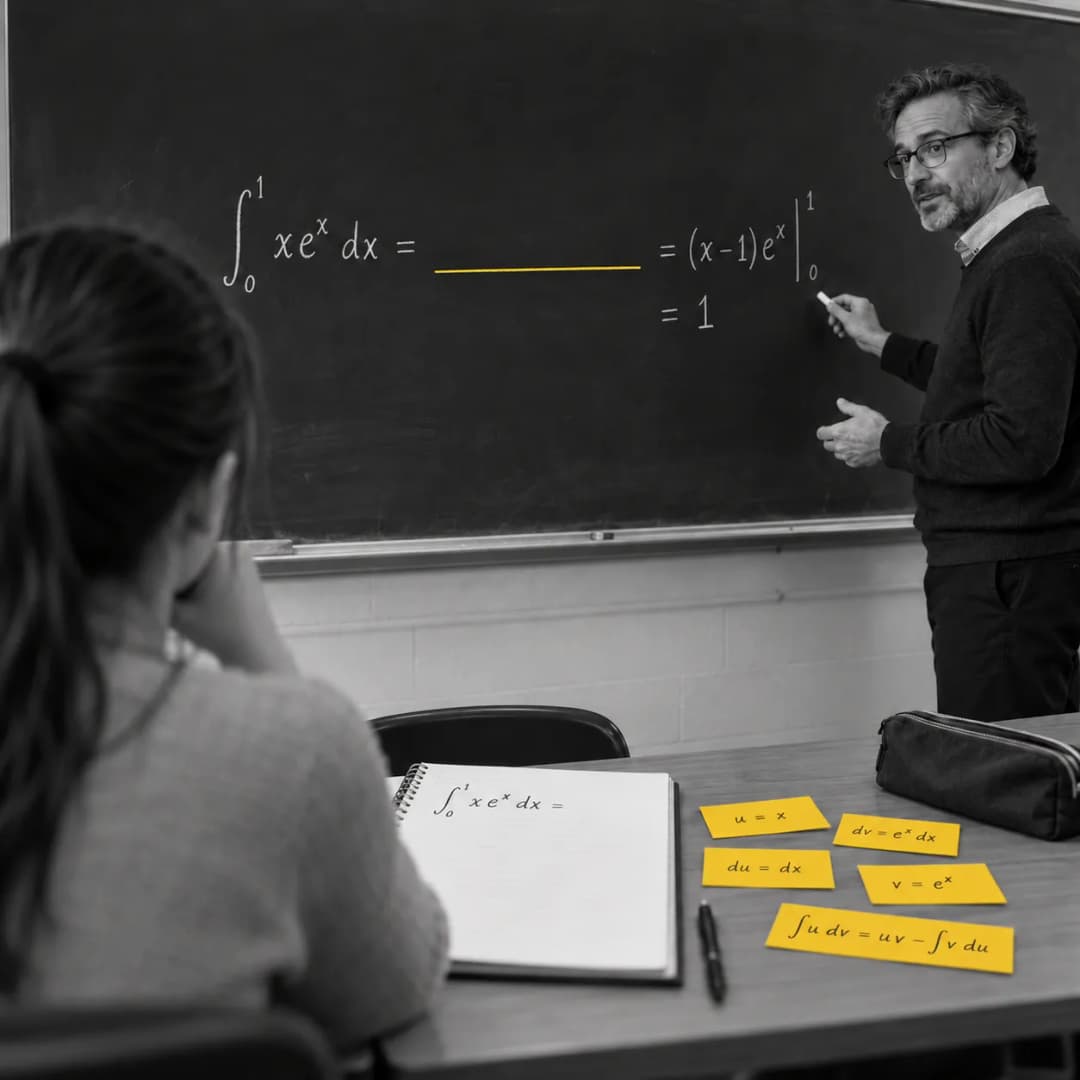
The expert blind spot is the tendency of teachers and other experts to misjudge what beginners find hard, because strong knowledge of a subject leads them to see it in its finished, abstract form. Mitchell Nathan, Kenneth Koedinger and Martha Alibali named it in 2001. Their best-known evidence is a ranking task in which high school teachers' view of what algebra students find difficult was unrelated to how the students actually performed. The evidence is a small set of studies, one of them a conference paper, and it is best read as a close relative of the curse of knowledge.
What it is
Nathan, Koedinger and Alibali introduced the term "expert blind spot" in a paper for the Third International Conference on Cognitive Science, held in Beijing in 2001. Their title states the claim: Expert Blind Spot: When Content Knowledge Eclipses Pedagogical Content Knowledge. The argument is that deep knowledge of a subject can backfire in teaching. An expert tends to assume that learners find abstract, formal representations as accessible as the expert does. That conflicts with how students actually develop, where informal reasoning often comes first and formal reasoning is built on it.
The authors drew on mathematics and on language arts, and concluded that teachers should use assessment practices that test their own assumptions about how students develop. The recommendation matters because it treats the problem as one of calibration. An expert who checks a prediction against real student answers can correct it. An expert who relies on introspection cannot, because the introspection is the source of the error.
The expert blind spot is an application of the curse of knowledge to the classroom. The curse of knowledge, named by Camerer, Loewenstein and Weber in 1989, is the general difficulty of imagining not knowing something. The blind spot is that difficulty at work in the specific task of judging what a learner will find hard. See Curse of Knowledge.
In effect
In research: ranking algebra problems
The central study had 105 school teachers rank a set of algebra problems from easiest to hardest for beginning algebra students. The problems varied by type (arithmetic or algebraic), by verbal form (story or word equation) and by symbolic format. The comparison data came from two samples of ninth-graders who had completed a year of algebra, 76 and 171 students, from earlier work by Koedinger and Nathan (1999). The students solved equations correctly less than 30 per cent of the time and verbal problems more than 50 per cent of the time, in both samples.
The 39 high school teachers judged verbal problems harder than symbolic ones and rated algebra story problems hardest, on the reasoning that students would find pure mathematics easiest. Their ranking was unrelated to the students' performance (a rank correlation of zero). The 30 middle school teachers predicted that story and word problems would be easiest, and their ranking matched the students' performance well (a rank correlation of 0.73). Knowing more algebra did not help the high school teachers see the problems as a beginner does.
In everyday life: choosing what to teach
The same paper reports a comparison from language arts, based on Grossman (1990), of six secondary English teachers who were all strong in literature and grammar. Three had formal teacher education and three did not. Asked to plan a hypothetical ninth-grade literature class, the teachers without teacher education chose about 72 per cent canonical texts and favoured a text-centred, analytical approach. The teachers with teacher education chose about 78 per cent adolescent literature and 22 per cent canonical texts, and focused on connecting the material to students' experiences and stage of development. The sample is six teachers, so it illustrates the idea and does not test it.
In design: instructions written by experts
The blind spot is not confined to classrooms. Pamela Hinds's 1999 study of expert prediction found, according to secondary accounts, that experts asked to predict how long novices would need to learn a new phone task, and what would go wrong, were too optimistic about both. The abstract was not available for this page, so the result is reported in direction only. For anyone writing a manual, the lesson is that the steps the writer finds trivially obvious are the ones most likely to be missing, and that the writer's own rereading will not reveal the gaps.
What it does not say
The evidence is thinner than the idea's reputation suggests. The founding paper is a conference proceeding, and the English teaching comparison rests on six teachers. A later study of pre-service and in-service teachers in an engineering-inspired training programme, by Anthony Petrosino and Prateek Shekhar (International Journal of Engineering Education, 2018), had participants rank six algebraic representation problems by difficulty for beginning students. It found no significant differences between pre-service and in-service teachers, and the authors read this as showing that teaching experience does not change how teachers judge difficulty. That is consistent with a persistent blind spot, but it is a ranking task with one subject area, and its figures are not reported here.
The studies do not show that every expert misjudges every learner, nor how large the effect is in general. The curse of knowledge more broadly is well supported in direction and disputed in size, since a 2014 replication of a false-belief version found less than half the original effect. The expert blind spot should be read the same way.
Who developed it
Mitchell Nathan, Kenneth Koedinger and Martha Alibali, in 2001. Nathan's university page sits at the University of Wisconsin-Madison. See Mitchell Nathan.
Sources
- Nathan, M. J., Koedinger, K. R., & Alibali, M. W. (2001). 'Expert blind spot: When content knowledge eclipses pedagogical content knowledge.' Proceedings of the Third International Conference on Cognitive Science. Beijing: USTC Press.
- Petrosino, A. J., & Shekhar, P. (2018). 'Expert blind spot among pre-service and in-service teachers: Beliefs about algebraic reasoning and potential impact on engineering education.' International Journal of Engineering Education, 34(1), 97-105.
- Hinds, P. J. (1999). 'The curse of expertise: The effects of expertise and debiasing methods on prediction of novice performance.' Journal of Experimental Psychology: Applied, 5(2), 205-221. doi:10.1037/1076-898X.5.2.205
- Camerer, C., Loewenstein, G., & Weber, M. (1989). 'The curse of knowledge in economic settings: An experimental analysis.' Journal of Political Economy, 97(5), 1232-1254. doi:10.1086/261651
- Ryskin, R. A., & Brown-Schmidt, S. (2014). 'Do adults show a curse of knowledge in false-belief reasoning? A robust estimate of the true effect size.' PLoS ONE, 9(3), e92406. doi:10.1371/journal.pone.0092406