Expressive Arts Therapy
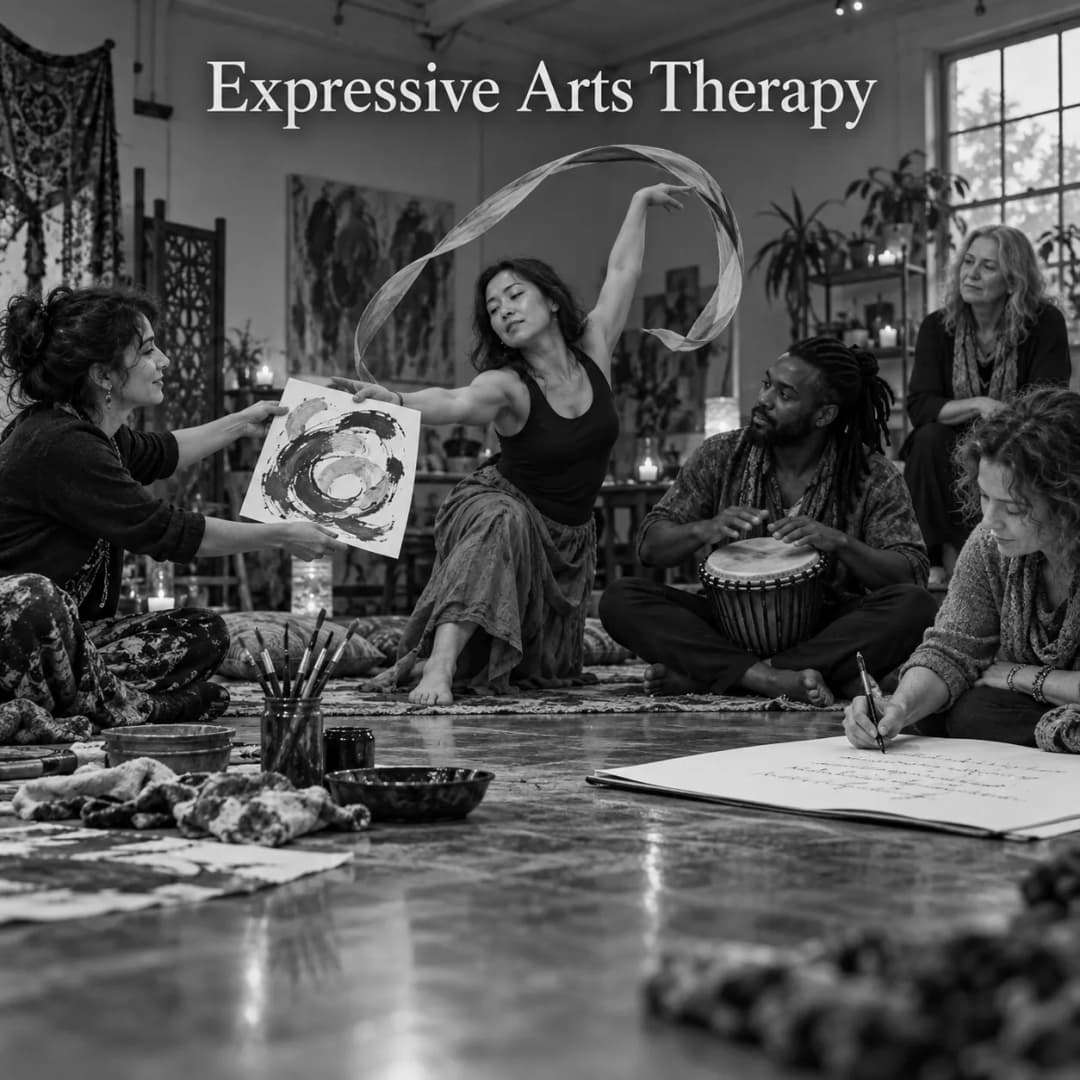
Expressive arts therapy is intermodal arts therapy: painting, movement, music, poetry and performance used together within one practice, on the premise that the imagination moves between forms and that restricting it to one medium restricts it. Shaun McNiff established the first graduate training in it at Lesley University in 1974. It is a tradition rather than a research claim. The tradition is real and long established; its outcome evidence is thin, and those two facts are not in tension.
What it is
The founding premise is intermodality. Where art therapy works in visual art, expressive arts therapy moves between forms on purpose, on the view that an image wants to become a movement and a movement wants to become a sound, and that stopping the transfer costs something.
It grew up alongside art therapy rather than inside it, and the distinction matters. Art therapy is a single-modality credentialed mental health profession, with master's-level training, board registration and growing state licensure in the United States. Its founding names are Adrian Hill, who coined the term in Britain in 1942, together with Margaret Naumburg, Edith Kramer, Elinor Ulman and Hanna Yaxa Kwiatkowska. Expressive arts therapy is a different lineage with its own training routes and professional bodies. Shaun McNiff taught Lesley University's first art therapy course in 1973 and established its Expressive Therapies graduate programmes in 1974, credited as the first expressive arts therapy graduate training.
Behind both sits the same founding methodological split, and the field still runs on it. Naumburg's art psychotherapy treats the image as material for verbal interpretation. Kramer's art as therapy holds that the healing is in the making. McNiff's Art Heals sits firmly on Kramer's side and extends it.
In effect
The evidence base belongs on this page and it is separate from the book that supplied the tradition. Art Heals contains no outcome study at all. The field's own evidence exists independently of it, and current reviews grade that evidence low to very low certainty.
Rebecca Joschko and colleagues, writing in JAMA Network Open in 2024, produced the largest synthesis of active visual art therapy. Improvement appeared in about a fifth of the pooled outcomes. Around four fifths showed no improvement and a small number favoured controls. Effects where present were small, and the authors describe overall study quality as low.
Lesley Uttley and colleagues, in Health Technology Assessment in 2015, could run no meta-analysis at all because the trials were too heterogeneous. They report that the included trials were generally of poor quality and likely at high risk of bias, and that adverse events were not reported in any of them. Their exploratory economic analysis suggested group verbal therapy appeared more cost-effective than group art therapy.
For trauma, Kirsty Maddox and colleagues, in Clinical Psychology and Psychotherapy in 2024, found post-traumatic stress outcomes not statistically significant overall, with a significant reduction in children only.
Music therapy is better evidenced than visual art therapy and is a different thing. Cochrane reviews find low to moderate quality evidence in schizophrenia and moderate quality in depression, and the 2025 update on music for dementia downgrades or nullifies several outcomes the 2018 version carried. Meta-analyses that pool music, dance and visual art into one estimate and then report it as art therapy are making a conflation, and it is a common one.
The World Health Organization Europe report of 2019 by Daisy Fancourt and Saoirse Finn is the document most often produced to end this argument, and it cannot do that job. It is a scoping review and says so on its own cover. It pools no effect sizes, sets no quality threshold, and includes uncontrolled pilots and case studies alongside randomised trials. It maps a field. It is not an effectiveness review and should not be cited as one. Peer-reviewed criticism of the policy conclusions attached to it is substantial and is named in the sources.
Five things every review agrees on. Blinding is never adequate. Outcomes are overwhelmingly self-reported. Risk of bias is high wherever it was assessed. Heterogeneity is severe and largely unexplained. Harms are essentially unreported.
What it does not say
It does not say that art heals. Nothing on this page supports that sentence, and the book that supplies the tradition makes no outcome claim anywhere.
It does not say the tradition is worthless. A practice can be valuable to the people inside it, institutionally serious, and fifty years established, and still lack the trial evidence that would let anyone claim what it does. Both halves are true at once.
It does not mean the same thing as art therapy. Single modality against intermodal, two training lineages, two sets of professional bodies. The conflation is constant and it usually runs in the direction that borrows credibility.
It does not inherit music therapy's evidence. Where an estimate pools the modalities, the pooling is the problem.
It does not license social prescribing policy. That is where the policy version of these claims lands, and the scoping review it usually rests on was not built to bear the weight.
Sources
- McNiff, S. (2004). Art Heals. Shambhala. The tradition, its practice and its founder's account of it. Not a source for any outcome claim, and the book contains none.
- Joschko, R., et al. (2024). JAMA Network Open, 7. Sixty-nine studies and 356 outcomes; fifty studies and 2,766 participants meta-analysed; improvement in 18 per cent of 217 pooled outcomes; change-from-baseline effect 0.38, post-test 0.19.
- Uttley, L., et al. (2015). Health Technology Assessment, 19. Eleven randomised trials, 533 patients.
- Maddox, K., et al. (2024). Clinical Psychology and Psychotherapy. Twenty-one trials, 868 participants.
- Geretsegger, M., et al. (2017). Cochrane. Eighteen studies, 1,215 participants. Van der Steen, J., et al. (2025). Cochrane. Thirty studies, 1,720 participants. Abbing, A., et al. (2018). PLOS ONE. Three randomised trials, 162 patients, all at high risk of bias.
- Fancourt, D., & Finn, S. (2019). WHO Regional Office for Europe, Health Evidence Network synthesis report 67. A scoping review. Criticism: Clift, S., Phillips, K., & Pritchard, S. (2021). Cultural Trends, 30. Kaasgaard, M., et al. (2024). Frontiers in Public Health, 12, finding every one of eighteen trials at high risk of bias on two criteria. Grebosz-Haring, K., et al. (2023). Annals of the New York Academy of Sciences.
- History: Hill, A. (1945). Art Versus Illness. Naumburg's priority claim holds for the United States only. American Art Therapy Association founded 1969; British Association of Art Therapists founded 1964. None read here.