Eye Tracking
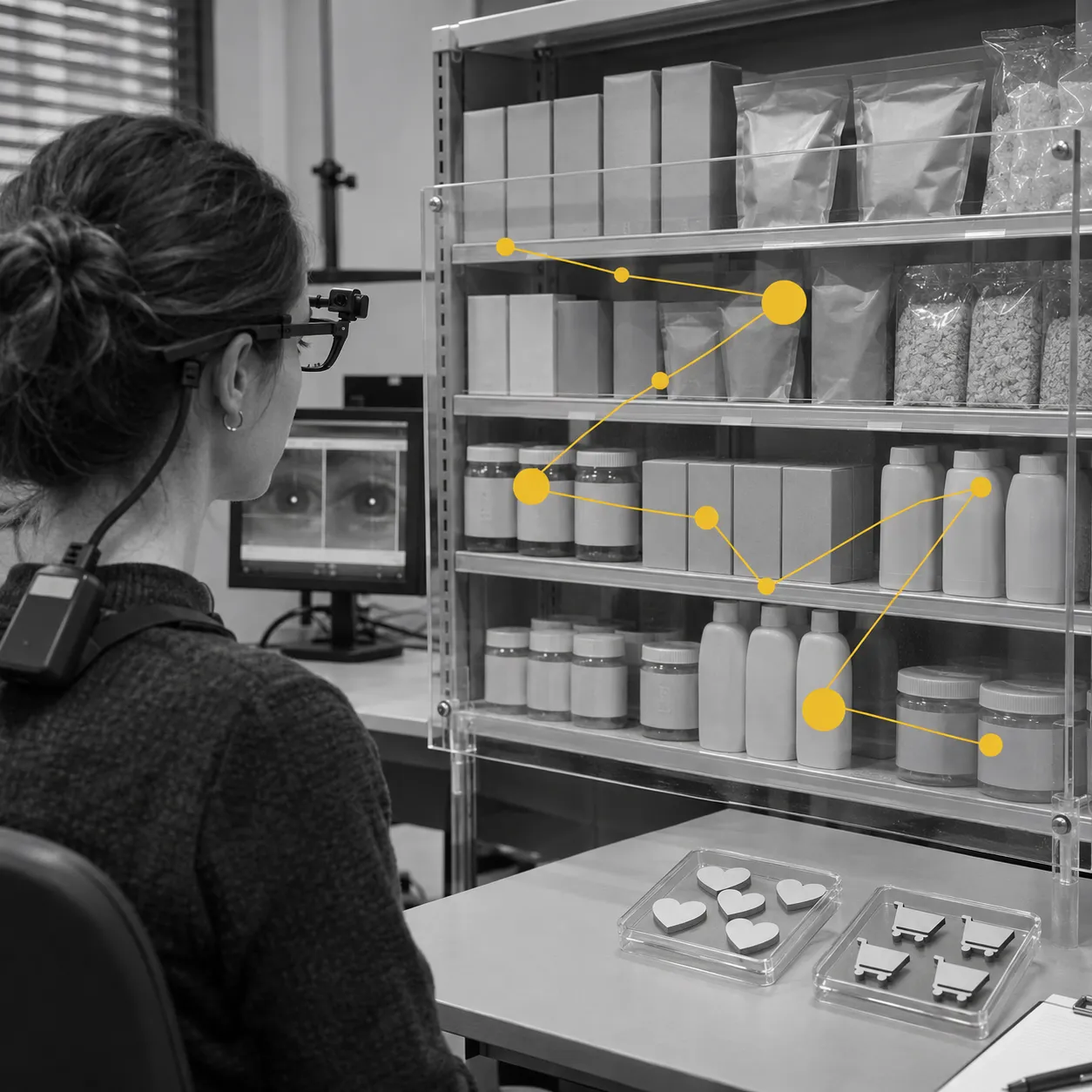
Eye tracking is a research method that records where a person's gaze falls and for how long. In consumer research it gives a measure of attention to an advertisement, a screen, a pack or a shelf, collected while the person is looking and without asking for an opinion. It measures attention. It does not by itself measure liking, memory or intent, and the published studies that use it say so in their own designs.
What it is
A gaze record is a sequence of positions and durations: where the eyes pointed and how long they stayed. Researchers usually summarise it as heat maps, gaze paths and the time spent on each region of a page, pack or shelf. Each of these describes attention, and attention is where a response to an advertisement or a product begins.
The method fits an argument made by Philip Graves in Consumer.ology. He holds that behaviour runs on processing a person cannot reach, that the explanations people offer for their choices are built after the fact, and that the better remedy is evidence of what people do in the real setting. A gaze record is evidence of that kind: it is collected during the event, and nobody has to explain themselves to produce it.
Eye tracking sits inside the wider field of neuromarketing, and it measures the eye rather than the brain. How that field is defined, and what brain measures add to it, is set out in the article on the neuromarketing definition.
In effect
Two studies in the Journal of Marketing show the method at work on different objects.
Rik Pieters and Michel Wedel analysed 1363 print advertisements tested with infrared eye tracking on more than 3600 consumers. They report that the three key parts of an advertisement, brand, pictorial and text, each have their own effect on attention. The pictorial was best at capturing attention whatever its size, the text captured attention in direct proportion to its size, and the brand element was the most effective at transferring attention to the other elements. Only increments in the text element's surface size produced a net gain in attention to the advertisement as a whole. The outcome throughout is attention, and the authors present the results as support for decisions about advertising.
Pierre Chandon and colleagues used eye tracking in a study of supermarket shelves. More shelf facings improved how a brand was evaluated, and the effect worked entirely through greater visual attention. Top and middle shelves drew more attention than low shelves, but only top-shelf placement improved evaluation. The authors conclude that eye tracking and purchase data should be combined to assess in-store marketing fully.
What it does not say
It does not say that looking means liking. In the shelf study a middle-shelf brand drew more attention than a low-shelf brand without gaining in evaluation, so attention and approval did not always move together.
It does not say that a gaze record predicts purchase. The shelf authors recommend pairing it with purchase data, which is a recommendation to add a second measure and not a finding that gaze alone is enough.
It does not say that every effect holds for every viewer. In the shelf study the gain from more facings was largest for frequent users of a brand, for brands with a low market share and for younger, more educated consumers who weigh brand against price. A reader of any eye tracking study can ask which viewers were recorded, what task they had and which second measure sits beside the gaze.
Sources
- Pieters, R., & Wedel, M. (2004). Attention capture and transfer in advertising: Brand, pictorial, and text-size effects. Journal of Marketing, 68(2). https://doi.org/10.1509/jmkg.68.2.36.27794
- Chandon, P., Hutchinson, J. W., Bradlow, E. T., & Young, S. H. (2009). Does in-store marketing work? Effects of the number and position of shelf facings on brand attention and evaluation at the point of purchase. Journal of Marketing, 73(6). https://doi.org/10.1509/jmkg.73.6.1
- Graves, P. Consumer.ology.